3.1 – Magala Resistance ( 1570 – 1578)
As stated in Chapter 1, one of Wei Yonglong’s cost-cutting measures was that he stopped giving return gifts to the Two Magala Nations in 1570 in exchange for their tribute. The Magala had been under the impression that the return gift was a part of the treaty they’d signed and were bitterly aggrieved to discover that the governor had no legal obligation to give them anything. In retaliation, the tributary delegations from the Two Magala Nations travelled with the Trasure Fleet in 1571, went to Beijing, and presented their tribute to the Longqing Emperor, who duly gave them gifts in return. They made it back to Xinguo in 1572. As they were on their way home, they were passed by two new delegations who boarded the Treasure Fleet for the trip to Beijing. They presented their tribute to the Longqing Emperor and returned to Xinguo in 1573.
By this time, however, Wei Yonglong had caught onto what the Magala were doing. Although they had every legal right to present their tribute to the emperor instead of the governor, Wei had his soldiers invent some bogus charges against the Magala delegations and had their goods seized. The delegations wre sent home with a warning. Meanwhile, two new delegations were on their way with tribute for the emperor; these delegations were likewise detained, had their goods seized, and were sent home with a message to the leaders of the Two Magala Nations: next year, in 1574, the Magala were to send tribute to Ningbo for both 1573 and ’74, and they were to continue sending tribute to Ningbo, not to Beijing.
Outraged, the Magala chiefs refused to send any tribute at all until their treaty right to send tribute to Beijing was respected. A legal battle ensued, with the Magala arguing their case in court while Wei used every dirty trick in the book to drag the case out for as long as humanly possible in the hopes that the Magala would give up. However, the Magala did not give up, so the case dragged on through ’73 and ’74 until 1575, at which point Wei Yonglong finally decided to change tactics. He declared the Two Magala Nations to be in rebellion on account of their failure to send tribute for the past several years. Because they were now in rebellion, the Magala could no longer plead their case in court; the case was thrown out and the people who’d been representing the Magala were arrested and imprisoned.
Wei Yonglong sent 2,000 braves to Yiwuxian Prefecture under the command of General Tang Liangfu, where they clashed with Magala braves. However, the Magala were not in any way prepared for a war; they’d been mostly at peace with the Xinguans and their fellow Prior neighbours since the creation of Yiwuxian Prefecture in 1507. Resistance was, therefore, minimal. The Yiwuxian Expedition killed around 100 people, arrested 400 more, and seized almost everything that wasn’t nailed down, including 5,000 livestock. Then the expedition returned to Ningbo with its booty.
Shocked at the suddent outburst of violence, the Magala were divided about what to do next. Some said they should bite the bullet and just pay the tribute. Others had their livelihoods ruined by the expedition. They had relied heavily on their livestock and hunting for furs to make a living, and with their stockpile of furs taken and their livestock driven off, many had no alternatives. To make ends meet, they turned to banditry by stealing livestock and foodstuffs from neighbouring Xinguan settlers. The settlers retaliated without differntiating between bandits and peaceful Magala. And so began the Magala Uprising.
For the next two years, the Magala and Yiwuxian settlers launched a series of tit-for-tat raids against each other. The settlers were constantly petitioning Wei Yonglong for help, but he was reluctant to respond because of how much it would cost to send another expedition. In 1578, however, he was finally persuaded to send 1,000 Black Banner Guardsmen to Yiwuxian, once against under the command of General Tang Liangfu. In Yiwuxian, they linked up with local militia and launched a major punitive expedition in April.
About 800 of these men were led by General Tang against the more numerous Northern Magala alongside 400 Yiwuxian militiamen. This time, they did not restrain themselves to the seizure of property. About a dozen villages were burned to the ground, 500 people were massacred, and thousands more livestock were seized. By the end of June, the surviving Northern Magala chiefs surrendered. Forced to sign away most of their remaining land, the Northern Magala were relegated to much smaller reservations on the western and northwestern shores of Yiwuxian Lake.
In the south, however, the Maodou were a different matter. Geographically separated from the Northern Magala with Maodou City—the main hub of settlement in the area—between the two, there was no real strategic coordination between the northern and southern branches of the Magala. 200 Black Banner Guardsmen and 400 Yiwuxian militia invaded Maodou territory in May, scattering local Maodou before their advance.
Word of what was happening to their northern cousins reached the Maodou, and so throughout June most of the Maodou chiefs surrendered and signed a peace treaty requiring them to pay an indemnity amounting to the value of all the tribute they owed for the years from 1570 through 1575.
Many individual Maodou, along with a handful of chiefs, were unwilling to accept such harsh terms, however. About 150 warriors took up a position near the southern shore of Onion Lake under the leadership of a chief with the Chinese name of Wulong. This area was rough country dominated by rocky outcroppings, ravines, and caves. It quickly became known as the Stronghold. Toward the end of June, 600 of the governor’s men and local militia besieged the Stronghold and set the date for the assault on June 29th. Two goals were set: capture the shores of Onion Lake to cut off the Maodou’s access to fish, and capture the freshwater spring that served as their water source.
When the sun rose on the morning of June 29th, it could barely be seen by those at the Stronghold because of a heavy fog blanketing the land. Nevertheless, the Xinguans went ahead with their attack. 500 men advanced through the fog into the Stronghold that morning. In the evening, 450 men groped their way out of the fog and back into their camp. Fifty had been killed and another fifty or so wounded. Stumbling around in the fog, they’d been unable to find their objectives. They’d been under fire the entire time from all directions and had tried to return fire, but had not laid eyes upon a single Maodou.
Having suffered this humiliating defeat, the Xinguans pulled back and laid siege to the Stronghold while awaiting reinforcements. After the war against the Northern Magala was over, troops began trickling south to fight the Maodou.
While the group at the Stronghold continued to hold out, another group of Maodou were resisting in the hills to the northeast of Onion Lake under the leadership of a chief named Kangbai. Kangbai’s group held out until mid-July, at which point he and some others attended peace talks with General Tang. However, Kangbai refused to agree to the harsh terms of the peace treaty. He was about to return to his own camp when, at General Tang’s orders, Kangbai and hose with him were killed. With the leadership dead, the rest of the warriors broke into smaller groups that were much easier to hunt down and crush one by one.
Meanwhile, back at the Stronghold, Xinguan reinforcements poured into the area. However, the resistance of those in the Stronghold inspired more Maodou to come and join them as well, including survivors from Kangbai’s group.
General Tang soon arrived in the Xinguan camp along with further reinforcements, bolstering the Xinguan army in the area to over 1,400 men. By that time, there were 300 Maodou warriors and 150 women, children, and elderly who’d fled to the Stronghold to escape marauding bands of Xinguan braves. General Tang made an offer to negotiate, but Chief Wulong refused, believing that he’d be killed like Kangbai. Consequently, General Tang scheduled a second assault on August 18th.
This time, the day of the attack dawned without any fog. Still, the Maodou knew the lay of the land and were able to hide and launch ambush after ambush while the Xinguans advanced toward their objectives, inflicting heavy losses. Twenty Xinguans were killed and forty wounded while only eleven Maodou were killed or wounded. Nevertheless, by sheer force of will to keep moving even under constant attack, the Xinguans were able to occupy both the southern shore of the lake and the freshwater spring. Cut off from both food and water, the Maodou now knew that their time in the Stronghold had come to end.
On the night of the 21st, the Maodou split into small bands and slipped out through the siege lines. Now divided and in open country, the Maodou were hunted down and either killed or forced to surrender over the following month. Chief Wulong and a group of twenty warriors made a final stand on September 12th. After a four-hour shootout, the Maodou were almost out of ammunition. The fight ended when Wulong ordered his men to surrender, then placed his chin on the barrel of a hand cannon and fired it, blowing hiw brains out the top of his head.
By the end of September, the Maodou Nation had been fully pacified. Maodou resistance leaders who were taken captive were boiled alive in Maodou City on October 2nd. The Magala Uprising, which had lasted from 1575 to 1578, was over and all resistance had been crushed.
Wei Yonglong was able to recover the cost of the expedition by selling Magala land off to private land speculators while the Magala had to find ways to pay off the backlog of tribute since 1570 and pay new tribute while feeding their families, all with just a fraction of the land they’d had before.
To pay what they owed the Provincial government, the Magala tribal governments taxed their people heavily. In desperation, many people turned to the excruciating expedient of selling their children into slavery. Child slavery was common in China at the time; in fact, the primary source of humans to enslave in China were the children of desperate people who faced the choice of watching their children slowly waste away from starvation or selling one of them to hopefully be able to feed the rest. In America, Priors naturally saw the practice as barbaric and viewed the merchants who dealt in child slaves as the very worst devilspawn to ever disgrace the face of the earth. However, parents who fell into the deepest pits of poverty often had no alternatives. Furthermore, the child slavers were, shockingly enough, extremely unscrupulous conmen who often did not properly explain what the parents were agreeing to before whisking the children away.
Through all of this, the spirit of the Two Magala Nations was not broken. Holding onto their Prior status, the Magala survived all hardships and still live on the shoes of Yiwuxian and Onion lakes to this day.
3.2 – Prefectures of the Weima Coast (1400s – 1589)
North of Ulnala and Yiwuxian is a region called the Weima Coast. In the 16th century, it was the northernmost part of Xinguo; its northern border touched the Japanese colony of Ryōseikoku. Weima consists of a series of river valleys separated from the coast by low mountains. To the east, the Sisikua Mountains stand tall and proud, with their peaks shrouded in snow. The main river valley is that of the Kalapuya River, which is the principal tributary of the Weima River on the western side of the Sisikua Mountains.
It must also be noted that the coastline was quite a bit different then than it is now. Although the coast has always been rough, with few good landing spots (much less sandy beaches), it was less rough with fewer cliffs in the 16th century, the coast was wider, and most of the bays and inlets that define the shoreline today did not exist.
The first outposts were built in the 1450s, but these were temporary harbours for otter-hunters, whalers, and passing traders. It wasn’t until the 1480s that the first permanent settlements were built and colonists began to arrive in the region. Even then, it remained a frontier region only loosely controlled by Ningbo. Local authority was concentrated in Dongzhou (Dōngzhōu, 東州 – literally: East Canton), which became the capital of Weima Prefecture in 1509. Later on, in 1529, Weima Prefecture was split into the three prefectures of Cinong, Kalapuya, and Shaoshao, which were centred on the Weima River estuary, the Kalapuya River valley, and the Wukua River valley respectively.
Dongzhou was located at the confluence of several streams in Dongzhou Bay. Not at the bay, mind you, but under it. The ramparts of the Dongzhou city walls can still be seen sometimes at low tide. After the splitting of Weima Prefecture in three, Dongzhou was made capital of the new Cinong Prefecture and remained the seat of power for the region as a whole. Cinong was given the unique status of prefecture-general and prefect-general had authority over the prefects of Kalapuya and Shaoshao.
Another important town in the region was Kaoli City (and I use the word “city” loosely here, since the “cities” of the Weima Coast were quite small compared to those of the Valley and Burning Coast to the south). Located along the banks of the Weima River some fifteen miles north of the confluence of the Weima and the Kalapuya, Kaoli was perfectly situated to serve both large ships coming in from the ocean and canoes heading inland on the river. It became the gateway for immigrants settling the Kalapuya Valley and for fur traders and explorers scouting out the vast American interior. After the destruction of Dongzhou in 1700, Kaoli City became the capital of the region.
Besides the fur trade, the second-biggest industry on the Weima Coast was logging. Its shoreline was rich with grand old forests long curated by indigenous peoples into a beautiful garden: heedless of these efforts, Xinguans cut down vast swathes of forest and sent the timber south to be sold to the Treasure Fleet, which brought it all the way to China, where it was fed into the shipbuilding industry. Speaking of which, by the late 17th century, just before the catastrophe of 1700 hit, Weima had developed a thriving shipbuilding industry of its own. Ships built in Weima during its boom period were sold all around the Pacific to merchants and naval fleets from Vietnam to Alasaka and from Peru to China.
Unlike Redwood, Ulnala, and Yiwuxian, Weima was not totally under the sway of local strongmen. Instead, the governors in Ningbo typically appointed men from the Valley to be prefects in Weima and rotated them out every few years to prevent them from building up a strong local power base. Nevertheless, there were plenty of local interest groups in the Weima Coast, from magnates to fur trading kingpins, who exerted a great deal of influence over local policy.
The indigenous peoples of the Weima Coast are many and varied. Most of them fall into the broad category of the Pacific Northwest peoples. Though farming was unknown to them, they had no problem living a sedentary life by extracting what they needed from the abundance of the natural environment around them. And yet, they did so in a sustainable way by always letting the first run of salmon go on by to their nesting grounds before initiating the salmon-fishing season. Similar practices applied to hunting and foraging. Like the peoples of the Two Provinces region to the south, those in the Weima Coast also used controlled fires to burn away old underbrush; this cleared away undesirable plants and enriched the soil with ashes to encourage the growth of plants good for eating or for medicine.
Like other Pacific Northwest peoples, Weima Priors had a well-developed sense of private property with houses, hunting grounds, fishing spots, and places with good foraging all being among the things that were privately owned. Society was highly stratified and largely patriarchal with rich men owning the best hunting and fishing spots and acting as leaders of their communities.
The history of the Weima Coast revolves around the duality of the fur trade and expanding settlements. China, having a population comparable to all of Europe compacted into an area about 60% the size of Europe, had an insatiable appetite for furs. Chinese men had a strong fashion sense when it came to hats, and felt hats made from the furs of animals such as the beaver and the otter had come into vogue in the mid-15th century. Chinese and Xinguan merchants travelled far and wide, sailing along coasts and up rivers, trekking over mountains and through forests in search of fur. Rarely did they trap the animals themselves; instead, they made contact with Prior nations and bought furs in exchange for goods the Priors could not produce; weapons and tools made of metal were the most common trade items, alongside woven textiles. Priors became dependent on these goods. In time, many of them lost the knowledge to produce traditional handicrafts like baskets, kitchenware, and clothing. In return, some of them learned new skills from the Xinguans and began smithing their own iron tools and developing new fashion styles using Xinguan textiles.
However, the fur trade was simply too lucrative for any other profession to really be worth investing in. Xinguo’s presence upset the political balance in the region, exacerbating existing tribal divisions. New wars between old rivals returned with unprecedented ferocity and deadliness. In this dog-eat-dog world, those who had access to Xinguan weapons and armour had the upper hand over those who could not purchase enough of them. Old methods of sustainable hunting were abandoned; ancient wisdom intended to prevent over-hunting was discarded. There was little sense worrying about what would be left to one’s descendants seven generations in the future when the present generation was in peril of being snuffed out.
Sources of fur quickly dried up when Xinguan traders entered a new region. This prompted them to move on in search of new sources. In their wake came the settlers. Mainly hailing from the Wu-speaking Zhejiang province and the Min-speaking Fujian province in China, the settlers usually purchased land from the Priors in a similar manner how it went in Ulnala. They cleared the forests, planted crops, and built villages.
There could be no more fur produced in settled regions as they killed or chased off most of the game. Settlers and fur traders were, therefore, in constant tension, especially when the settlers showed up before the fur traders were done with the area. Often, they had to compete over the same land, leading to legal battles in which Priors defended their right to a plot of land with fur traders siding with them against settlers who sought to clear the land for farming. Sometimes feuds broke out, claiming the lives of perhaps a few dozen.
Occasionally, hostility reached the point where the settlers would massacre a Prior village. Priors would respond by massacring settlers, who would retaliate in kind. However, such incidents were rare, and there were no major declared wars between the settlers and the Cinong or the Kalapuya, the two biggest Prior nations in the region. There was, however, constant frontier “friction.”
Weiman history in the 15th and 16th centuries is, therefore, the history of personal rivalries, feuds, legal battles, and fur traders talking to people. In short, it’s long, intricate, not very exciting, and the events are mostly disconnected from each other and almost completely unrelated to things happening in the rest of Xinguo, so we aren’t going into it in any real detail here.
3.3 – Border Guards (1520s – 1589)
Besides the Outer Prefectures, there is one more major group of people in Xinguo in this time period whom we have barely touched upon so far: the Mongol and Jurchen clans, collectively referred to as Tatars (Dádá – 韃靼, literal translation unknown), whom Xinguo employed as border guards and irregular cavalrymen. Beginning at the dawn of the 16th century, the constant friction on the frontiers convinced the governors that it’d be useful to have some kind of irregular cavalrymen to guard the frontiers. To that end, then-governor Wei Chengjia of North Province convinced the emperor to recruit some Mongols and send them on over to Xinguo.
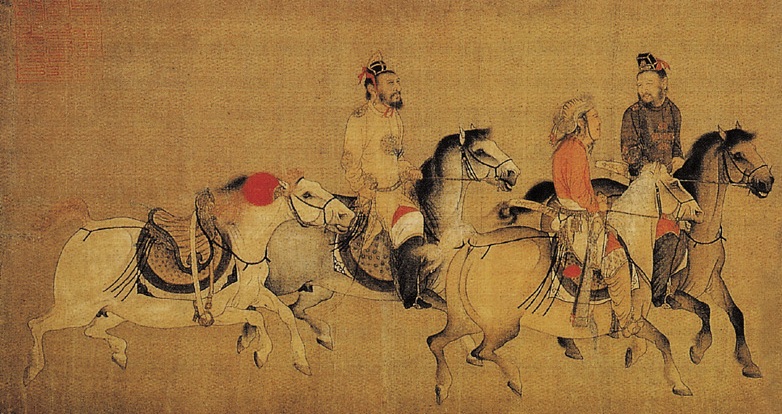
A minor Chahar Mongol prince by the name of Tögöldör was convinced to cross the Pacific with his people and livestock in the late 1510s. Tögöldör’s people moved into the area that later became known as Little Mongolia Prefecture. Little Mongolia’s capital was named Yuan City after the Mongol-led Yuan Dynasty of China, which had been supplanted by the native Chinese Ming Dynasty. Over time, they slowly migrated east into the Great Basin and then north into the Grass Seed Basin. Until the mid-17th century, they were generally called the Chahar Mongols or simply Northern Mongols.
Jealous, then-governor Bai Shunyong of South Province also contacted the emperor and convinced him to send some Jurchens over.
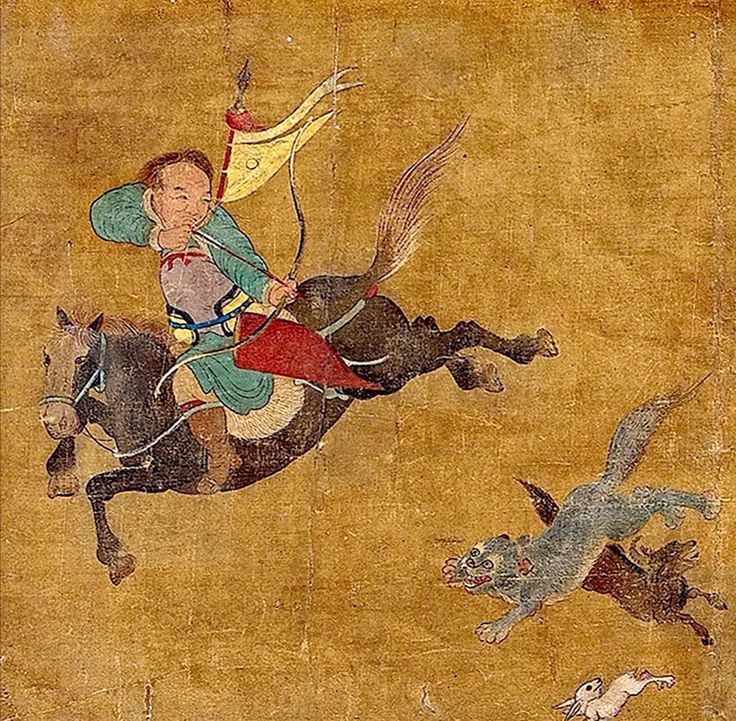
Now, while I think the Mongols need no introduction, the Jurchens are not so famous a people. Jurchens are from what is today China’s Three Northeastern Provinces, better known as Manchuria, since they renamed themselves Manchu in the early 1600s. In the 16th century, however, they were divided into many smaller kingdoms. To the extent that their homeland had a name common to all Jurchens, it seems to have been Nurgan—or at least, that’s what the Chinese called the region, and it is clearly a word of Jurchen origin. Some Jurchens led a settled life of farming in the river valleys while others raised livestock in the mountains above, migrating down into the valleys for the winter. Although they could not be described as steppe nomads, their proximity to the Mongols led to a pervasive cultural emphasis on horse archery so that they fought wars in a Mongol-like manner.
Although Nurgan was not a part of China, the Ming Dynasty was constantly trying to extend its influence into the region and had, in fact, taken control of the southern part of Jurchen lands, an area they called Liaoning. The Ming had plenty of contacts in the Jurchen kingdoms, which made it easy to launch an advertisement campaign to draw recruits for Bai Shunyong’s border guards.
Once in Xinguo, they took up residence in the southern tip of the Valley around Lake Youkuci and were called the Southern Jurchens. Eventually, they migrated into the Great Basin.
The success of these migrations led to more Jurchens and Mongols being recruited. North Province recruited Jurchens and settled them in the foothills of the Sisikua Mountains along the Weima River in the Weima Coast region. These people were called the Northern Jurchens and would later migrate over the mountains onto the Weima Plateau.
Meanwhile, South Province recruited a group of Tümed Mongols from the Ordos Triangle and let them take up residence in the far southern end of the Valley, whence they expanded into the Antelope Nü Desert by the mid-16th century. As farmers came along behind them and the old frontier was converted into a settled farming region, the Tümed (or Southern) Mongols kept on migrating southeastward. By the mid-17th century, they were inhabiting the Ajimei’er River country.
Throughout Xinguan history, Tatars enforced the law on the frontiers. They ran down those who fled from the law; they cleared out bandits and livestock rustlers; they were the first people that Priors saw when Xinguo went on the warpath against them; they were the last Xinguan forces to leave an area after conducting a raid in enemy territory. During all this, they were largely given a free hand to deal with hostile people however they saw fit, which led to a great many abuses and atrocities committed by them, mostly against Priors. In essence, the New World Tatars fulfilled the same function for Xinguo as the Cossacks did for the Russian tsars. Riding a steppe pony with composite bow in hand, the Tatar became the symbol of the expanding frontier.
[Next]

 Lord of Lore
Leave a comment