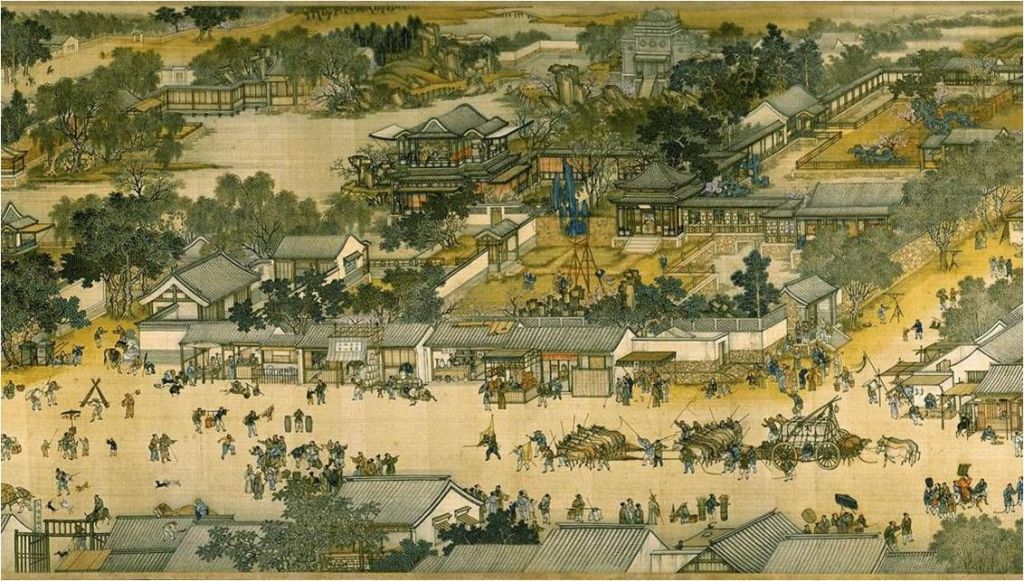
4.1 – China and the Master of Two Provinces (1591 – 1592)
When last we discussed the core territory of Xinguo, it was the year 1591. Governor Wei Yonglong was the man who’d initiated the first outright war between the long-time rivals of North and South Provinces, and he was the man who’d united the two provinces under his rule. 1591 was the year when Yonglong died and was succeeded by his son Wei Ruzheng. As discussed in Chapter 1, Wei Ruzheng automatically inherited the title Duke of Jia from his father as that was a rare case of a heritable title in the Chinese peerage system, but he did not automatically become governor of North Province and he most certainly had no legal claim to the office of governor for South Province. Nevertheless, he was the man in power. He called himself governor of North Province and even began referring to himself as Master of Two Provinces as if it was an official title. Despite some protests from Southerners that they should have their own governor, no one could seriously challenge Wei Ruzheng unless they were willing to launch a revolution against him. As a matter of fact, such people did exist, but we’ll get to them later.
For one man to take control of all Xinguo had always been the worst fear of the emperor and his highest officials in Beijing. Technically, the Xinguan provinces were part of the Viceroyalty of the Eastern Ocean, together with Xiaweiyi Province. The viceroy was a man in Beijing who travelled with the Treasure Fleet every year and met with the governors of all three provinces to audit them and deliver messages from the emperor. His actual influence over policies in the three provinces was limited. Now, however, he had almost no influence at all in Xinguo.
In 1592, the viceroy went to Xinguo with the Treasure Fleet and delivered a message to Wei Ruzheng, although he refused to meet with or show his face to Wei. The message was a letter written by the Wanli Emperor. In it, the emperor demanded that Wei Ruzheng come to Beijing to be officially confirmed as governor. Wei Ruzheng was, quite understandably, concerned that he may instead by stripped naked in the public square and slowly have chunks of flesh sliced off until he died by death of a thousand cuts. Or he could be strung up over a bamboo shoot with a sharpened tip and left to hang until the bamboo grew through his still-living body. Or he could be put in a cauldron of water and boiled alive. The Chinese had no shortage of torture-execution methods that they’d developed over the course of their millennia-old civilisation. If the Wanli Emperor wanted to remove the Master of Two Provinces from the picture and devolve power in Xinguo so this wouldn’t happen again, then this was the way to do it.
Guessing (correctly) that this was what the emperor had in mind, Wei Ruzheng decided that he quite simply would not go to China to be confirmed. However, he continued sending tribute to China every year. The mass exchange of copious quantities of goods via the Treasure Fleet was a huge part of the Xinguan economy and could not be neglected. If some of Wei’s appointed officials had to prostrate themselves in front of the emperor and assure him that Wei was his loyal and obedient servant, then that was simply the price of doing business.
And so, over the course of Wei Ruzheng’s reign, a surreal, unspoken arrangement emerged between him and the emperor. He would not be legally confirmed as governor and the emperor would overlook his printing currency using his own seal. In return, the annual exchange of good would continue. From the Wanli Emperor’s perspective, the arrangement was far from ideal, but since his gambit to have Wei come to him had failed, the only way to remove Wei from power was to send an army to do it by force. Such an expedition would require tens of thousands of soldiers, hundreds of ships, and generous local support in order to succeed. Deciding it just wasn’t worth it, the Wanli Emperor went along with the arrangement as long as the flow of treasure from Xinguo was not interrupted.
Meanwhile, to ensure total Northern control over the silver trade, Wei Ruzheng forced the merger of the Dongguang Silver Society into the Ningbo Silver Society. We discussed the DSS and NSS at length in my previous work, The Xin-Mei Wars Volume 1. These two merchant guild had long been the only ones authorised to trade silver in Xinguo, and were therefore the main people doing business with the Treasure Fleet every year. After conquering the South, Wei Yonglong had placed restrictions on the DSS, but allowed it to continue to exist to maintain the veneer of Southern independence. Wei Ruzheng preferred direct control, so he simply ended the Dongguang Silver Society’s existence in 1597, after 147 years of continuous operation.
Closure of the DSS would have ramifications in the dawn of the 17th century, which we’ll get into in a later chapter.
4.2 – Magnates of Xinguo (1587 – 1604)
Consolidation of Northern rule over the South began during the Two Provinces War with the dispossession of the Southern magnates. We discussed in some detail how land ownership worked in Xinguo in the 16th century in my previous work, The Xin-Mei Wars Volume 1: Diplomacy and War Between Xinguo and Mexico in the 16th Century. Now, however, it’s time to go into detail on some aspects of the system that we didn’t get into there.
In brief, magnates (translated from Dàrén – 大人, big person) emerged as a result of early settlement patterns by immigrating Asians, particularly the Chinese. Magnates were stupendously, almost incomprehensibly wealthy families who owned huge swathes of land in Xinguo.
In 1576, before the Acapulco Expedition upset everything, there were about 100 magnate households in Xinguo, evenly split between North and South. Out of a total of 600,000 households, the magnates made up a grand total of 0.016%. Between them, they owned 60% of all the land under cultivation, which at that time was approximately 6,000,000 acres. That means 3,600,000 acres were owned by 100 households, each of whom owned an average of 36,000. This, by the way, doesn’t take into account land used for animal husbandry, timber, or mining of any kind; only land under cultivation.
By contrast, we may look at Chinese land ownership in the mid-20th century. According to data collected in China before the land reform movement around that time, the average gentry household (of whom there were 400,000, or 3.79% of the 10,554,000 households who owned land in China at the time) owned 23.7 acres of farmland. To be fair, this is comparing apples to oranges. First, you will notice that the 3.79% figure is out of the landowning households in China while the 0.03% number of magnates in Xinguo is out of the total number of households. Second, Xinguan magnates were not gentry, they were in a social class that transcended the petty concerns of those who were merely rich. Still, it gives some idea of just how fabulously wealthy the magnates were, even when compared to wealthy landlords from other parts of the world.
Another place we may look at is England. In the 16th century, there were 300-350 members of the English nobility of the rank of baron and above who collectively owned 1.6 to 3 million acres of cultivated land, giving an average of 4,571.4 to 10,000 acres each.
These are some very rough comparisons, but it illuminates the general idea that Xinguan wealth inequality was already extremely high in 1576; not only were the magnates rich beyond belief compared to the peasants of their own country, they were wealthy even compared to their ostensible class peers from other countries.
To understand how it had come to this, we need to discuss land ownership in traditional Chinese jurisprudence. In Xinguo, and in China before the 20th century, land can effectively have two separate owners simultaneously, each holding different rights to the land. The primary owner held subsoil rights, which meant that as long as he paid taxes on it he held a permanent claim to it and could charge rent on its use. The other owner was the one who held topsoil rights. Topsoil owners had the right to live on the land, use it however they saw fit, and even sell or rent it to a third party without needing permission from the subsoil owner as long as they paid rent to the subsoil owner. Subsoil owners did not have the right to actively use land that they didn’t hold topsoil rights to; not to cultivate it, not to live on it, not to use it for any other purpose. Nor could they evict the topsoil owner. If, however, the topsoil owner died without an heir or failed to pay rent for a period of time, then topsoil rights would revert to the subsoil owner.
This becomes relevant when we examine the process of how the Xinguan provinces acquired land from Prior nations and redistributed it among the settlers. We’ve discussed this before, but it bears repeating here. Land was either purchased in a treaty, given as part of a nation’s tribute, or outright conquered in a war. Priors, being unaware of the ins and outs of Chinese jurisprudence, were usually unable to negotiate the retention of subsoil rights for themselves. Also, they were usually unable to read the contents of the treaties they were signing, so they didn’t know what the fine print was anyway. It was only after becoming familiar with Xinguan jurisprudence that Prior organisations began opening court cases in which they argued that they ought to own the subsoil rights for all the land in Xinguo.
Once in possession of the land, the government needed large quantities of poor people to cultivate it so it could be taxed and turn a profit for the government. The land would be surveyed, divided into plots, and auctioned off to the highest bidder (or to people with personal connections to those in charge of selling it). Typically, land was purchased by high-end speculators (people looking to buy a good—land, in this case—on the cheap and then sell it as quickly as possible for a high mark-up), many of whom formed guilds or societies in order to pool their capital.
Those who bought the land became the holders of both subsoil and topsoil rights, but were expected to find people back in China or elsewhere in Asia who would be willing to come over and work it. The government thereby offloaded the work of actually settling the land onto the speculators. Speculators, in turn, hired emigration agencies that quickly formed in China, Korea, Japan, Vietnam, and Dongdu (a city in the islands that would later be named the Philippines) to find, recruit, and transport peasants across the Pacific.
This system, combined with the division of subsoil and topsoil rights, highly incentivised land speculators to sell the topsoil rights on newly-acquired land and hang onto the subsoil. With the profits made by selling topsoil rights to incoming Asian peasants, not to mention the long-term income from the rents collected on those lands, the earliest land speculators in Xinguan history immediately became the wealthiest people in the country and were therefore those in the best position to purchase the most land when the next influx of newly-acquired land went up for auction.
The trend, then, was for the already rich and established landowning families to accrue ever more land and wealth with each new acquisition from the Priors by the government. Some meek attempts were made by various governors over the years to curtail this trend by forcing land speculators to sign contracts requiring them to sell a given percentage of subsoil rights to the settlers they recruited in Asia.
However, the influence of the magnate lobby was strong. With nothing better to do, magnates tended to cluster around the provincial capitals, where the land auctions were held (except in the Outer Prefectures, where auctions were held in prefectural capitals), so as to snap up as much land as possible in every auction. From here, it was easy to inject inconsiderate quantities of their voluminous wealth into the political system in the form of bribes and donations to the government and government officials, which made it very hard to go against them in any meaningful capacity. I say ‘inconsiderate quantities’ because 1,000 silver coins was a superfluous amount of money to a magnate, even though it was enough for any modest person to live on for a decade. Furthermore, a large portion of the government officials the magnates were lobbying to were themselves members of the extended family of those same magnates.
All of that, however, was before 1576. The Acapulco Expedition of that year precipitated the Three Governors’ War that tore South Province apart over the years 1576 – 1587. In 1587, Wei Yonglong’s Northern armies swarmed across the border in their vast hordes. Even as they continued to pillage and conquer their way toward the end of the Valley, Wei Yonglong began the work of consolidation by stripping any and all potentially disloyal Southerners of their land. The process was continued by Wei Ruzheng so that, by 1595, there were 60 magnate households in possession of subsoil rights on 80% of all the cultivated land in Xinguo, and most of them were Northerners. This meant that 60 households (0.01% of all households) shared 4,800,000 acres of land between them, with an average of 80,000 each.
The rich got richer and the poor got poorer.
4.3 – The Lower Classes of Xinguo (1587 – 1604)
And what of the poor? Often, they were descended from peasants of modest means in Asia who were recruited by an agent from an emigration agency for some land speculator’s settlement scheme. Another common story was that people already in Xinguo would form associations to help their extended family members follow them across the ocean.
Topsoil rights on newly-acquired land in Xinguo usually sold for a quarter to a third of the price land was traded for in China, which enabled households of modest means to buy what were, by the standards they were used to, quite generously-sized plots of land. An average peasant in China had around 3-5 acres of land to farm while their counterparts in Xinguo had more like 5-8. Also, many Xinguan peasants had access to wilderness tracts where they could go hunting and gathering to supplement their income.
Consequently, the amount of calories available to Xinguan peasants was somewhat higher than was available to those in China, which resulted in a slightly higher population growth. Infant exposure (the practice of leaving infant children outside to die) was common in China as a means of family planning, especially among households that couldn’t afford another mouth to feed. Greater availability of calories in Xinguo meant infant exposure was less common, and this meant Xinguo had almost no gender imbalance, unlike China, where infant girls were exposed at a significantly higher rate than infant boys, who were perceived as being more valuable. Having a less significant gender imbalance naturally enhanced the higher birth rate in Xinguo, as there were more men able to find a partner to have kids with.
These and other factors made emigration to Xinguo a highly attractive option for those who came by the opportunity. Still, the cost of travelling across the biggest ocean in the world, not to mention acquiring any tools, seeds, or farm animals they may need, could be ruinous in combination with the nominally-priced topsoil rights. That’s where the loans came in. Often, the migrating peasants would bring only themselves, their families, and a few essential items across the Pacific, since they couldn’t afford to pay to bring seeds, tools, and animals with them. Once in Xinguo, they would have to borrow money to buy these things. Often, the money was borrowed from the selfsame land speculators they had just purchased topsoil rights from.
Thus indebted, they had to work for years, sometimes decades, and sometimes for the rest of their lives to pay it off. People who found themselves in this situation fell into an emerging social class called peons (Zhàigōng – 債工, debt worker) or, more cynically, daytime slaves (Rìnú – 日奴, daytime slave). Debt was calculated household to household, rather than individual to individual, so debt could not be escaped via the death of the one who contracted it. Some households continued in debt for generations.
Peons almost invariably lived in poverty even compared to other peasants because they had to pay both rent and debt instalments. Magnates could hold this over their heads by threatening to sue the peasants to take back their topsoil rights if they failed to make their payments on time. This was rarely done because it would mean the magnate would have to find someone else to work the land and the peasants would now have no means of paying off the debt. The fact that it was unlikely, however, did nothing to ease the anxieties of desperately poor people having the threat of eviction dangled over their heads. To make the payments, peons often had to perform extra labour for the debtor in the form of field work, spinning thread or weaving textiles, doing household chores, or even sexual favours.
Despite these difficulties, most people did become debt-free within a years years, or perhaps a decade, of landing in Xinguo. Only the truly diabolical land speculators were unscrupulous enough to find ways of trapping people in debt forever. Most were content to collect rent, which was plenty enough to make them wealthy on its own.
Overall, it’s fair to say that until the magnate consolidations that began in 1587, the average peasant in Xinguo (both the peon and the debt-free) was better off than their counterparts in China. During the consolidations, however, peasant quality of life dropped dramatically. After the consolidations were complete, Xinguan peasants were markedly worse off than their Chinese counterparts. Many of them went into debt and became peons; others lost their land rights and had to become renters or day labourers working on magnate plantations.
But at least peons were still a step above actual slaves. Or rather, the lucky ones were. Unlucky children in peon households might be sold into slavery by their parents to make ends meet.
4.4 – Slavery in Early Xinguo (1450 – 1500)
China was never at a point where its society as a whole could be described as a slave society, but there were times and places where slavery was quite prevalent. These tended to be concentrated in particular areas, such as the region around the Pearl River delta or the city of Beijing. Slaves come from several sources, such as criminals being condemned to it or prisoners of war being sold into it.
By far the most common source of slaves, however, was parents selling their own children into slavery. The reasons why they might do this come mainly down to poverty. Famines, floods, and earthquakes happened periodically throughout China, plunging hundreds of thousands or even millions of people into desperate straits. Many made the decision to sell one child in order to be able to feed the rest rather than watch them all slowly waste away to starvation. Even something so simple as less rain than average could ruin a farmer’s crop, thus raising the spectre of starvation. Peasants built support networks with landlords and other peasants to prevent starvation in such cases, but sometimes these safety nets failed.
Of course, some parents were quite simply psychopaths who didn’t care about their children. Furthermore, one did not have to be a psychopath to discard a daughter in a society that saw women and girls as less valuable, or even a burden, rather than a benefit. Even decent, normal people could be persuaded to sell a girl off in lean times.
Speaking of persuasion, another reason parents might sell their children was that the merchants who traded in enslaved human children were not above lying, conning, and tricking parents to get them to make a deal. Shocking, I know. Sometimes, they outright kidnapped kids. Most vulnerable of all, of course, were orphans. Orphans could just be picked up off the street and sold with almost no overhead.
Because boys were valued more highly by their parents, the majority of slaves throughout Chinese history were female. Boys, after all, could inherit property and carry on the family name. In fact, older couples who had no male children sometimes bought a male child-slave and adopted him as their son to carry on their name. Girls, on the other hand, most often ended up as domestic servants, from which position they might become the concubine of their master or be married to one of the master’s menservants as a reward for the manservant’s loyal service. In either case, it’s unlikely the girl was given much choice in the matter. Still, at least being married or taken as concubine meant that she was no longer as slave—though given the state of women’s rights in China at the time, it isn’t clear to this author that being a wife was necessarily a better state to be in than slavery.
Those were the lucky slaves, though. Unlucky boys could end up working in mines or other hard labour jobs under brutal conditions while many a slave girl ended up in a brothel, to be used by men often much older than she, potentially for the rest of her life. Even after being freed, a slave girl who’d worked in a brothel was viewed by society as being good for nothing else. Usually, she was forced to continue working in the sex industry, sometimes in the same brothel where she’d been enslaved. Boys freed from enslavement while working hard labour could find other work if they were extremely lucky, but most had no contacts and no other skills, and therefore no opportunities but to continue doing what they had been doing.
Slavery in China could, of course, be every bit as nasty and brutish as slavery anywhere else. Fortunately, the majority of people who were enslaved as children did end up being freed by the time they reached adulthood. It was considered to be good form for a master to release a child slave in their mid- to late teens, and people who cared about their image among their peers most often did so. It was, however, entirely at the master’s discretion whether or not this was actually done.
All of this was exported to Xinguo from the 1440s onward. The biggest difference was that in Xinguo, enslavement fell more harshly on Priors than it did on anyone else. Most slaves remained, of course, the children of Asian settlers, but the racial dimensions of enslavement cannot be overlooked. Priors suffered from enslavement at a much higher rate per capita and, unlike Asian child-slaves, who could expect to be freed before the age of twenty more often than not, this socially-enforced rule was not applied to Prior child-slaves, who were routinely held in bondage to their dying day.
Priors could be enslaved in a variety of ways. They could, of course, be forced into poverty by having most of their land seized. This might be enough to persuade parents to sell their children, but Priors had no previous tradition of such a thing being normal and many refused to engage in such practices. No matter; war was endemic in frontier areas. Rebels and raiders could be captured in battle and sold. Xinguo was not only reactive, but proactive, as Tatar border guards routinely launched raids on hostile and even neutral Prior nations both in frontier areas and beyond the frontier, deep in Prior territory. Mongols and Jurchens became Xinguo’s biggest traders in enslaved Priors in the 16th century and remained so until the 19th.
Furthermore, Prior nations had pre-existing rivalries with each other that were exacerbated by the process of colonisation. Merchants from North Province goaded Priors into attacking other Priors who were allied with South Province, and Southerners did the same to allies of the North. Land speculators looking to help the government acquire more land to put up for auction would prod Priors into war by selling weapons to both sides, weakening them to make it easier for the government to seize their land. For these reasons and more, Priors went to war and enslaved other Priors. Many such slaves ended up in Xinguo.
Slaves were one of Xinguo’s most important exports in the early days. From the time the Treasure Fleet was established in 1450 until 1500, some 80,000 people were exported from Xinguo to Xiaweiyi, North Sunrise Island, Guandao, and China. Most of them died of diseases, but some lived, had children, and established communities in their new homes. Some were eventually able to return to their homeland, but they were a minority even within the minority who managed to regain their freedom.
Those who were unable to make it back to America put down roots wherever they found themselves. On North Sunrise Island and Guandao Island, the descendants of Prior slaves make up nearly half the population today. In China, a Prior minority 12,000 strong thrived in the 1640s, spread across the cities of Nanjing, Yangzhou, Suzhou, Ningbo, and Hangzhou, mostly in the lower Yangzi River region. These people were devastated by the Qing conquest of China, especially in the brutal sacking of Yangzhou, but they survived and continue to live there to this day.
Eventually, the silver trade with the Purepecha, Aztecs, and Incas was established, reducing the value of enslaved persons as a commodity. Meanwhile, the demographic collapse of the Prior population of Two Provinces dramatically reduced the availability of Priors to enslave. Very few slaves were exported to China after 1500. Enslavement of Priors remained a common practice, they were just kept within Xinguo.
[Next]

 Lord of Lore
Leave a comment