5.1 – Reign of Wei Taixun (1604 – 1625)
In 1604, Wei Ruzheng died of natural causes and was succeeded by his son, Wei Taixun. Like his father, Wei Taixun never went to China to be confirmed as governor. In so doing, he became the first ruler of North or South Province who never visited China. Even Wei Ruzheng had been there once, when his father had gone to be confirmed as governor. In fact, Wei Taixun never bothered with the title of governor, preferring instead to exclusively use the title Master of Two Provinces.
The most notable thing to happen during Wei Taixun’s reign is that it was the beginning of an extensive communications integration between Xinguo and Europe that would facilitate the easy transfer of knowledge—most notably scientific knowledge—between the two.
5.2 – The Jesuit Missions in Xinguo and China (1582 – 1625)
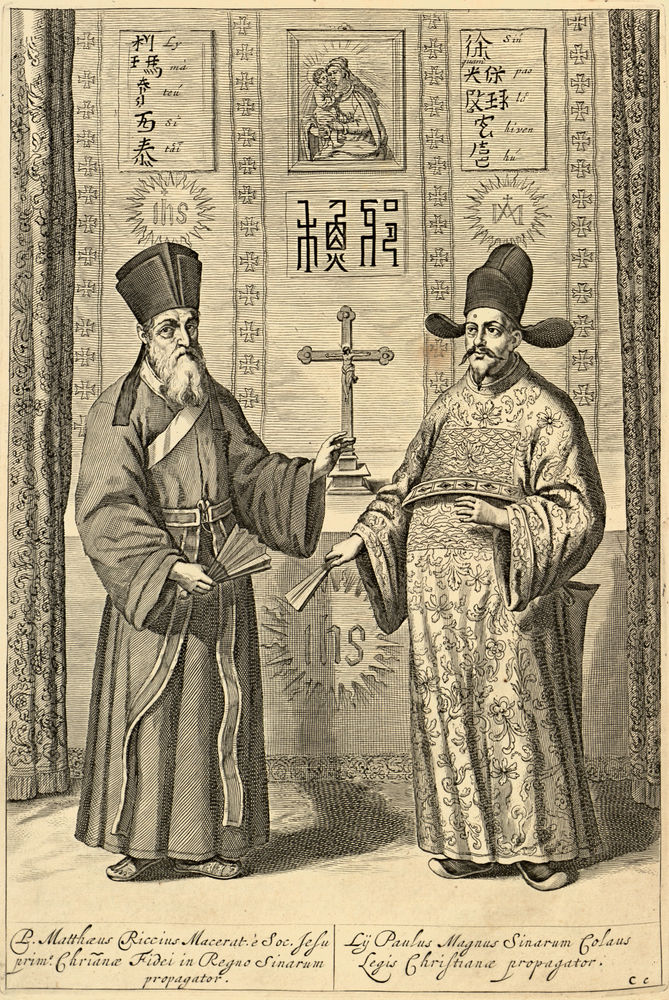
In 1582, Italian missionary Matteo Ricci and others from the Society of Jesus (better known as the Jesuits) were the first Christian misisonaries to make it deep into the interior of China. They came to preach the Gospel of Jesus Christ, but they also brought practical European knowledge of cartography, astronomy, mathematics, and other subjects. This was the start of the Jesuit China Mission, which continued until the early 18th century, when the Chinese Rites Controversy resulted in most missionaries being expelled from China.
For its part, Xinguo had been periodically visited by missionaries from the Dominican and Franciscan orders as well as the Jesuits since the 1550s. Now, the rulers of Xinguo have rarely, if ever, cared about religion per se. Like China, Xinguo was governed according to Confucian moral principles, but Confucians think of Confuciaism more as a philosophy than a religion. As such, they were content to tolerate the spread of Christianity as long as it wasn’t a political threat to their rule. For example, all members of the Dominican and Franciscan orders were expelled from both provinces of Xinguo in 1576, when the Warehouse War broke out. This wasn’t because they were Christians, but because those two orders (especially the Franciscans) had very close ties to the Spanish government and were therefore viewed as arms of Spanish political influence.
Jesuits were still allowed to operate in Xinguo despite facing periodic harassment and occasional imprisonment by local magistrates. Still, there weren’t many Jesuits there until 1605, when the Jesuits decided to greatly expand their presence in Xinguo as an extension of their China Mission.
Diego de Pantoja, a musician and astronomer who’d been working as a missionary in China since 1597, was asked to lead the mission to Xinguo. He agreed and set out in 1606 with a number of other missionaries and a handful of Chinese Christians. Travelling with the Treasure Fleet, they arrived in Ningbo that July. The first thing they noticed upon arrival was that Xinguo had far fewer restrictions on foreigners. The ban on foreigners owning property or staying the night in Ningbo (enacted by Wei Chengjia in the 1560s) had long since been lifted, which enabled the establishment of a thriving community of foreigners in the city. People from all over the Spanish empire were there; Castillians, Catalans, Italians, Walloons and Flemings, Mexicans, Peruvians, and more, around 1,000 of them. There were also a couple hundred or so Portuguese present. Most of them were transient, arriving to conduct business and then leave again, but some put down permanent roots.
Shortly after arriving, Diego de Pantoja met with Wei Taixun and shared his knowledge of astronomy and music with the Master of Two Provinces and the people close to him. In 1608, de Pantoja negotiated a deal that allowed the Jesuits a more or less free hand to preach in Xinguo in exchange for sharing European knowledge. Jesuits were even invited to serve in various positions in the government, mostly having to do with science.
Thus established, the partnership between Xinguo and the Society of Jesus would continue for a long time to come. More importantly, it opened the door to further communication between Xinguo and Europe, which laid the groundwork for the integration of the scientific community in Xinguo with that of Europe.
5.3 – The First Expedition to Europe (1610 – 1612)
Meanwhile, tales of what the Jesuits were sharing in China crossed the ocean, as did a world map produced by Matteo Ricci in 1602, in collaboration with Chinese cartographers. It was the first world map written in Chinese. Copies were transported to Xinguo where, for the first time, Xinguans were able to see their relative position in the world compared to Europe. Explorers island-hopping across the Pacific all the way back in the 1430s had dared to imagine that they could reach Europe this way, but instead discovered America. Later generations of explorers had gone up and down the coasts of America. In the north, they had discovered Alasaka, the Bering Strait, and had sailed down the coasts of what later became the Russian Far East on their way back to China. Others had sailed south, made contact with the Purepecha, Aztec, and Inca empires, and explored the Chilean coast. However, none of them had ever made it as far as Cape Horn.
The Ricci map was a sensation in Xinguo and reignited interest in the idea of reaching Europe. To that end, a group of private interests—mostly merchants looking to expand their markets—founded the Society of European Exploration in 1608. This group lobbied the government until Wei Taixun authorised the funding of an expedition to Europe. With funding from both the government and private backers, the First Expedition to Europe was outfitted in 1609, consisting of four ships filled with trade goods and supplies. Command of the expedition was given to Jia Majixi, a merchant and explorer from the Dongdu colony of Tagum (his name is a Romanisation of the Chinese spelling of the Tagalog name Gat Makisig).
Jia Majixi was given plenipotentiary powers by Wei Taixun, enabling him to sign treaties with foreign powers on Wei’s behalf, and he also had a translation of the account of the Magellan Expedition’s circumnavigation of the globe in 1519 – 1522 (acquired via Jesuit missionaries). The expedition set out in July, 1609, so that by the time they reached Cape Horn, it’d be summer in the southern hemisphere.
The first part of the journey was largely uneventful. Jia Majixi passed through the Spanish colonies of New Spain, New Granada, Peru, and Chile. Beyond Chile, he reached the Straits of Magellan in November. This was a treacherous passage, but it was sheltered from the gale-force winds and icebergs found in the open ocean beyond Cape Horn. Jia Majixi had the Ricci Map in his possession and he had a Jesuit missionary onboard to act as interpreter, but he had neither a detailed map of the straits nor a guide to show him the local landmarks (the Jesuit had reached Xinguo via the overland route through New Spain). The best he had to go on was Magellan’s account of his passage through the strait, and even then Jia had to read the account backwards because he was entering the strait from the opposite end of where Magellan had entered. During the passage through the strait, one of the ships ran into some rocks and had to be abandoned, with several sailors being killed in the process. All things considered, it could’ve been worse.
Once on the other side, however, it was clear sailing up to Brazil. Jia Majixi passed through Spanish colonies along the way until reaching Salvador, capital of Portuguese Brazil at the time, in January, 1610. In Salvador, he met with the governor, exchanged gifts with him, and managed to acquire a guide. With the guide showing the way, Jia Majixi sailed to the Portuguese colony of Cape Verde, and from there to Lisbon, Portugal, which they reached in late March.
In Lisbon, Jia Majixi and his crew became the first Xinguans to reach Europe. Their arrival had been expected for some time because news of their passage along the coast of New Spain had filtered across the Atlantic before they’d made it through the Straits of Magellan. Lisbon, however, had not expected to be the place where the expedition would land first; the sight of three exotic, Asian-style ships with their distinctive junk-rigging entering Lisbon harbour created an instant sensation throughout the city. By the time Jia and his crew attempted to disembark, there was a huge crowd waiting for them, eager to see these unexpected visitors. In fact, the docks were so crowded that it was hours before Jia and his crew were able to physically get onto the shore. Once there, they were met by a delegation from the Council of Portugal.
At the time, the Kingdom of Portugal was ruled from Spain by King Felipe III, who was also King Filipe II of Portugal. Portugal enjoyed a fair bit of autonomy, however, under the rule of the Council of Portugal.
Jia and his officers were wined and dined sumptuously for two weeks. They tried to get the Council to sign a treaty with Xinguo, but the Council didn’t have the authority to do such a thing without authorisation from the king. And that meant one thing: Jia would have to visit Madrid to see Felipe III/Filipe II.
Jia Majixi and a party of crew members travelled to Madrid and arrived in early April, causing a sensation in every small town they stopped at along the way. Jia records in his account of the expedition that he could barely contain his excitement at the prospect of meeting the king, but goes on to recount how the king completely gave him the cold shoulder. Felipe III refused to meet with Jia, shunting the responsibility onto his royal favourite, the Duke of Lerma. Lerma met with Jia but refused to sign any kind of treaty, and especially would not allow a treaty between Xinguo and Portugal.
Shocked at this reception, Jia could only guess as to the reasons why he was being treated this way. He stayed in Madrid for three weeks, enjoying some local sights and attending the local theatre scene. He did manage to secure one meeting with Felipe III, but it was brief and the king said almost nothing. What proved more productive were several more meetings with Lerma, where they discussed some matters of international relations. Lerma kept trying to get Jia to agree to exclusive trade deals with Spain, but Jia was here to expand trade, not limit it. Nothing could be agreed to and no treaty was signed. Jia went back to Lisbon and prepared for the next leg of his journey with a bitter taste left in his mouth by the ordeal so far.
We, however, know the situation from the opposite point of view. Felipe III was notorious for being a shadow-king who made as few public appearances as humanly possible on the advice that doing so would increase his stature among the common folk by reducing the visibility of his faults and elevating him to the status of a legendary, almost mythical figure within the kingdom. Whether or not it ever occurred to Felipe III that his advisors may have told him this in order to minimise his influence over policy while maximising their own is not known to this author.
As per this policy, Felipe III showed what he believed to be the proper degree of interest in the matter of a surprise foreign dignitary’s arrival while leaving the nuts and bolts of negotiation to his trusted favourite. The Duke of Lerma, on the other hand, was in panic mode as he felt he could feel Spain’s monopolising grip on the China-Xinguo-Spain-Europe trade slipping through his fingers. Hence his attempts to get Jia to sign a treaty to exclusively trade with Spain and not with other Europeans.
Leaving Madrid and Lisbon behind, Jia Majixi hoped the next capital on his list would treat him better: Paris. The First Expedition to Europe landed at Le Havre, at the mouth of the Seine River, on May 10th, 1610. Here, he was assured King Henri IV would most certainly be pleased to meet with Jia and sign a treaty. Furthermore, Jia Majixi was given an invitation to the coronation of Marie de Médicis, who, despite being the wife of the king since 1600, had not yet been crowned queen.
Jia Majixi and a small entourage took a boat up the Seine and arrived in Paris, where their reception was much more muted than it had been in Lisbon, owing to the upcoming coronation, which was set for May 13th. Jia Majixi was given a place of honour to witness the coronation, and during the party afterward he presented the new queen with an armful of bolts of silk cloth. King Henri promised Jia that negotiations over a treaty between Xinguo and France could begin the next day in the Palais du Louvre, although the king would only stay long enough to open negotiations because he was leaving soon to participate in the War of the Jülich Succession and he didn’t have time to dither. Again, Jia recorded in his account that he was excited to finally begin negotiations and noted that this king seemed very busy, but much more promising than the last.
Jia Majixi and his entourage were staying at the Palais du Louvre inside Paris while King Henri was in the Château de Fontainbleau, southeast of the city. While waiting for the king to arrive so that negotiations could begin, Jia spent the morning perusing works of art made by the many artists Henri sponsored and kept at the Louvre. Meanwhile, Henri was riding in his carriage not far away when he was halted by congested traffic. An assassin leapt out of the crowd and into the carriage, where he stabbed the king to death. He was quickly seized and hauled away to jail before the crowd could lynch him.
When Jia learned of the assassination shortly afterward, he collapsed into the nearest chair and moaned out loud. France was in such turmoil for the next two weeks that everyone all but forgot about the foreign dignitary from an obscure country that no Frenchman had ever been to. Jia watched the execution of the assassin on May 27th and quietly took his leave the same day.
Next on the list was Amsterdam, but Jia didn’t dare get his hopes up about this one. He arrived in the Dutch capital at the end of May. To his great shock and amazement, his fears turned out to be completely unfounded. Not only was there nothing exciting happening in the Netherlands at the time, but even the eternal conflict known as the Eighty Years’ War between Spain and the Netherlands had been put on pause a year earlier—a stroke of serendipity, considering the truce had been signed while Jia’s expedition was being outfitted. Jia Majixi met with members of the Dutch government, including the stadtholder Maurice of Orange (later known as Maurice of Nassau). Jia and Maurice signed a “Treaty of Commerce and Friendship” that laid out some basic guidelines regulating trade between the two countries.
After Amsterdam, Jia visited London and signed a similar treaty with King James IV and I (of Scotland and England).
With London struck off the list, Jia Majixi’s work was done The First Expedition to Europe turned toward home at the beginning of July, 1610, and arrived in Ningbo in late November. It’d been a gruelling and embittering experience what with the shockingly cold reception in Spain and the incredibly bad timing of his arrival in France, but Jia cultivated a flickering hope within himself that his visits to the Dutch and English capitals would bear some fruit. Overall, he was severely disappointed with the trip and confided in his expedition journal that the whole thing may have been a waste of time.
In the short term, it would seem his trip had been in vain. England had no real way of getting to Xinguo at the time, so the treaty they’d signed lay forgotten on some shelf gathering dust. The Dutch were much more able and excited to get involved in the Xinguo trade, but was not yet in a position to take advantage of the treaty. It wasn’t until the 1630s that the first Dutch ship made it to Ningbo. However, even the Dutch were unable to come in great numbers. By that time, the Eighty Years’ War had started up again and the Dutch were also at war with Portugal. Spain and Portugal, however, controlled all the coasts on the route around South America, and the only other option for the Dutch was to sail around Africa, across the Indian Ocean, and then all the way across the Pacific. For the time being, Spain remained Xinguo’s only serious trading partner in Europe.
With that being said, Jia Majixi’s establishing of a route to Europe did quite a few things that were important in the long-term. For one thing, cartographers who studied his expeditionary journal were able to draw up more detailed maps of South America, including a detailed map of the Straits of Magellan, which would be indispensable to future maritime expeditions to Europe and Africa. Others were able to follow in his footsteps and produced even better maps. Soon, Xinguan intellectuals began spending time in Europe to attend universities and rub shoulders with European intellectuals. Through these interactions, Xinguo acquired devices such as telescopes, microscopes, and the printing press in exchange for knowledge of cartography, shipbuilding, and engineering. Cultural exchange took place as well, with great works of literature, philosophy, and history being translated and exchanged on both sides.
Meanwhile, it did not escape China’s notice that their ostensible colony of Xinguo was now signing treaties without asking permission or giving notice to the mother country. These were not mere tributary treaties with Prior nations, whom the Chinese did not regard as being real countries; these were international treaties with countries that were on the same level as China in terms of science and state organisation, much as the Chinese were loathe to admit it. It was just one more reason for the Ming rulers to consider military intervention in Xinguo.
5.4 – Concluding Wei Taixun (February 2nd, 1612)
On February 2nd, 1612, two men were carrying a sedan chair through the crisp morning air down a street in Ningbo. Inside the chair was Wei Taixun, Master of Two Provinces. Marching ahead and behind were twenty bodyguards keeping the street clear and making sure no one got too close. It was two days before the New Year (according to the Chinese lunar calendar), and the city was in a festive mood. At various street corners and plazas, performers were already putting on pre-shows in the run-up to the main event on the 4th.
Wei Taixun was on his way from the governor’s palace to the docks to oversee some business. At one corner that he had to pass on the way, a pair of women were setting off firecrackers. As the sedan chair approached, Wei Taixun told the men carrying him to slow down while he pulled aside the silk curtain to watch the firecrackers. One woman held out a torch so that the other woman could use it to light a pair of firecrackers. The second woman stepped away, drawing the eyes of Wei Taixun and a small crowd of onlookers. Meanwhile, the woman holding the torch threw a grenade into Wei Taixun’s lap. Both women instantly bolted and disappeared into the New Year’s throngs. Behind them, the sedan chair exploded, spraying the bodyguards and the crowd with wood splinters, shredded silk, and bits of Wei Taixun.
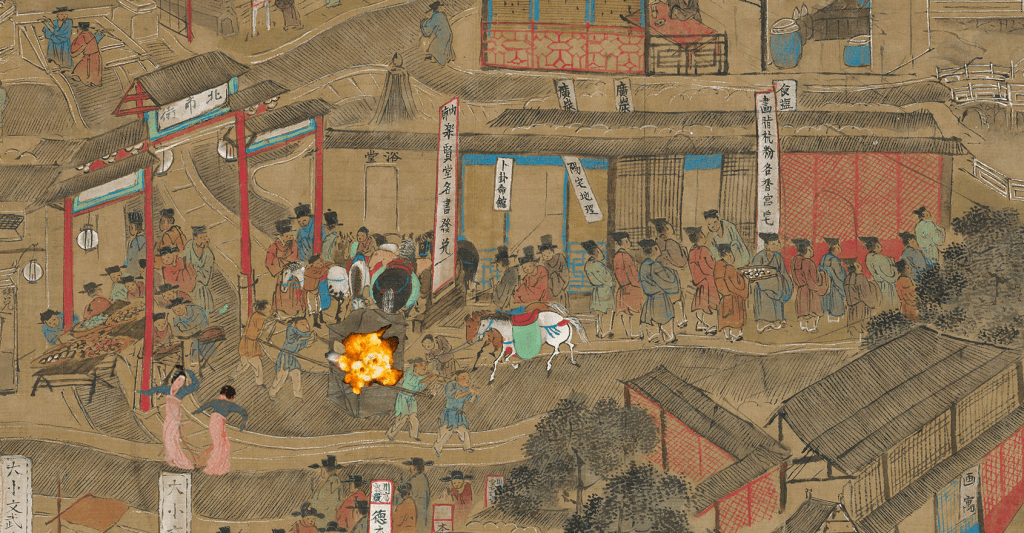
This was the first time a governor of Xinguo was assassinated and it would signal the beginning of a people’s war against the Northern tyrants. Before we can get to that, however, we’re going to have to explain how things had gotten to this point, and that means we need back things up quite a bit and examine the history of the Western Children Sect.
[Next]

 Lord of Lore
Leave a comment