6.1 – Heritage of the Western Children
Religion is a complicated subject in China and Xinguo and we in no way have time to go wade into the details here. Basically, there are three great religions considered to be “traditional” in China: Confucianism, Daoism, and Buddhism. Yet, I must swiftly add that there are many pitfalls in describing these three as “religions”. First of all, practitioners don’t necessarily think of them as religions. Confucianism in particular is more of a moral philosophy than a religion. Second, calling them “religions”, as of a plural number of separate things, is misleading. While a person can devote oneself wholly to one of the three, the vast majority of people in China and Xinguo today and in the past are Confucian, Daoist, and Buddhist simultaneously. All three have different things to say about how to conduct one’s life in different situations.
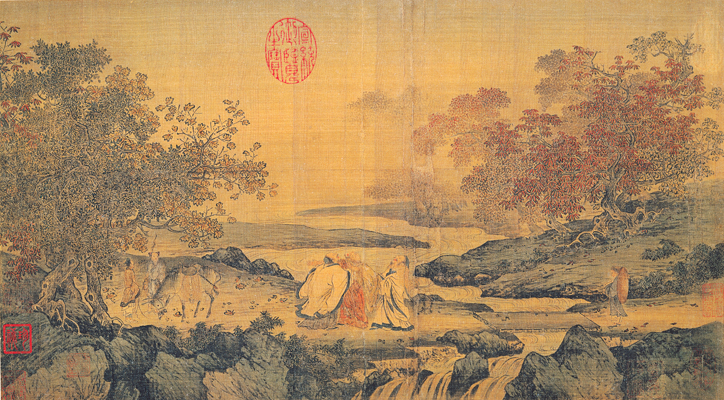
Rather than thinking of them as separate religions, it is perhaps better to think of them as three great religious traditions within the broader milieu of Chinese religion. They can be thought of as three ingredients in one stew, or as three threads braided together to form one rope. There is a famous painting, for example, called Three Smiles at Tiger Creek, which depicts three men laughing together, representing the relationship between Confucianism, Daoism, and Buddhism.
There is, however, a fourth, oft-underrated, great religious tradition in China. Chinese folk religion, sometimes called Shenism from the Mandarin word for god, divinity, or spirit, is difficult to define because of its extremely decentralised, folksy nature. There is no one way to practice Shenism, no canon scriptures, no central organisation or leadership. Instead, it’s a set of beliefs and practices surrounding a diverse array of figures, some mythological, some legendary, and some quite real. As suggested by its status as a folk religion, Shenism is largely overlooked by the government, which traditionally operated along Confucian lines. But everyone (Confucianists, Daoists, and Buddhists alike) practices Shenism on top of their other practices—or rather, it would be more accurate to say they practice Shenism underneath whatever other practices they engage in. If the big three are ingredients in a stew, then Shenism is the broth they’re cooked in. If the big three are three men laughing as they cross a stream together, then Shenism is the air they’re breathing.
Of course, other religions existed and continue to exist in China and Xinguo, from the folk traditions of ethnic minorities to Islam and Judaism, to religions that once existed in China but have since died out, such as Zoroastrianism, Manichaeism, and Church of the East Christianity. But there is still one more great Chinese religious tradition we have yet to discuss. This one is even harder to name, describe, and categorise than Shenism. Like Shenism, it has no central leadership and no unified canon of holy texts, although individual sects may have a canon unique to them.
What we are describing may be called Salvationism. It’s debated whether it should be called Salvationism, as of a single tradition, or Salvationist religions, as of multiple separate, but related traditions. Either way, Salvationist teachings seek “salvation”, or moral fulfilment, for both individuals and society as a whole. They’re heavily influenced by both Daoism and Buddhism, not to mention influences from Manichaeism, Mohism, and others, as well as being deeply rooted in Chinese folk and shamanic traditions. Some argue that Salvationism began as a divergent sect that split off of Daoism, and others argue it began as a Buddhist sect that split off. It’s also possible that both are true, and they dovetailed together to form Salvationism.
And this is where the Western Children come in. They are a sect—more of a movement, really, rather than a single organisation—of Salvationism native to Xinguo. Before we can discuss the Western Children in any depth, however, there is another phenomenon of Chinese religion we need to discuss, one that overlaps a great deal with Salvationist movements: the secret society.
Secret societies have a long, long history in China, so it nclear when they first became a thing. For our purposes, however, we may begin with the White Lotus movement of the Mongol-led Yuan Dynasty. The White Lotus began far earlier than the Yuan Dynasty, but during Mongol rule it became a fertile breeding ground for nativist insurrectionaries who sought to overthrow the descendants of Genghis Khan and replace them with a Han Chinese dynasty. The secretive nature of White Lotus meetings provided the perfect venue for insurrectionary planning while their religious nature provided a unifying idea to rally around.
And so it went. Secret societies became a mainstay of movements seeking to overthrow or otherwise resist the government for centuries to come. Out of the White Lotus came the Red Turbans, then came the Heaven and Earth movement, out of whom came the Triad rebels, and after them came the Boxer Rebellion, and then the Red Spears. This is far from an exhaustive list of Chinese secret societies. Not all of them were related to the White Lotus, not all were Salvationist, and not Salvationist movements are not necessarily connected to secret societies; there is, however, considerable overlap.
What secret societies did was create a core of dedicated people who could organise rural militias in order to mobilise a broad section of society and direct them toward a shared goal. In this way, the Triad movement was able to raise tens of thousands of rebels to fight the Qing Dynasty during the concurrent Taiping Rebellion of the mid-19th century. The same thing happened during the Boxer Rebellion, except that the Boxers were directed at excising foreign influences (mainly Christianity) from China, while the Red Spears organised self-defence militias in the wake of the central government’s collapse to protect rural communities from the predations of bandits and warlords.
Drawing upon Salvationist beliefs, secret societies of these kinds often taught their members powerful magic spells. Boxers and Red Spears, for example, shared a belief in spells that could (supposedly) render them invulnerable to bullets, blades, and speartips.
6.2 – Birth of the Early Sects (15th – 16th centuries)
And so, we come to the 15th century colonisation of Xinguo. Some of the earliest settlers were members of the White Lotus and similar movements, and they quickly established societies in both North and South. In America, Salvationist teachings mingled with indigenous traditions.
In Redwood Prefecture, the Minwei people mixed Salvationism with Weiyue traditions to form the World Renewal Sect, named for a traditional dance among the Weiyue.
In the prefectures of Red Earth and Meixiaze, as well as Little Korea and western Batewan Prefecture, a movement called the Western Guhuma Sect (Gǔhúmā – 古胡媽, literally: ancient barbarian mom) arose. Meanwhile, its cousin, the Eastern Guhuma Sect, emerged in the northern Valley and the Golden Mountains. Both sects derived from a mingling of Salvationist teachings with the traditions of the Kuksu religion, which was prevalent throughout much of the Burning Coast and the Valley in pre-contact times. Differences between the two seem slight to outsiders. Western Guhuma is based on Kuksu as practiced by the Red Earth people and their neighbours in the west while the Eastern Sect emerged from a subset of Kuksu called Hesi, which is traditionally practiced by the Batewan and Maiduan peoples in the east. The most obvious difference is that the Eastern sect is far more egalitarian as it encourages women to participate in secret meetings and join in the dances while the Western sect was, traditionally, exclusively male. The name derived from kuhma, a Red Earth word for secret societies who practiced Kuksu dances.
Xinguo-Chinese practitioners of Eastern Guhuma had a problem, namely foot-binding. Since the 13th century, it had been common in China to bind the feet of young girls, mutilating them and stunting their growth so that adult women had tiny feet, which Chinese men found sexy, but which prevented activities like dancing. In extreme cases when the feet had been bound most tightly, victims of the practice might not even be capable of running. While common in Xinguo, it was not universally practiced, especially among the lower classes. Poor families often bound the feet of the eldest daughter in the hopes that she might be able to marry into a wealthier family. Her younger sisters, being expected to have to work for a living, would not be subjected to foot-binding, or would have their feet bound relatively loosely so that the resulting mutilation would only minimally impair their ability to work on their feet. Even the elder daughters in peasant and urban poor families generally didn’t have their feet bound as tightly as daughters of rich families did.
The result was that, while Eastern Guhuma was practiced in some Xinguo-Chinese communities, it was almost exclusive to the lower classes.
Western Guhuma is especially popular among the Meixiaze people of North Province while Eastern Guhuma was carried into South Province at the end of the 15th century by Batewan and Maiduans escaping racial persecution in the North. And it is here that we can finally begin speaking about the founder of the Western Children: Cai Meishan (měishān – 美山, Beautiful Mountain).
6.3 – Life of Cai Meishan (c. 1479 – 1517)
Cai Meishan was born the third daughter of her parents and spent her girlhood in a village in Westfield County, which is part of New Guangdong Prefecture. Her date of birth is unknown, but she later recalled to her followers that her first memories were of the aforementioned Batewan settling on a tract of land near her village. Since the Batewan fled south in the 1480s, during and after the last of the Batewan Wars, this means Cai was most likely born circa 1480. Part of the deal the Batewan chiefs made with South Province in exchange for a tract of land was that they would learn to farm and pay tribute. One of the people contracted by the government to teach them how to farm was Cai Meishan’s father.
This and the close proximity between her home and the Southern Batewan villages gave her plenty of opportunities to visit and make friends with Batewan children while growing up. According to oral traditions of her teachings, Cai claimed to have been adopted as an honorary member of the nation and was inducted into a dancing society at the age of sixteen. Whether or not this is true cannot be verified; the Southern Batewan have no record of adopting a Xinguo-Chinese girl into their nation, or of initiating anyone named Cai Meishan into one of their secret societies. That being said, it’s unlikely that any such records would’ve been made even if it was true—Guhuma dances are practiced by secret societies, after all.
Regardless, Cai Meishan is said to have been a devout practitioner of the Eastern Guhuma Sect and participated in all the sect’s dances from the ages of sixteen to twenty-four. Whether or not she participated in any dances, she almost certainly observed quite a few and was profoundly impacted by the experience. Watching and/or participating in co-ed dances where men and women mingled and shared time and space with each other is, according to her later teachings, what made Cai Meishan start thinking that men and women should not be as segregated from each other as they were in mainstream Xinguan society.
Cai married her first husband around the time the Gold Rush of 1504 – 1514 started. Gold Fever swept both provinces, prompting thousands of Xinguans to pour into the highlands in search of gold. Boom towns sprung up overnight, thrived for a week, and then died. It was an era of opportunity for poor Xinguans looking for a lucky break—and an era of blood for the Priors who already lived in the mountains. Peoples such as the Maidu, Washishu, Fly Larva Eaters, and the Monong suddenly found their homelands flooded with Asio-Americans turning over every pebble in every stream in search of gold. Conflict naturally arose between the natives and the trespassers. Better armed and more numerous, the trespassers tended to win. They also did not distinguish much between peaceful Priors and hostile ones, nor between warriors and non-combatants. They suffered from the disease known as Gold Fever, and in the throes of the orgy of violence they enacted upon the Priors who were in their way, nothing could make them see sense or remember their humanity.
Cai Meishan’s first husband was one such man caught up in the excitement of the era. Against his wife’s judgement, he decided to move the family into the Monong Valley to stake their claim. Tucked away between mountain spines, Cai helped her husband pan for gold in the streams while also having to forage for wild vegetables and roots, not to mention cooking food, cleaning and mending clothes, and keeping the tent they lived in feeling like something resembling a home, all while looking after their infant son. Despite her husband’s dogged determination, their lucky break never came. The couple found barely enough tiny bits of rock to keep themselves financially solvent, and sometimes they didn’t even find that much.
For three years, they lived in tents, in cramped cabins shared with multiple other families, or under the starry sky with no shelter at all. One day, Cai Meishan and her husband were panning for gold on a tributary of the Nimi River, as they did every day. Cai was facing toward the shore and the not-too-distant treeline while her husband had his back to the shsore and was about to squat and do more panning when arrows flew out of the treeline and hit her husband in the back and neck, knocking him flat on his face. Cai Meishan was frozen in terror as a dozen Prior warriors emerged from the trees. With her son in a harness hanging from her shoulders and her back up against the creek, Cai had nowhere to run, and couldn’t have run fast enough even if she did. Her husband, who was immobile but still alive, was scalped and then had his skull beaten in with a club.
Cai was seized, along with all the valuables in her and her husband’s tent, and then force-marched along with the warriors. As they headed away from the couple’s camp, Cai’s infant son wouldn’t stop crying, so one of the warriors grabbed him and slammed him against the rocks on the shoreline while Cai watched, silent and fixed to the spot in horror.
She spent the rest of the day hiking through woods and over rocky foothills on a trail known only to the Priors. Anytime she stumbled or slowed down, she received a slap across the face, a kick to the groin, or a knock on the head from a club. Each night, she had to do chores for the men while they jeered and groped her. All the while, she was silently crying and praying to a goddess known as the Queen Mother of the West for protection.
Three days later, Cai’s captors encountered a mixed group of Prior men and women. One of the men saw Cai and started speaking with her captors. Cai couldn’t understand a word they were saying, but she could see the pity in the man’s eyes. He purchased her from her captors in exchange for a bottle of rice wine, and brought her to live with him in his lodge.
At first, Cai Meishan was just as terrified of this new group as she had been of the men who killed her husband and son. However, the man and his village treated her well, fed her like one of their own, dressed her in their clothing, and taught her their language. She learned that the man who’d bought her was from the Monong Nation and her captors had been Fly Larva Eaters. Soon after arriving in the Monong village, Cai married the man who’d bought her and settled into life among the Monong. During this time, Cai was known by a new name: She is Worth a Bottle.
They lived high in the mountains, away from the the streams where prospectors continued to pan for gold. But even on the roof of the world, they couldn’t escape the madness below. After three years living a happy and relatively quiet life, Cai Meishan and her second family were caught up in the Monong Genocide (1507 – 1512). One night, a group of prospectors fell on the village, killing all the men, elders, and children too young to walk for themselves. Then, they scalped the dead, seized all the valuables in the village, tied up the inhabitants who were still alive—including Cai Meishan—and marched them away.
Cai’s husband and her second son were both killed in the massacre. The rest of the Monong nation and the Fly-Larva Eaters would continue to suffer raids and massacres for several more years before they finally decided to migrate over the mountains and into the Great Basin, eventually settling near Great Salt Lake, far outside the reach of Xinguan death-squads (for the time being, at least).
Cai Meishan’s fate, however, was to suffer another hard trek down into the valley to Nimi City. Along the way, she was barely fed and had to perform chores while being beaten whenever she stepped out of line and sexually assaulted anytime her captors were in the mood. It did not escape her captors’ notice that she was a Xinguan woman living among the Monong, so they called her Monong Whore, and this is how they introduced her when they sold her in the slave market in Nimi City.
Cai was bought by a brothel owner in the frontier town, who amended her name to Monong Wife and put her to work. She worked in the brothel for five years, forced to please men who came by and paid her owner to use her. During this time, she gave birth twice; one child was stillborn and the other was taken from her and discarded outside town to die of exposure, since her master didn’t want her to be distracted from her work, nor did he want the expense of raising a child. It was soon after the latter incident that she escaped the brothel and fled town. With knowledge of wild plants learned from her time among the Monong, Cai was able to live off the land as she travelled down to Dry Lake City, and from there to Tall Pine in the southern end of the Golden Mountains, and finally to Shaoguan, capital of South Point Prefecture at the very southern tip of the Valley.
Settling down in Shaoguan was a time for new beginnings—and time for a new name. Cai Meishan, for a time known as She is Worth a Bottle, and more recently called Mongong Wife by others, now chose a name for herself: Huangnü (Huángnǚ – 凰女, literally: “Phoenix” Woman). The first element of Huangnü comes from the fenghuang, also known as the Chinese “phoenix”, even though it isn’t actually related to the phoenix of Greek mythology. Fenghuang symbolises femininity, just as the dragon symbolises masculinity. The second element of Huangnü is the basic word for woman, but in Xinguo it’s also the word used for a broad grouping of Prior Nations. Specifically, it refers to any individual, tribe, or nation who speaks a language belonging to the Numic branch of the Uto-Aztecan language family. Peoples who speak Numic languages typically refer to themselves as simply “the people”, the word for which always contains an element that sounds like nü, so that’s what the Xinguans called them. In naming herself Huangnü, the woman formerly known as Cai Meishan would later tell her followers, she was reclaiming herself, her body, and her femininity after years of enslavement, and making a callback to the happy years she spent with her second husband.
6.4 – Founding of the Western Children (c. 1517 – 1544)
At the time she reached Shaoguan about 1517, Cai Huangnü was probably around thirty-seven years old. Initially, she worked as a prostitute, but she soon started a dance tutoring business. As the third daughter of a middle peasant family, Cai Huangnü’s feet may have been bound, but would not have been so tightly bound as to prevent her from dancing. Speaking of foot-binding, setting up a dancing practice in Shaoguan of all places was not happenstance. South Point Prefecture was mostly settled by Hakka people, a subgroup of the Han Chinese who never took up the practice of foot-binding.
Eventually, Huangnü was able to convince the affluent parents of one of her students to let her use a building they owned as a dance hall. The dances were a mixture of dancing she’d learned from the Batewan all those years ago and what the Monong had taught her mingled with traditional Chinese dance with her own flourish added in.
While teaching dance, Huangnü also taught her own personal brand of folk wisdom that she’d formulated over the years. Over time, the spreading of her ideas overtook the dance lessons in importance, with the latter serving more as a way of getting people interested in the former, rather than as an end in itself.
In time, as she worked through her traumatic experiences, Huangnü’s scattered thoughts coalesced into a coherent philosophy based around the core idea of the duality of happiness and suffering. Happiness, she said, is greatly to be desired, but it’s an unnatural thing that must be worked for to acquire and lasts only a short time. Suffering is natural to humans. Though unpleasant, it teaches vital lessons that make you a better person. Even though more can be learned from suffering than in happiness, suffering should not be sought out, for it will find you on its own. Happiness should be enjoyed while it lasts, but ought not be grasped too tightly, for the harder you hold onto it the more it will slip through your fingers.
She was also a strong proponent of an ancient Chinese mother goddess called the Queen Mother of the West. The Queen Mother of the West nurtures her children in happiness and holds their hands through suffering.
Another teaching was that men and women are equal and should respect each other as such. Huangnü taught both men and women, allowing them to mingle freely, and was entirely too familiar with her male students for the delicate Xinguan sensibilities of the time. Many accused her of sexual misconduct. It’s true she did give birth to two more children after moving to Shaoguan even though she never married for a third time, but she didn’t teach sexual promiscuity, only that men and women should mingle freely without shame.
Huangnü was eventually run out of Shaoguan for being a whore corrupting the youth with immorality. She moved to Yudu, Zhugai, Potato City, and Twin Sisters, spreading her ideas in each city. Everywhere she gained a following, she created a local society dedicated to practicing her dances and spreading her ideas even further. By the time she died around the year 1544, Cai Huangnü had formed an interconnected network of societies throughout the southernmost portion of the Valley in the prefectures of South Point, Youkuci, and New Prospects. Collectively, these societies became known as the Western Children Sect because of their veneration of the Queen Mother of the West.
It’s said that, on her death bed, Cai Huangnü delivered a prophecy that, in one hundred years, the Queen Mother of the West would come to watch over her children. The provenance of this legend about her death is not known. Huangnü died in obscurity as the leader of what was, at the time, still quite a fringe movement, so none of the details of her death are known for certain. Although the story about the prophecy is likely apocryphal, it nevertheless gained a great deal of traction, leading many Western Children to believe that some kind of messianic figure was going to be arriving in Xinguo in the 1640s.
[Next]

 Lord of Lore
Leave a comment