What if The Roman Empire—But Also Medieval Europe?
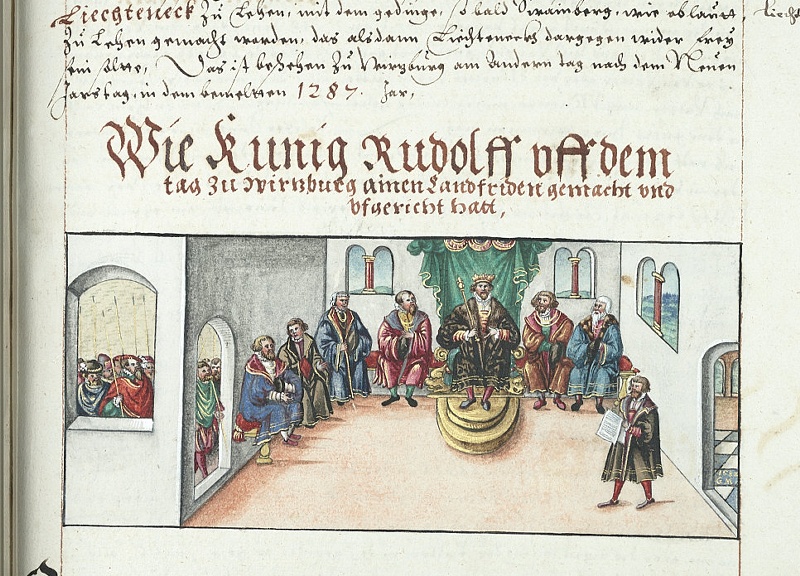
It is March 17th, 98 AD. We are in the Free and Imperial City of Goslar to witness the Hoftag—court day—of the Holy Roman Empire. All the princes who did not march with William of Holland are here, and even some of those who are with William have sent representatives. There are so many things to discuss. What has happened? Who is still here and who is not? What should be done next? What should be done with all the orphan territories? Is the emperor really gone, and who should replace him? All these things and more are brought up, discussed for endless hours, and shelved for the night so the princes can sleep.
We shall not bore ourselves with the details. Suffice to say that everyone became convinced of what happened; all of the lands west of the Rhine and south of the Danube are gone and have been replaced by a heathen people. Not everyone is yet convinced that those heathens are, in fact, the ancient Romans, nor can they agree on whether the heathens have come to join them in the Year of the Lord 1250, or if the people of 1250 have gone to some other time.
Follow me on Bluesky for updates (with teasers!):
Or subscribe to my newsletter to get updates via email:
As for the orphan territories, they are divvied up via common consensus of all the princes or by smaller committees. King Wenceslaus I of Bohemia’s seizure of Weisenland (formerly northern Austria) is accepted as a fait accompli, but the other territories spark heated debates that last weeks. In the end, many such debates will be settled in the most feudal way possible; with knights and men-at-arms on the field of battle.
Once everyone has accepted that the Act of God is real, it is easy enough to agree that an imperial election is necessary, but the next step is more controversial. Traditionally, seven electors put forward their candidates and cast their votes. Up until the Act of God, those seven electors were the archbishops of Mainz, Cologne, and Trier, the king of Bohemia, the dukes of Saxony and Swabia, and the pfalzgrave of the Palatinate. Of these seven men, five are gone and only two remain, those being the king of Bohemia and the duke of Saxony. As for the rest, four disappeared as of the Act of God: Trier, Cologne, and Mainz are, presumably, still in 1250 AD and are wondering what happened to the rest of the Holy Roman Empire and where all these Germanic tribesmen came from. The Duchy of Swabia traditionally held an electorate as well, but it was already functionally defunct by 1250. Meanwhile, there is a special case in the Palatinate in that, while the physical territory of the Palatinate is extant after the Act of God, its prince is not, because he was duke of Bavaria before he was pfalzfgrave of the Palatinate, and he lived in his homeland south of the Danube.
All this leaves the Holy Roman Empire with only two electors. Two men cannot elect an emperor alone, but to whom shall the five vacant electorates fall?
The third secular electorate is granted easily enough to the margrave of Brandenburg, who is the most powerful prince after King Wenceslaus and was probably going to replace the duke of Swabia soon anyway. After that comes the fourth secular electorate, which is hotly contested between the margrave of Lusatia, the margrave of Thuringia, and the duke of Brunswick-Lüneburg. The duke of Brunswick-Lüneburg wins the contest thanks to support from the margrave of Brandenburg—who does not wish to see his rival in Lusatia win the electorate—and from Saxony and Bohemia.
Then there are the three ecclesiastical electors. But that is… problematic. The Church is currently in complete disarray. Without the pope, there is no overall leadership to pull the bishops together. Most archbishops are gone as well. Furthermore, the Church in Germany and Bohemia has not established communications with Church leaders elsewhere yet, and they don’t know how many other places there even are. They know Denmark is still there, as are Pomerelia and Poland, the Teutonic Knights, and the parts of Hungary on the northside of the Danube. An ecumenical council will have to be called for the Church to put its business in order, including the election of a new pope.
For now, the hoftag selects the archbishop of Bremen and the bishops of Magdeburg and Fulda as ecclesiastical electors on the understanding that this is subject to change in the future.
Around this time, news of the Battle of Linter reaches the Hoftag. This is good news, since it means that the election can happen straight away. By tradition, the election takes place in the city of Frankfurt, which until recently was in immediate danger of being besieged by Trajan Augustus. With Trajan out of the picture for now, the electors can meet there without fear of attack. And so it proceeds; the Hoftag is concluded toward the end of April and the seven electors travel to Frankfurt.
Several candidates are put forward, including the possibility of simply confirming William of Holland as emperor. However, many voices are still critical of William. In spite of his victory and in spite of the Act of God, the internal politics and pre-existing rivalries of the Holy Roman Empire have not changed. Instead, one man rises from the rest and builds a strong case for his candidate, a case whose merit none can deny. That man is King Wenceslaus and his candidate is himself. Wenceslaus is easily the most powerful single prince in the entire Empire. What the Empire needs right now, he argues, is a strong hand on the tiller to guide her into safe harbour. Wenceslaus wins the election with five votes; his own, of course, was never in doubt, but neither was the vote from Saxony; the Saxon duke had already agreed to vote for Wenceslaus before ever going to Goslar. At Goslar, Wenceslaus gained another vote in the form of the duke of Brunswick-Lüneburg, who promised his vote to the king of Bohemia in exchange for the latter’s aid in getting the duke elector status. By the time Wenceslaus reaches Frankfurt, he needs to sway only one more elector, and he sways two; the bishops of Magdeburg and Fulda. Brandenburg votes for himself—a protest vote, since he sees Bohemia as a rival. Bremen abstains; though the archbishop voices some mild support of William of Holland, he is not so brazen as to come out and vote for William in this assembly, where William has few to no other supporters.
And so it is that King Wenceslaus I of Bohemia becomes King of the Romans and Germans. However, he is only emperor-elect. To take on the full title without the qualifier, he must be crowned as such, and that would require a pope to crown him in the name of God. No pope exists, of course, so Wenceslaus will have to wait for the Church to conclude its own reorganisation, and there’s no telling how long that could take.
Still, even without being crowned, holding the title of emperor-elect confers a great deal of prestige and influence upon Wenceslaus, who uses it to pursue his ambitions within the Empire. Some of the orphan territories are still up for grabs, since the Hoftag was unable to come to a conclusion about many of them. Matters within the Empire will have to be resolved quickly, however, because from beyond the frontiers the spectre of the Heathen Roman Empire looms large.
[Next]

 Lord of Lore
Leave a comment