
The Roman Empire—But also Medieval Europe
It is January 98 AD; yes indeed, we have gone back in time so that we may examine events in the Kingdom of Hungary starting from the immediate aftermath of the Act of God.
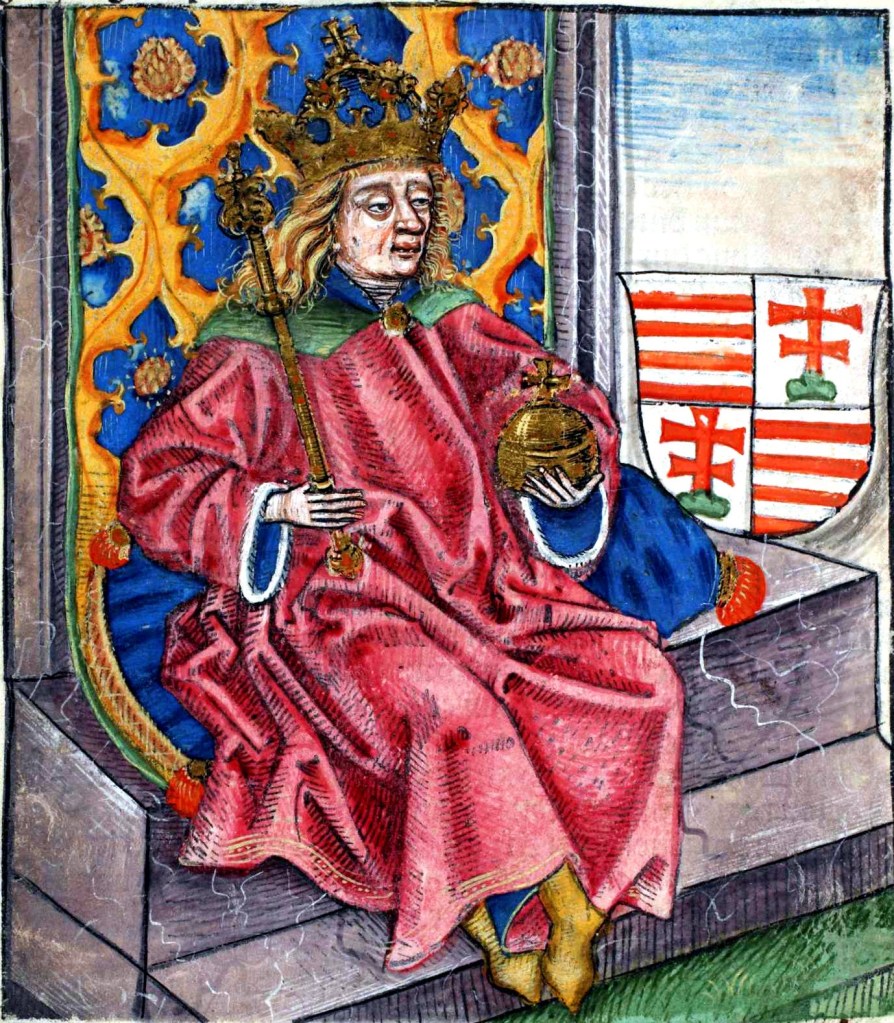
Hungary has a threefold problem: firstly, the capital city of Esztergom was on the south side of the Danube River, and so it does not exist yet; secondly, King Béla IV of Hungary had been in his capital preparing for the invasion of Austria planned for that summer, and so he also is not here; thirdly, both of his sons are gone as well. Hungary is a truncated kingdom. Half of it has not come along with the Act of God, leaving the half that did come in complete anarchy. With no king and no heir to take control of the situation, the nobles immediately start bickering among themselves and quickly turn to feuding. Knights and men-at-arms march hither and thither to take control of Hungary’s orphan territories and to fight their prince’s rival. To make matters worse, the Heathen Romans launch a number of cross-border expeditions that clash with local nobles. The only good news is that with Trajan Augustus busy on the Rhine frontier, there is no emperor to lead a major invasion of Hungary, so the violence is limited to a series of skirmishes.
Follow me on Bluesky for updates (with teasers!):
Or subscribe to my newsletter to get updates via email:
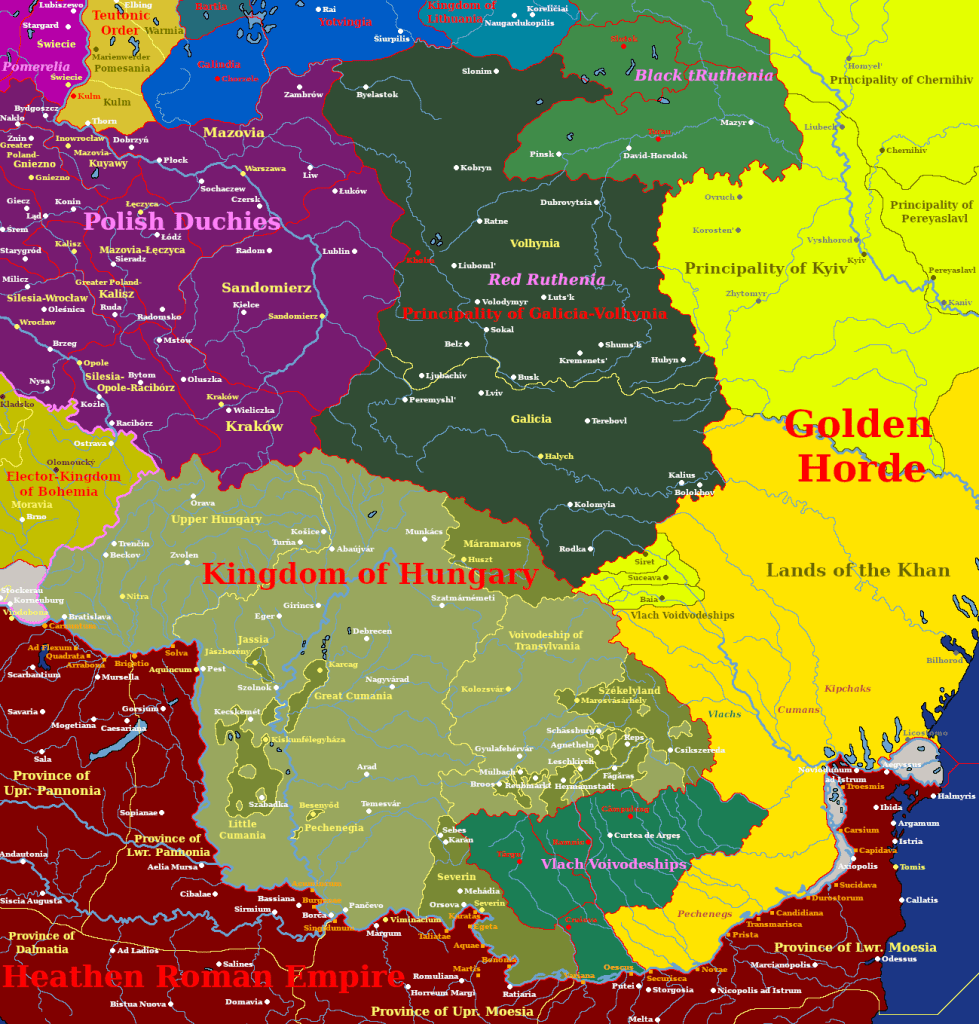
Chaos reigns in Hungary for months. And with chaos comes opportunity. For you see, just beyond the Carpathian mountain range in the Principality of Galicia-Volhynia lives a woman named Constance, who is newly married to a man named Leo. Leo is the son and heir of Daniel I, Prince of Volhynia, and his wife Constance is daughter of King Béla IV. Galicia-Volhynia is entirely north of the Danube, so she has not lost any territory to the Act of God and has, in fact, not been directly touched by it. It took time for Prince Daniel to first hear about what has happened, second to believe it, and third to fully comprehend its implications. Once this process has run its course, Daniel realises that a golden opportunity has been cast into his lap by the hand of God Himself.
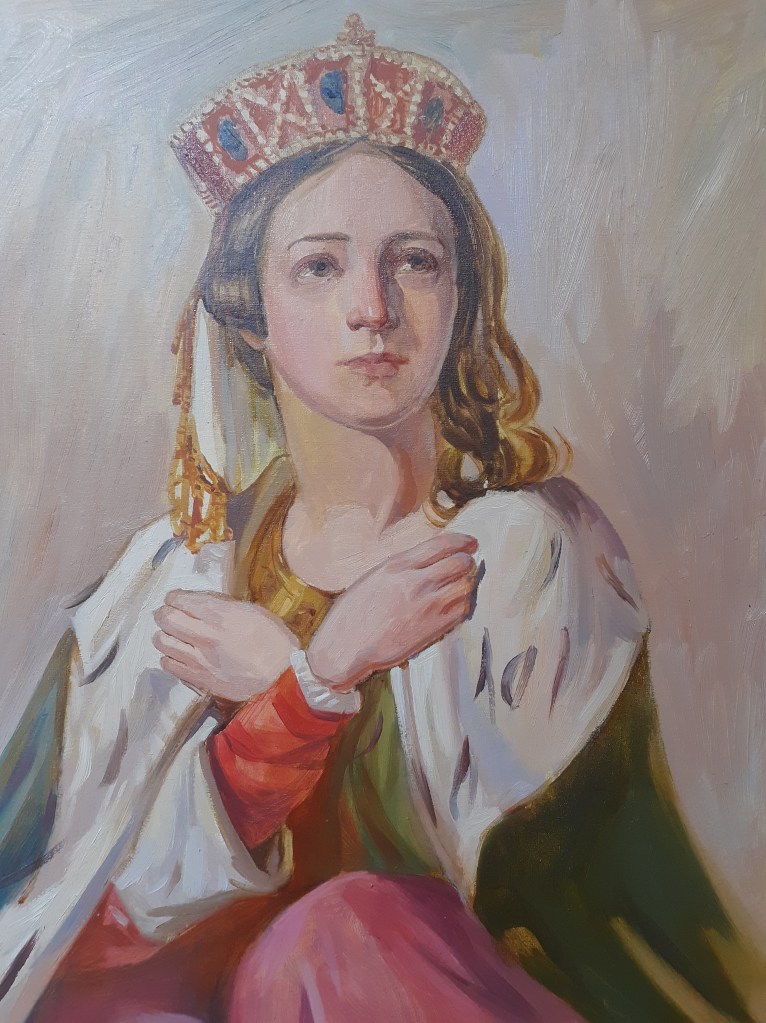
At Daniel’s behest, Leo and Constance march with an army of 4,000 men over the Carpathian Mountains in April and descend into Hungary, where Leo announces his intention to take the throne in the name of Constance, the heir of King Béla. They face some scattered resistance, but most nobles allow them to pass by as they make their way to Debrecen. Leo and Constance occupy the city and send out messages to all the nobles and notables in what’s left of the Kingdom of Hungary to come and swear fealty to the two of them.
Many nobles answer the summons and proclaim Leo and Constance king and queen easily enough. After months of the chaos in the kingdom, they are glad someone has come to take control of the situation, restore order, and establish a defensive perimeter against Heathen Roman raids. Most of central Hungary supports Leo and Constance, but there is an issue stuck in the craw of some local notables, namely the fact that Prince Daniel is a client of the Golden Horde. This is an issue for the chiefs of the Cumans and Kipchaks, Pechenegs, and Jassians settled along the Tisza River in central Hungary—all of whom are often grouped together as Cumans, who are most numerous among them. All of these peoples are former steppe nomads who settled in Hungary over the past few decades after being expelled from the steppe proper by the Mongols, and so they quite understandably maintain a blazing flame of hatred for the Mongols within their hearts.
Leo counters that, while his father may be a Mongol client, Leo himself is not, and furthermore, even if he was he would still protect the Cumans from the Mongols and anyone else who would threaten them. Reluctantly, the former nomads accept Leo and Constance as king and queen, but mostly only due to the fact that all the Hungarian nobles in their part of the kingdom have already done so and they cannot risk isolating themselves.
Leo and Constance now enjoy the support of nearly all the nobles and Cuman chiefs in central Hungary, but there are still many on the periphery who reject them. There are several nobles powerful enough that they are not afraid of any army Galicia-Volhynia can send at them and ambitious enough to reject a foreign king with a flimsy claim to the throne. One such noble is Voivode Lawrence I Kán of Transylvania, who had been appointed by King Béla to govern Transylvania on his behalf. Lawrence summons the nobles of Transylvania to Kolozsvár. Also invited are the nobles of the border province of Székelyland and the rulers of the German colonies in the region. Stephen Csák, Ban of the border province of Severin, was invited, but he declines to come. In Kolozsvár, Lawrence is proclaimed King of Hungary by the Transylvanians, Székelys, and Germans.
Meanwhile, in the northwest, there are eight counties usually called Upper Hungary, but sometimes called the Slavic Counties because the majority of the local population are Slavs. In time, they will come to call themselves Slovaks, but for now they simply call themselves Slavs or Slovini, while the Germans call them Wends and the Hungarians call them Totok. Nobles in this area, bordering both Bohemia and Poland, would prefer to take this opportunity to have a more distant king. After all, if the king is going to be a foreigner, why not have one who still lives in a foreign land and thus is unable to curb the power of the local nobles? To this end, the Slavs invite Bolesław V the Chaste, Duke of Sandomierz and Kraków and High Duke of Poland to be their king. Their rationale is that Bolesław is also married to a daughter of King Béla, namely Kinga. Bolesław and Kinga are too pious to partake of the actions necessary to produce an heir, so they have no children, but Kinga’s younger sister Yolanda is also living with them in Kraków, and it is with her that the Hungarian Slavs have placed their hopes and dreams. Notably, both Kinga and Yolanda are older than Constance, giving them each a stronger claim to the throne.
However, Bolesław does not wish to risk war with Daniel and Leo, so he makes a show of turning down the invitation and instead sends a letter to Leo and Constance congratulating them on their recent accession to the Hungarian throne. Leo, noting that Bolesław still has two stronger claimants to the throne, asks the High Duke to send Yolanda back to Hungary as a show of good will. Bolesław does so, and Yolanda takes up residence in Debrecen with Leo and Constance, where she is persuaded to take a vow of chastity and join a convent.
Unsatisfied with this outcome, the Slavic nobles turn to King Wenceslaus of Bohemia, but he declines to get involved in Hungary since he already has his hands full in the Holy Roman Empire and, furthermore, he has no claim at all to intervene. Finally, reluctantly, the Slavic nobles accept Leo and Constance as their king and queen.
That leaves Lawrence of Transylvania as the sole rival to the throne of Hungary. Leo leads his Galicia-Volhynian army, reinforced by 1,500 Hungarians (including Cuman horse-archers), against Lawrence. Lawrence marches out with his own army and clashes with Leo on the banks the Sebes-Körös River. Leo’s heavy cavalry and his Cumans drive the Transylvanian cavalry from the field, but then they get distracted looting Lawrence’s camp. Lawrence’s infantry, meanwhile, continue fighting and defeat Leo’s infantry before continuing on to loot Leo’s camp. Constance, who was also present at the battle, barely escapes with the retreating infantry. In the end, both sides suffer heavy losses, both camps and are looted, and no decisive result is achieved.
And so it would go for the next several years. Leo’s limited popularity would enable him to hold onto the throne—just barely, and only with his father’s help. Lawrence would be able to instigate revolts against Leo’s rule but his own lack of legitimacy made it hard for him to gain any headway outside of Transylvania. But those tales are long and tedious, and we have other places to be.
[Next]

 Lord of Lore
Leave a comment