The Roman Empire—But Also Medieval Europe
It is the middle of May, 101 AD. Over the winter, Trajan has recruited replacements for the casualties of the previous campaign season in addition to forming two new legions and over a dozen new auxiliary cohorts. Not all of these troops will be going to the Rhine frontier—many are needed to reinforce the Danube, after all, and shore it up against another Mongol attack—but Trajan nevertheless is able to collect an army of 40,000 men on his march from Rome to Augusta Treverorum.
However, due to spending time training and organising the new recruits, Trajan has arrived in the theatre a bit late. William of Holland has already crossed the river and is ravaging his way through the countryside of Germania Inferior along the Meuse River on his way toward the Heathen towns of Aquae Granni and Tongrorum. However, William has very little idea of where he’s actually going, since he has no maps of Roman territory, and is therefore playing it by ear. At Aquae Granni, William finds a tiny settlement that doesn’t quite reach the level of a town centred on the hot springs there. He doesn’t even recognise it as the site of the later Medieval city of Aachen, traditional location of Holy Roman coronations. Heading west, William sacks the town of Tongrorum and heads south in the general direction of Augusta Treverorum.
Follow me on Bluesky for updates (with teasers!):
Or subscribe to my newsletter to get updates via email:
By the time Trajan reaches Augusta Treverorum, the city has been swelled by an influx of refugees fleeing William’s army. They have filled the inns and homes of relatives and spill out onto the streets, where they’ve erected makeshift shelters for themselves, if they can, or lie under eavestroughs, under carts, or under anything they can find to keep them modestly dry when it rains. Deducing that William of Holland must be close by, Trajan marches out of the city and scours the local area in search of him. What Trajan finds, however, is only more refugees. None of them know where William is, but they all have strong opinions on the subject.
In point of fact, William has turned eastward. Without any clear idea of where he’s going, he has decided to head back to the Rhine, where he engages a contingent of his men in building a series of castles along the left bank of the river. These castles are very small and basic, consisting of little more than a tower ringed by a palisade and a ditch, but William hopes they’ll provide a springboard from which to launch future invasions of Heathen territory. Meanwhile, William takes the bulk of his army on a campaign to systematically evict Heathen garrisons from their remaining forts from the Rhine’s mouth all the way up to Agripinna.
Trajan finally hears word of this and marches his army east to meet William. All of this takes another two months, so we are now in July. William’s scouts warn him of Trajan’s coming, so he recollects all of his troops and prepares to meet him. However, William’s 34,000 men are moderately outnumbered by Trajan’s 40,000, and with the fortunes of war being uncertain, William is in no hurry to join battle. Instead, a complicated dance ensues between the two armies. First, Trajan finds a hill to his liking, with plenty of forest cover to restrict the movement of William’s knights. Here, he draws up his army in battle formation in full view of William’s camp nearby. William refuses this offer and makes a counter-offer, drawing his army up in a flat location near the Rhine with plenty of room for knights to manoeuvre. Trajan considers this, but turns it down and picks another place slightly less advantageous to himself. Round and round it goes, with each general picking a place suitable for his own purpose, but not overwhelmingly so, where he hopes his opposite number will come and fight him.
After a week of marching in circles around each other, supplies of food in the local area have been almost completely used up. William, however, is comfortable with this eventuality. Thanks to his earlier efforts at clearing Heathens from the left bank of the Rhine, William can have have his supporters bring food to his army via river boats. If Trajan were to attempt the same thing, his supply ships would have to run a gauntlet of Holy Roman castles and cities on the right bank who might seek to steal his supplies. Battle will have to be joined soon, or Trajan will have to abandon the area in search of supplies, which William is confident will force him to accept battle on William’s terms.
Just as William is congratulating himself on a campaign well-executed and dreaming of the glorious victory to come, news arrives that jolts him like a lightning bolt: Wenceslaus I, William’s rival as emperor-elect, has decided that he doesn’t need a pope to crown him and is on his way to Frankfurt to be crowned by the archbishop of Magdeburg. For all his bluster against Christians killing each other, William knows that the most dangerous man to his current position is Wenceslaus. With the prestige and legitimacy conferred by a coronation, even if performed by an inferior prelate like an archbishop, Wenceslaus will be able to strip supporters from William, who may then be crushed or forced to concede the emperorship to his rival, putting an end to William’s own ambitions. Frankfurt is not far away; if William can finish his business with Trajan, he can march on the city and prevent the coronation—or, failing that, kill or capture Wenceslaus before he can rally his supporters.
To that end, it is now William with the time pressure to rush into battle against Trajan.
The day after William receives the news, Trajan draws his army up in the vicinity of a small town of no note named Cow Market. Home to a large, Germanic-speaking, rural community, the area has been clear-cut for farming, making for wide open spaces with no trees, but waist-high stone walls criss-cross the area demarcating the boundaries between fields belonging to different villages in the vicinity. William accepts the location, drawing up his own army so that the two face each other down over the wheat fields by the time the sun has climbed to his noonday height.
William of Holland has drawn up his army in three lines: crossbowmen and light cavalry stand in front, knights in the middle, and infantry bring up the rear. This enables his crossbowmen to skirmish with the enemy, while the knights have the freedom of movement to assist the skirmishers if necessary or to make assaults upon the enemy lines. Infantry, sometimes more of an afterthought in the 13th century than an integral part of the army, can secure lanes of retreat or march to support the knights as the situation demands.
Trajan Augustus, meanwhile, draws up his army according to standard Roman doctrine: heavy infantry, making up most of the army, form the body of the formation divided into their classical three lines, while a small number of archers stand in front and cavalry cover the wings. Also in front of the army are the ballistas attached to each legion. In comparison to large siege ballistas, these engines are rather demure, being relatively small weapons intended for anti-infantry use in field battles. In addition, Trajan has deployed perpendicular to a series of dirt roads between fields, with waist-high stone walls blocking access to the fields, which will force William’s knights onto the roads between fields—narrow funnels that Trajan’s men have littered with caltrops. He has also placed sharp wooden stakes in front of his heavy infantry as further cavalry deterrence.
The battle opens with Trajan’s ballistas loosing bolts upon William’s crossbowmen, who rush forward and start shooting at the Heathen archers. Crossbows of the 13th century are a brutal weapon, honed by two centuries of feudal warfare into a powerful anti-armour weapon capable of penetrating chainmail and even shields at close ranges. Although it lacks the rate of fire of a bow, it does have superior range, which forces Trajan’s archers to advance in order to return fire. In the ensuing missile duel, the Heathen archers suffer heavy losses to the crossbow’s sheer power and to the superior number of crossbowmen, who outnumber the archers nearly two to one. Both sides take cover and continue trading missiles.
Meanwhile, William’s light cavalry—who are also equipped with crossbows—move to take a hamlet on Trajan’s left flank. The hamlet is occupied by Trajan’s men, but they’re chased off and the Williamite light cavalrymen take positions in the houses and start shooting at the Heathen flank. Irritated, Trajan sends his own cavalry into the hamlet, driving off the Williamites.
Hours pass while the missile duel continues and the cavalry keep skirmishing over the hamlet, without either side gaining a clear advantage over the other. Although William’s knights are eager to attack, he is waiting for an opportunity to present itself. Trajan, meanwhile, is bored with this display and wishes very much that the knights would charge into his caltrop lanes. In order encourage them to do this, he orders his ballistas to cease firing at the Williamite crossbowmen and fire on the knights instead. This works; the German and Dutch knights, unwilling to sit still while the enemy pelts them with bolts from afar, spur their mounts into action. Without orders from William, they surge forward directly into Trajan’s caltrop funnels. This doesn’t stop them completely—such a thunderous charge of horses and men has a great deal of momentum that would take nothing short of a castle wall to stop entirely, not to mention the fact that these horses have shoes which make them less sensitive to caltrops than the Heathens had been hoping. Nevertheless, the caltrops do their job of hobbling many horses and, in some instances, causing horses to throw their riders. More than a few knights end up abandoning their horses and continuing the charge on foot. By hoof or by foot, however, the knightly charge finds the Heathen lines ready to receive them. While the knights struggle through the caltrops and anti-cavalry spikes, the Heathens hurl one pilum and then the second at them, damaging armour and shields and even injuring or killing some.
Even so, the knights keep coming and finally engage the Romans sword-to-sword. In the clash of shields, the knights thrust over their enemies’ shields to strike them in the face, or they go for the bare forearms and forelegs. Heathens strike back, of course, but the Holy Roman knights are wrapped arm and leg in mail, and the Heathens are unfamiliar with the locations of weak points. An exhausting melee drags on for some time, with knights dashing forward to make aggressive strikes on their adversaries, trusting their own heavy armour to protect them, before dashing backward several steps out of striking distance.
William of Holland himself has had to join in the fray. Although he did not command the charge, he could not put a stop to it once it began, and so was just as much swept up in it as every other man who joined it. Now, he tests the Heathen lines with his retinue around him. Wearing ostentatious armour and with a man at his side proudly flying his banner, William seeks to make such a display of bravery as to compel those around him to greater deeds, and so cut his way through the hordes of hell.
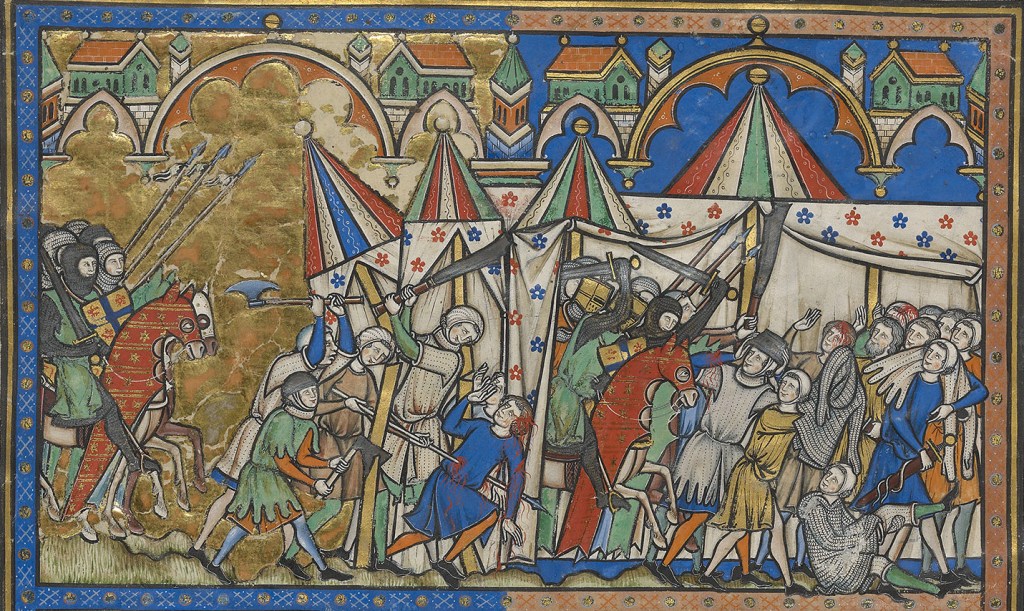
Meanwhile, the Williamite infantry are still standing at a distance watching events unfold. Having received no orders to advance, they hold position and wonder whether they should be doing something. The crossbowmen, on the other hand, watch as the Heathen archers and ballista operators retreat behind their heavy infantry. With no one to stop them, they take the opportunity to get a little closer and pour missiles directly into the lines of heavy infantry. Funnelled through the caltrop lanes, the knightly charge was uneven and even now does not cover the whole frontage of the Roman lines, leaving plenty of gaps for the crossbowmen to fire into without worry of hitting their own lieges in the backs. Having used up their pila on the knights, the Heathens have no means of striking back at the crossbowmen, and even the vaunted Roman scutum and chainmail are imperfect protections against the powerful crossbow at this close range. To make matters worse, the Williamite light cavalry have taken the hamlet again and are shooting at the Heathens’ left flank.
By now, it’s getting late in the day. Both sides are exhausted from the melee, and losses are mounting. Trajan has his front line fall back and has his second line fight for a time before falling back to his third line. Finally, he begins slowly withdrawing. Seeing the enemy backing off, the the knights of Germany and Holland, exhausted, decide to lay off a bit and go round up their horses, who by now are scattered across the wheat fields of Cow Market. Two thousand Heathens lay dead and dying on the field, while only some fifty knights and a few hundred crossbowmen and light cavalry share the same fate. The greater cost for the Williamites is in horses, several hundred of whom have been killed or maimed beyond use as warhorses to the financial ruin of their owners, who will have to fight on foot until they can procure replacements. Trajan, too, has suffered a substantial material loss, as his ballista crews had to abandon their engines to the enemy, who has carted them away to their camp now that this day’s fighting is over.
The next morning, Trajan draws his army up again not far from the site of the previous day’s fighting, and William also prepares for another day’s fighting. Before joining battle, however, William decides to see if this might be resolved some other way. He gathers a small retinue of followers, including Bishop Henry of Utrecht, and goes into the middle of the field between the two armies under a white flag. Trajan reciprocates, going out to meet William with a clutch of his own officers, including Hadrian.
After fighting three battles against each other, William of Holland and Trajan Augustus finally meet face to face for the first time. Each man sizes the other up. Trajan notes that William looks like he’s trained as a warrior since childhood (as, indeed, any knight has), but also notes the uncouth mannerisms that betray these men as barbarians, whatever their martial qualifications. William sees that Trajan plays the part of emperor well with his regal bearing, but also believes this Heathen thinks too highly of himself and wishes he could humble Trajan before God.
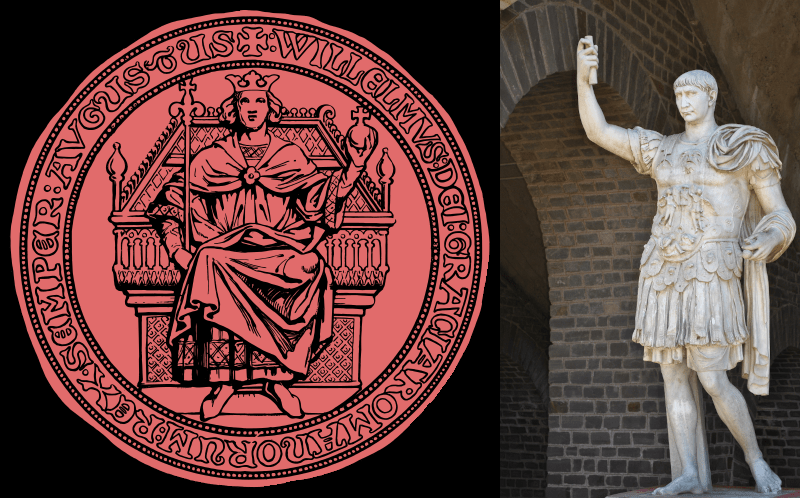
As they speak, the conversation turns to the battle that lies ahead. William suggests that perhaps further bloodshed might be avoided if they were to simply go their separate ways and avoid further confrontation. Trajan senses weakness in the offer, but he is not opposed to it. After all, he’s been fighting for several years now, has nothing to show for it, and isn’t even sure what he’s actually fighting for. Thus, the two men make a verbal agreement to a truce, with promises of signing some kind of treaty in the near future. Trajan swears to cease persecution of Christians in his realm while William swears to reign in the princes on his side of the Rhine.
With this agreement made, William appoints some of his retinue to stay with Trajan and hash out a treaty. Bishop Henry is appointed to lead the negotiating party. As soon as his affairs are in order, William announces he is taking his army to Frankfurt to stop the false emperor-elect, Wenceslaus I, from usurping William’s rightful place as King of the Romans.
Trajan, meanwhile, initially intends to take some much-needed time rebuilding the defences of the Rhine, but soon hears word that a Mongol army has crossed the Danube into Lower Moesia.
[Next]

 Lord of Lore
Leave a comment