The Roman Empire—But Also Medieval Europe
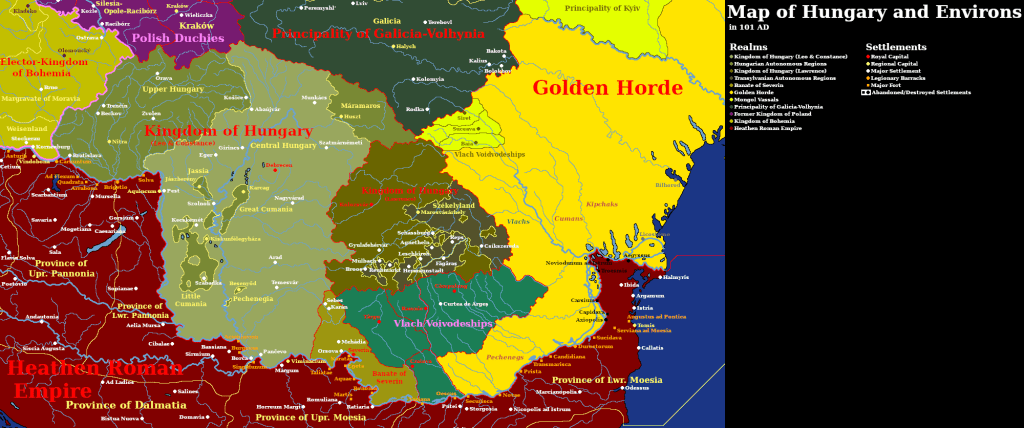
It is August, 101 AD. Central Hungary is the only part of the Kingdom of Hungary truly under the control of King Leo. He rules only through the modicum of legitimacy he can garner by virtue of being married to Constance, daughter of King Béla IV, the true king of Hungary who was snatched away by the Act of God. Upper Hungary, sometimes also called the Slavic Counties because the majority of the population are Slavs, is largely independent of Leo’s control, although they do pay lip service to him as king. Up until very recently, Transylvania was in civil war with Leo over the crown, but now that Lawrence’s skull is sitting among Batu Khan’s dinnerware, that’s one headache Leo doesn’t need to worry about anymore. On the other hand, a far worse migraine has taken its place; for the second time, the Mongols are in Hungary.
For the past two months and change, King Leo has been attempting to bring the Mongol leader Nogai to battle. This is easier said than done, however, since Nogai’s army is made up entirely of cavalry who are riding light on supplies, which enables them to stay out of Leo’s reach, though not without effort. Leo follows Nogai closely, with his Cuman horse-archers and Hungarian knights often able to destroy foraging parties and stragglers and even catch up to and skirmish with the rear guard of Nogai’s main force.
Follow me on Bluesky for updates (with teasers!):
Or subscribe to my newsletter to get updates via email:
Toward the middle of August, however, two pieces of news drastically change things. First, the good news is that Prince Daniel, King Leo’s father, has crossed the Carpathian Mountains with an army in order to keep his son on the throne of Hungary. Second, the bad news is that another 10,000-man army has entered Central Hungary from the south under the command of Berke.
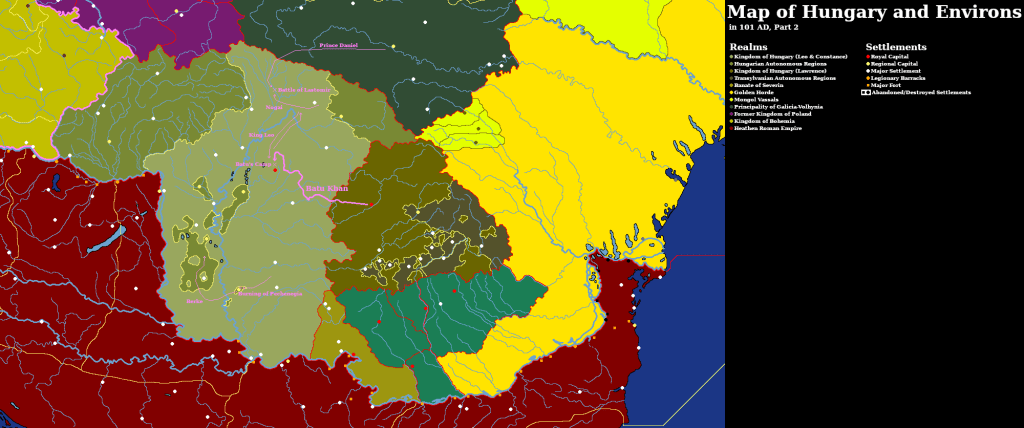
For Nogai, however, the news of Daniel’s arrival is quite bad. Dodging two armies on his tail will be significantly more difficult than dodging one. Allowing the two armies to unite, however, would be the greatest disaster. Nogai, therefore, decides upon a bold course of action. Force-marching his men from dawn til dusk, he slips out of Leo’s grasp just as the latter was getting too close for comfort near the city of Szatmárnémeti; he then swiftly marches northwestward to where Daniel’s army is descending from the Carpathian Mountains into the Pannonian Plain. There, near a small village called Lastomir, Daniel chooses to make a stand.
Now, Daniel’s army relies on three different contingents. First, there are the nobles and sons of nobles who make up the heavy cavalry, equipped in the style of western European knights (though with typical Rus’ characteristics, such as a prevalence of scale armour and viking-style helmets). Then there are the light cavalry, made up of nobles’ sons and members of the gentry, who wield bows and are trained to fight in the Mongol style. Third are the heavy infantry, recruited from the peasantry and equipped with mail and scale armour paid for out of Daniel’s own pocket. A fourth contingent, that of the select levy of men with only textile armour, spears, and cheap shields, will not be present in this battle because, in his haste to mobilise an army, Daniel did not take the time to call the levy from their farms. Daniel has only 4,400 men against Nogai’s 10,000, and though he is bolstered by a contingent of Cuman cavalry operating far in advance of Leo’s main army, all of Daniel’s men feel mounting dread at the prospect of the coming battle.
Daniel forms up north of the village of Lastomir. Fortunately, the Cumans inform him of Nogai’s impending arrival in time for Daniel to dig ditches in front of his army, constricting freedom of movement for approaching cavalry. Two ditches are dug, one covering each flank of the infantry. At the far right end of the ditches, Daniel deploys his cavalry, while the left end is anchored on Laborec Stream, preventing an approach from that direction. There are, therefore, two ways for Nogai’s men to aproach the army; from the right wing, covered by Daniel’s light cavalry, or straight down the centre into the teeth of the heavy infantry. Heavy cavalry, meanwhile, stand in reserve in the rear.
Nogai approaches from the south, with Laborec Stream to his right. His horse-archers are strung out in front of his army in loose order while his heavy cavalry brings up the rear. In the centre, Mongol horse archers charge the infantry again and again, arrows pouring forth from their bows like deadly rain in a cloudburst that will not end. As the riders come close, they loom over the infantry, who wonder when they’ll stop—or if they’ll stop—and just when it seems man and horse will plough through the infantry like a bull trampling dogs, the riders turn their backs to the enemy, twist in their saddles, and let loose with another storm of arrows no less intense and no less accurate than the first. And even as they withdraw, more of their comrades charge. Once a Mongol has withdrawn, he cues up at the back of the line so that a never-ending stream of horses keep charging the Galicia-Volhynian infantry, never wavering, and never letting up. Every man receives arrows to his shield, to his head, shoulders, and perhaps even to his face. They tear holes in his shield, damage his armour, and a few inflict wounds on the men themselves. Most importantly of all, however, is the psychological strain of cavalry charging and withdrawing and the constant pelting of arrows. It’s unnerving, frightening, disturbing.
On the Galicia-Volhynian right flank, Daniel’s cavalry likewise face charging and withdrawing Mongols. Here, a complicated dance ensues as the horse-archers endeavour to stay ever-moving, ever the elusive target to evade enemy arrows while returning those arrows in kind. But they are outnumbered and outmatched. Slowly, the Galicia-Volhynian cavalry are whittled away by repeated Mongol charges. Things start to unravel when the Cumans decide this battle is no longer worth fighting. Wheeling around, they withdraw northward, past the heavy cavalry, and off the field of battle. Abandoned by their allies, the hearts of Daniel’s men begin to melt, their bravery flayed by others’ cowardice.
Nogai, realising what’s happening, sends in his heavy cavalry on both fronts. Daniel’s horse-archers move out of the way and he personally leads his own heavy cavalry to counter the Mongols. The first Mongol charge fails to break the Galicia-Volhynians, but when they withdraw and charge again, the heavy infantry are no longer able to take it. Losing the will to fight, the heavy infantrymen scatter away from the incoming Mongol charge before it even connects with them. Mongol lancers strike fleeing infantry in the back as every man seeks to save his own life. Daniel’s horse-archers finally break and run and, seeing this, Daniel himself sounds a general retreat.
Many of his prized heavy infantry are cut down in the pursuit, but most of his cavalry are able to escape. Ultimately, some 650 of Daniel’s men are killed or captured. Fleeing northward, Daniel crosses back over the mountains into his own lands, where he initiates the muster of the general levy. If the Mongols wish to continue this war, they’ll soon find Daniel a far more formidable foe.
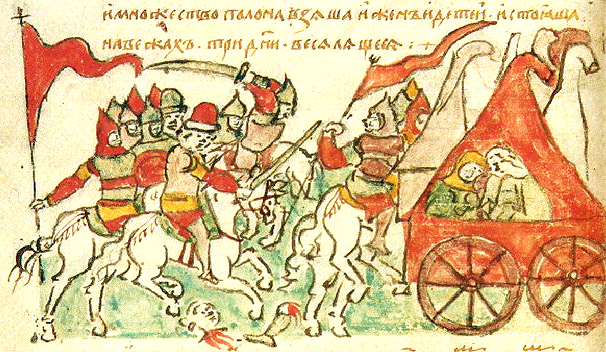
Meanwhile, Leo is struggling to catch up to Nogai with his main army. Once again, Leo’s vanguard made up of Cuman horse-archers and Hungarian knights skirmish with Nogai’s rear guard. Nogai, however, has just received new orders in the aftermath of the Battle of Listomir. Nogai is to march northward into Galicia-Volhynia to harry Prince Daniel and keep him from intervening further in the war.
Escaping Leo’s grasp once more, Nogai moves north; at the same time, King Leo receives news that forces him to turn his army around. Batu Khan of the Golden Horde, grandson of the greatest conqueror the steppes have ever produced, has just entered Central Hungary and is on his way toward Debrecen.
The rest of August and the first week of September go by in a blur. Batu razes the countryside in the heart of Hungary while Berke does the same in the south. King Leo’s agents round up all the fighting men they can muster and bring them to Debrecen while Leo himself shadows Batu with his field army and does as much to hamper the khan’s efforts as he can. Meanwhile, Leo sends Queen Constance and their son Yuri, along with the queen’s sister Yolanda, away to Nitra in Upper Hungary. Nitra is a place not fully within Leo’s grasp. The nobles of Upper Hungary are not overly enthusiastic about Leo ruling over them; though they have not openly defied him as of yet, they also don’t feel the need to follow his commands with alacrity. Nevertheless, Nitra is a far safer place for the king’s family to be than Debrecen.
We pick up in the second week of September, 101 AD. Constance does not rest on her laurels while taking refuge in the highland city of Nitra. She embarks upon a letter-writing campaign, sending messages to Bolesław V the Chaste, High Duke of Poland, and to his wife Kinga, who is Constance and Yolanda’s sister, begging them for aid. Not satisfied to stop there, Constance writes to all the dukes of Poland, and as well as the grandmaster of the Teutonic Knights, and to the masters of chapters of various knightly orders located in Hungary, Poland, and Bohemia. Furthermore, she writes to many of the princes of the Holy Roman Empire, both secular and ecclesiastical, and to bishops and archbishops all across Catholic Europe. To all of them, she writes a similar plea; the Mongols knock on the gates of Christian Europe again. All the princes of Europe must stand united against them, lest all be trampled under hoof, crushed beneath the weight of the endless Mongol hordes.
Many sympathetic ears hear her pleas, but most of them have more pressing concerns closer to home. Holy Roman princes are consumed by their own local rivalries and by the Heathen Roman Empire breathing down their necks while the Teutonic Knights are busy crusading every year against the Baltic pagans—a matter to which we shall turn our full attention in the future, I promise you. Only in Kraków, seat of Bolesław the Chaste, and in Prague, capital of the newly-crowned King Ottokar of Bohemia, are Constance’s letter received with anything more than sympathetic disinterest.
Bolesław the Chaste feels compelled to pledge support for both social and pragmatic reasons. Firstly, Constance is his sister-in-law, and refusing to help her would be seen as a dereliction of his familial duties, making him appear weak to his rivals and unreliable to his allies. Secondly, the last Mongol invasion was only twelve years earlier and Bolesław himself had to flee and hide from their wrath after being defeated in the field, an experience he well remembers. If he must fight Mongols again, he’d far rather do it in Hungary and hopefully spare Poland another invasion by doing so.
But Bolesław’s pledged support will take too long to materialise, so we are more concerned with something else the may have far greater consequences. King Ottokar II of Bohemia, as a central figure in the Holy Roman Empire (indeed, he is soon to be elected emperor in his late father’s place), is distracted by the aforementioned internal politics and the presence of the Heathen Empire across the Danube, but he’s well aware of the threat the Mongols pose and doesn’t want them to strike him in the back while he’s distracted with other matters. Though he was only a child when it happened, he too remembers the last time the Mongols invaded Central Europe, and how his father’s vigorous defence of Bohemia prevented the Mongols from doing anything more than pillaging some rural areas of Moravia, in the eastern part of the kingdom.
However, Ottokar’s pledge of support does not come without cost. He demands that, in return for promising an army, he be betrothed to Yolanda. Royal marriages of this kind are, of course, very common throughout history, but the problem with this one is that Leo only rules Hungary by virtue of being married to Constance. As stated in previous chapters, Yolanda is older than Constance, which gives her the stronger claim to the throne, which would give Ottokar the opportunity to overthrow Leo should he wish it.
This prospect horrifies Constance, who, in loyalty to her husband and her infant son, urges Yolanda to reject the proposal. But not all are so quick to denounce such a proposition. The nobles of Upper Hungary jump at the chance to have a king other than Leo—and a distant king at that; one who would rule Bohemia as his primary realm, leaving Hungary to be ruled by a viceroy (and who knows? The viceroy could even be one of the Upper Hungarian nobles who helped the new king form the marriage alliance that would enable his ascension to the Hungarian throne…). In addition, many of the Upper Hungarians are not, in the most exclusive sense, “Hungarian”. Many of them speak a Slavic dialect that will one day be known as Slovak. Now, we must stress here that this is not the age of nationalism; these nobles are not seeking to sever ties with the alien Hungarians and unite with brother Slavs in Bohemia. These are men seeking something baser, something ambitious men everywhere are in search of; a way to increase their own power while weakening the control held over them by their superiors. That being said, the shared Slavic heritage on both sides of the border does lend a degree of cultural and linguistic affinity that has the potential to smooth over disagreements that might otherwise arise.
And so, the nobles of Upper Hungary place enormous pressure on Yolanda to renounce her vow of chastity, marry Ottokar, and thereby seal an alliance between Bohemia and Hungary (one that the nobles secretly hope will break down in the future—though even if it does not, the threat that Upper Hungary could support Ottokar for king will be a powerful bargaining chip to use against Leo). Constance tries to stop them, but here in Nitra, far from her base of power in Debrecen, there is little even a queen can do. Yolanda caves to the pressure. Renouncing her vow of chastity and her status as a nun, she heads west under an escort provided by the Upper Hungarians to meet her future husband in Prague, where the marriage is planned to take place.
All this takes about a week. During this time, King Leo is locked in a deadly dance with Batu Khan. Batu seeks to weaken Leo by ravaging the countryside and destroying a series of castles around Debrecen. Leo, too unsure of victory to face Batu openly, attacks Mongol foraging parties to deny them supplies and harasses Batu wherever and whenever he can. He’s hampered in these efforts when most of his Cumans desert the army in order to travel south to protect their home communities from Berke, who is running wild in southern Hungary, rampaging through Pechengia and coming dangerously close to Little Cumania. Fortunately, Leo is reinforced by survivors from Székelyland. Though they supported Lawrence as king until very recently, they now switch allegiance in hopes of gaining a small measure of vengeance against Batu. The Székelys are among those in Hungary who carry on the traditions of generations past. Hungarians were once a steppe people like the Mongols, and the Székelys still maintain a strong tradition of mounted archery.
In mid-September, Batu tires of this game of cat and mouse. He marches directly for Debrecen and camps near the city. Before laying siege to it, however, he sends a messenger to Leo’s camp with a simple offer. If Leo will come to Batu’s camp, kneel before the Khan of the Golden Horde and join the multitudinous ranks of Batu’s vassals, then Batu will be merciful and spare Debrecen the fate that he inflicted upon Marosvásárhely and Kolozsvár.
Upon hearing the message, it does not escape Leo’s notice that he is required to go to Batu’s camp—not to meet in a neutral place, or in a field between the armies, but to go directly into the lion’s den and place his neck in the lion’s mouth, praying to God that the lion’s jaws will not shut. The other option? To fight the lion alone with his bare fists. For the sake of the city, for the sake of his crown, and to save his family, Leo reluctantly agrees. And so it is that in the middle of September, 101 AD, King Leo of Hungary takes a small retinue of men and goes into the camp of Batu Khan, where he approaches the grand tent of the khan himself. Inside, he kneels and swears fealty to the grandson of Genghis Khan.
“Tell me, Leo,” Batu asks, “do you like kumis? Your father was partial to wine when he knelt before me.”
“I’ve not had it before,” Leo admits, “but now I think it is my favourite drink, since I’m one of yours.”
At that, the khan laughs and bids Leo take a seat. For the remainder of the afternoon and into the evening, they drink kumis together. All the while, Batu insists that Leo drink kumis served to him by Transylvanian slaves in Batu’s special new item of dinnerware; Lawrence Kan’s skull. As afternoon gives way to evening, Batu gifts him Lawrence’s skull;
“As a reminder of what your liege can do for you.”
He doesn’t need to say out loud that the gift is also a warning of what might happen if Leo were ever to defy Batu. Then Batu issues his first order to his new vassal; the army Leo had prepared to fight against Batu will now march alongside Batu in his next campaign.
“Where are we marching?” Asks Leo. Batu answers with a single word:
“Rome.”
[Next]
Credits:
Cumans and Rus’ via Wikipedia

 Lord of Lore

Leave a comment