The Roman Empire—But Also Medieval Europe
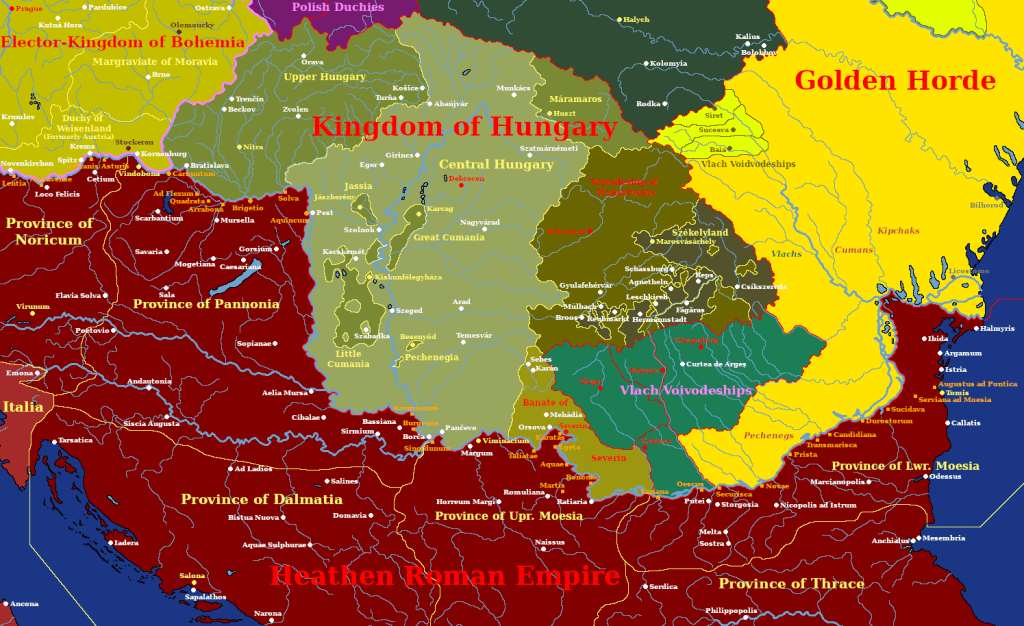
It is mid-September, 101 AD. Batu Khan remains encamped near Debrecen for a week while preparations are made for the campaign across the Danube.
During this time, King Leo receives a letter from Queen Constance informing him of Yolanda’s decision—under pressure from the Upper Hungarian nobles—to renounce her vows and marry Prince Ottokar of Bohemia (who, unbeknownst to both Leo and Constance, has, in the meantime, become King Ottokar upon the death of his father Wenceslaus). At first, Leo is upset. Then, he’s enraged—how dare Yolanda try to undermine his legitimacy this way?! Finally, he calms down and decides there’s nothing he can do about it now, and so it’d be better to make the best of the situation. By leaning into her decision and giving the marriage his blessing, he could make Ottokar into an ally and one day cast off the shackles of the Mongol yoke so recently placed upon him. Therefore, he writes back to Constance informing her of the situation with the Mongols and instructing her to attend the wedding and seal the alliance with Ottokar. In the meantime, Leo appoints a trusted subordinate as regent to run Hungary in Leo’s absence and prepares his army to go on campaign with Batu.
Follow me on Bluesky for updates (with teasers!):
Or subscribe to my newsletter to get updates via email:
Leo’s army consists of the usual rag-tag feudal assortment of nobles and their retinues, knights, men-at-arms, mercenaries, and levies. In all, he has nearly 15,000 men under his command. Batu tells him this is too many—within the confines of Batu’s mind, he has noticed that the combined forces of Hungary and his Rus’ vassals number 25,000, a force plenty large enough to challenge his own army of 20,000 Mongols, even if combined with Berke’s force of 10,000. As such, Batu orders Leo to send half of his army home, leaving him with 7,500 men, which is still the single largest of all the vassal armies accompanying Batu.
And so, though only a week ago Hungary and the Golden Horde were at war, the Hungarian army now marches in the wake of the Mongols together with the Rus’ and other Mongol vassals, all heading toward the Danube river. Along the way, they’re joined by Berke and a contingent of Cuman troops. The Cumans hate the Mongols with every fibre of their being, but even they have to admit that working with the Mongols is better than watching helplessly while the Mongols burn their new homes in Hungary to the ground.
This great army of 48,000 men is quite a diverse one. There are Mongols, Kipchaks, Cumans, Pechenegs, Alans, Hungarians, Rus’ mainly from the principalities of Kyiv, Chernihiv, and Pereyaslavl, but from a dozen other principalities as well; there are Circassians, Bolgars, Bashkirs, Slovaks, Germans, and Vlachs, and this is not an exhaustive list. Over fifteen different languages are spoken, with Latin and Greek being the closest things to a lingua franca in use.
To utilise this army effectively, Batu organises it into four divisions: Batu commands the largest division, consisting of his personal army of 20,000 troops (mainly Mongols, but also the Chinese siege engineers and their cannon), his brother Berke remains in command of his 10,000 and Leo of course leads his Hungarian army of 8,000 (including the Cumans who’ve joined him), and the 10,000 Rus’ and other assorted Mongol vassals are placed under the command of Alexander Yaroslavich, Grand Prince of Kyiv (a title also claimed by Prince Daniel of Galicia-Volhynia, though his claim is not recognised by the Mongols) and several other places as well, making him foremost of all the Rus’ princes.
It is now nearly at the end of September, 101 AD; at this point, Sartaq and the remnant of his army have just finished pillaging southeastern Thrace and are now withdrawing from Roman territory with Servianus and a small army on their tail. Trajan Augustus, in command of the main Roman army, is currently in the mountains near the border between Upper Moesia and Macedonia, since he last heard that the Mongol army was sacking Pella and news of Sartaq’s defeat hasn’t reach him yet.
As such, there is no major army in Pannonia to stand in Batu’s way. Only the local border guards can offer any serious resistance, and they’ve had their numbers steadily downsized by having units be pulled away to reinforce more important fronts on the borders with the Holy Roman Empire and the Golden Horde. The border with Hungary has thus far been quiet, so there’s been no need for a major presence here.
This has left approximately 14,000 soldiers defending a frontier hundreds of miles long, divided into two half-legions (the other halves are in the mountains with Trajan) and around two dozen auxiliary units. Cities in the province have their own watchmen and militia, but these are of dubious use in a pitched battle. Command of the province is in the hands of one Quintus Glitius Atilius Agricola, who is a fairly nondescript senator with a long and illustrious career—as all nondescript senators do—of serving in various offices as tribune, quaestor, aedile, praetor, various governorships, and even suffect consul, before landing a position as governor of Pannonia in 100 AD. In short, he’s exactly the kind of workman-like general Rome has been really good at producing in large quantities ever since the foundation of the republic (which is what makes him so nondescript). His competence is not especially noteworthy, but neither is he incompetent; he’s simply adequate for the job, which is all you need when you’re Rome and you can just keep flinging armies at any problem until it goes away. A true genius like Julius Caesar is extremely rare, even in the storied history of the Roman legions.
When Batu Khan crosses the Danube, he does so just north of the Hungarian town of Pest. Pest’s sister-city of Buda, directly across the river, was replaced in the Act of God by the Roman city of Aquincum, which is a major fortified location. Agricola is 130 miles away in Vindobona (the city the Medieval Europeans know as Vienna), the capital city and also the only place Agricola considers to be worth putting significant military resources into at this time. The Hungarian border with Pannonia has been quiet since the Act of God, but Vindobona sits across the river from the Duchy of Weisenland (formerly northern Austria) which is now part of the Kingdom of Bohemia, which makes Vindobona a key part of the frontier facing the Holy Roman Empire. Consequently, the majority of all legionaries and auxiliaries in Pannonia are concentrated in and around Vondobona under Agricola’s personal command. Specifically, there are 10,000 men there, leaving only 4,000 to guard the border facing Hungary.
Indeed, the Hungarian border is a very low priority. Or, at least, it was a low priority until Agricola hears word of a huge army amassing just across the Danube, whereupon he sends letters to the governors of Noricum and Upper Moesia begging for help, as well as sending a letter to Trajan appraising him of the situation. This letter is carried by a man who doesn’t know where Trajan is, since he can’t exactly look it up on a satellite map, so the messenger heads toward Macedonia hoping to find Trajan somewhere along the way.
Meanwhile, the devastation of Pannonia begins. And what a devastation it is! If 10,000 Mongols were able to bring Macedonia to its knees imagine what 48,000 men marching under the Mongol banner can do! A few hundred Roman soldiers attempt to hold up in Aquincum, but Batu’s army makes short work of the city. Before the cannon can even be brought to bear, Batu’s men scale the walls with ladders and overwhelm the city, turning it into a ghost town by enslaving the inhabitants. Aquincum falls so easily Batu decides to leave his cannon behind so he can move more quickly. Setting a rapid pace, the Mongols fan out into the countryside pillaging every village and town they come across, including Gorsium, one of the largest cities in the province besides the capital. Penetrating deeper into Pannonia, the Mongols sack Caesariana, Mogetiana, Sala, and Savaria, along with countless smaller settlements.
All this happens in the span of a couple of weeks as the Mongol cavalry leave the slow-moving Rus’ and Hungarian infantry behind and blaze their way across the Pannonian Plain at lightning speed. So many Romans are taken captive that the Mongol advance stalls out due the quantity of newly-enslaved people in their baggage train rather than due to any resistance from the Roman army. Sometimes, the captives are simply killed to allow the advance to keep moving, but the majority are put under guard by infantry units and sent back across the river to be sold in Hungary.
The pitiful sight of long lines of enslaved women, children, and men bound together with chains or ropes passing through the streets of Pest becomes a common one. Because Pest is directly on the Danube, it becomes the primary market for all the human beings sent back to Hungary. Pest’s marketplace is quickly flooded with human merchandise, crowding other merchants out of the main square and onto side streets. This influx of enslaved people causes the price of slaves to collapse. Soon, even households with a middling income have a Roman or two. Most end up in the cities and larger towns, where they’re forced to perform domestic chores and manual labour, as well as helping out with the family business—be it blacksmithing, tanning, or whatever else. Many are sent on to Bohemia, the Rus’ lands, or even all the way to the Mongol capital of Sarai on the edge of Europe. Some are taken to Scandinavia and a few are even taken as far away as Scotland and Iceland (the latter an island the Romans didn’t even know existed).
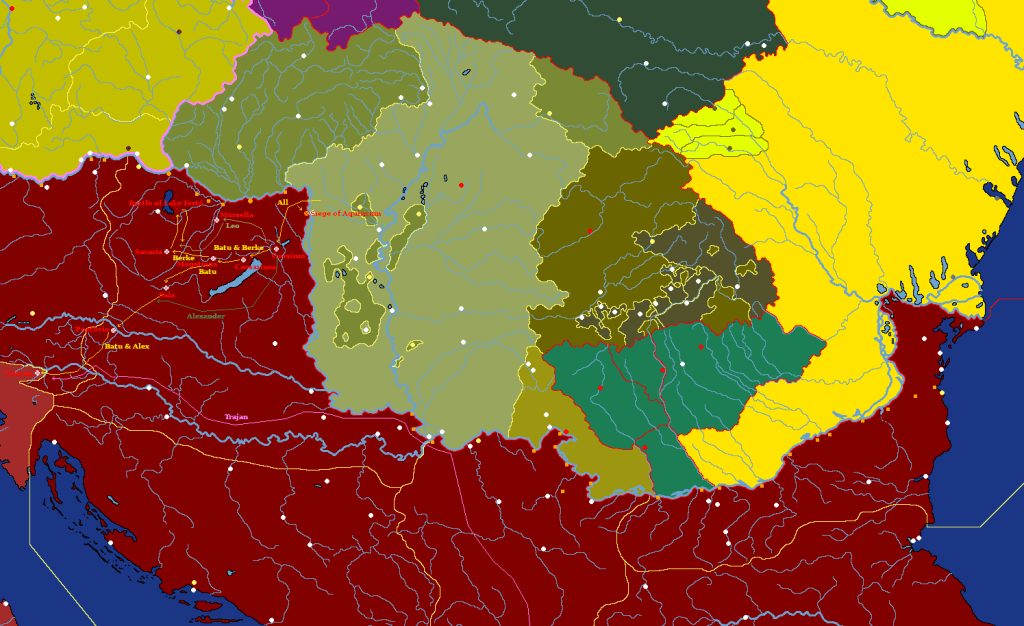
While that’s all going on in the background, however, Batu Khan’s brother Berke finds himself along the northern edge of the Mongol raiding area near Lake Fertő, Europe’s biggest endorheic lake (a lake with no outlets). One day, Berke’s scouts have a run-in with some Roman cavalry. Charging, the Romans manage to chase the Mongols off, but then the Mongols come back with reinforcements, so the Romans retreat to a nearby villa on a hill overlooking Lake Fertő and enlist the help of an infantry cohort stationed there. Berke’s men send word back to him and he arrives with his army only to find that Agricola and his army have also arrived. Agricola is modestly outnumbered, with 8,500 men (the rest are tied up guarding the Bohemian border). Both sides are surprised to see the other and start feeding men into the battle as quickly as they can form up. Three different confrontations emerge in the confusion. On the two wings, the Roman cavalry desperately try to keep the Mongols from outflanking the main army, while in the centre the Roman infantry hold the villa while Mongol horsemen dismount and assault it or ride circles around it while shooting arrows at any Roman foolish enough to show his face.
The whole afternoon is spent in this confused fighting, but eventually the two sides are forced apart by the setting of the sun. Berke withdraws to a distance, enabling Agricola to build his camp between the villa and Lake Fertő. When morning comes, the two armies form up and prepare for another confrontation.
Normally, the Roman camp would be surrounded by a palisade made of stakes carried by the Roman soldiers, but Agricola has his soldiers drive the stakes into the ground in front of his infantry instead, which creates a limited number of paths the Mongols can use to approach the army. Thus, Agricola’s right flank is anchored on Lake Fertő awhile his left flank is up against the villa, where he has stationed most of his archers. Beyond the villa, however, is forested, hilly terrain nearly impossible for horses to cover. Any Mongols attempting to turn the left flank would have to ride past the villa in range of the Roman archers. Even if they managed to make it through, they’d find themselves cut off form their fellow Mongols and under attack by the Roman cavalry held in the rear on the left flank in case of just such an eventuality.
Berke assaults the Roman positions. Despite Agricola holding all the advantages, Berke believes he can push the Roman infantry away from their palisade and destroy them. The morning is spent in wave after wave of horse-archers charging and retreating, pouring arrows into the Romans standing in the gaps in the palisade, but the Romans do not budge. In the afternoon, the Mongol heavy lancers launch several charges at the Romans, but this, too, is fruitless. Finally, Berke keeps the main body of Romans busy with his horse-archers while he makes an attempt to seize the villa, but this also fails.
By mid-afternoon, Berke finally admits defeat. He collects his camp and all the loot his army has collected and withdraws. Agricola does not pursue, wisely concluding that chasing Mongols over the wide open Pannonian Plain is a fool’s errand and a great way to get surrounded.
Over two days of fighting, the Mongols take 1,200 casualties while the Romans lose only 300, with the majority of the Roman losses being taken in the confused fighting of the first day.
The Battle of Lake Fertő is a minor victory, all things considered, but it shows the Romans of Pannonia that victory against the Mongols is, indeed, possible, and buoys the downcast spirits of Agricola’s men. However, it does little for the civilians and undefended cities still in the Mongols’ path.
Perhaps the most significant outcome of the battle is that it causes Batu to reconsider his movements. He decides to send Leo and the Hungarians north to reinforce Berke, and orders Berke to capture Vindobona. Batu, meanwhile, links back up with Alexander Yaroslavich and the Rus’, and they head west with the intention of finding a pass over the Dinaric Alps and down into Italy. Along the way, they pillage several cities and countless rural settlements until they arrive in the far reaches of the upper Savus River in early November, 101 AD.
While all this has been going on, Hadrian has been in command of Roman defences along the Rhine river, where he’s been dealing with frequent cross-river raids by minor princes and mercenary companies from the Holy Roman side. At the time Batu crossed the Danube, Hadrian was dealing with a raid by mercenaries based out of the city of Lupfen. He defeated the mercenaries near Brigobannis, chased them across the river, and burned the suburbs of Lupfen in retaliation for their harbouring the mercenaries. Upon his return, Hadrian heard of the Mongol invasion of Pannonia. Soon afterward, he received news that Mongols were headed southwest in the direction of Italy.
Italy is a place that has not seen the banners of a foreign army in a long time. The only military forces in the region (Italy isn’t a province) are the Praetorian Guard and the Urban Cohorts, both of whom are stationed in the city of Rome itself. Other than that, cities maintain their own watchmen and there are some retired veterans in Italy who would take up arms against an invading army. However, there is no one in Italy to take charge of the situation and lead a defence. Hadrian, on his own initiative, takes his army toward Italy. Infantry move too slow, so he rushes ahead with the cavalry and soon arrives in northern Italy. Here, he launches into a whirlwind of activity. Issuing letters in the name of Trajan, he commands all the cities of northern Italy to send him detachments of their city watchmen. This doesn’t work all that well, since Hadrian as no authority in Italy nor does he have the authority to issue orders in Trajan’s name. In fact, to a lot of people, this looks an awful lot like a bid to usurp the throne. But Hadrian doesn’t give up; he cajoles, makes wild promises, begs and pleads, and manages to scrounge up 7,000 men. This “army” is made up of town watchmen armed with spears and clubs, retired veterans with old, rusty swords, and random volunteers wielding everything from hunting bows to blacksmith hammers.
Obviously, this is nowhere near enough to take on the Mongols, so Hadrian starts boasting to anyone who’ll listen (and to everyone who won’t) about the size of his army. He writes another slough of letters to all the cities in the area in which he exaggerates the number of troops that other cities are sending him and he sends agents into the countryside asking for volunteers while giving inflated figures for the number he’s already gathered. Soon, the rumours say that Hadrian has 10,000 men, then 20,000, and then 40,000. By the time the rumours filter across the mountains and reach Batu, he is informed that an army of 60,000 veteran legionaries is waiting for him directly on the other side of the Dinaric Alps.
Meanwhile, a very real army of 40,000 men is approaching Batu from behind.
[Next]

 Lord of Lore
Leave a comment