The Roman Empire—But Also Medieval Europe
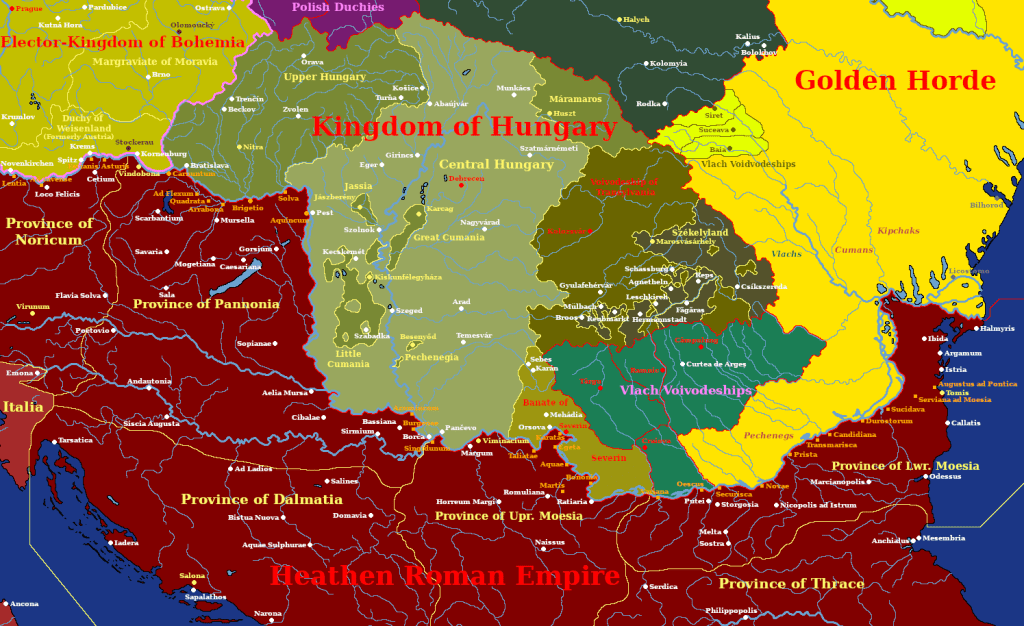
It is October, 101 AD. Trajan Augustus and his army of 40,000 men were crossing the mountains separating the provinces of Upper Moesia and Macedonia when Batu Khan crossed the Danube in mid-September. He was on the trail of Sartaq, not knowing that Sartaq had already been ambushed and defeated by Servianus. Upon entering Macedonia, Trajan traversed the ruins of the countryside halfway to Pella before he heard of Sartaq’s defeat. Around the same time, Agricola’s messenger arrived and informed him of Batu’s invasion of Pannonia. Trajan sighed and turned his army back around the way he’d just come.
It is the end of October by the time Trajan makes it back to Pannonia and picks up the trail of Batu, who is heading toward Italy. Batu sacks the city of Emona, situated in the Emona Basin, which is a valley between the southeastern section of the Alps proper and the northwestern fringes of the Dinaric Alps. Hearing words of Hadrian’s supposedly huge army, Batu encamps outside Emona to take stock of the situation and consult his advisors. All of them tell him that crossing the mountains so late in the year is a bad idea because the snow will surely come soon and could trap them in Italy until spring, by which time they might be cut to ribbons by Hadrian and his phantom army.
Follow me on Bluesky for updates (with teasers!):
Or subscribe to my newsletter to get updates via email:
While they’re deliberating this, long-range foraging parties encounter Trajan’s army and hurry back to Batu’s camp, where they inform him of the augustus’s approach. Batu begrudgingly decides to shelve his idea of invading Italy and sacking the capital of the empire, and instead turns eastward to face Trajan.
Trajan, arriving at the eastern mouth of the Emona Basin, has trapped Batu within the basin. Batu can’t stay in the basin for long or his troops will starve and he can’t get escape without fighting Trajan. That’s fine by Batu, however. He relishes the opportunity to destroy Roman resistance and open the region for further conquest.
The Romans form up in the valley with high mountains on both sides making it difficult to outflank them. Then, they dig ditches in front of their infantry, line them with anti-cavalry spikes, and scatter caltrops across the approaches between the ditches. Trajan has learned from fighting the Holy Romans that these technologically sophisticated barbarians from the future are deadly horsemen, and he’s not taking chances.
After their preparations are finished, Batu Khan arrives on the field with his Mongol cavalry. Strangely, the the Rus’ are not present. Having heard that the Rus’ were accompanying Batu, Trajan concludes they must have separate at some point. The battle begins with the typical Mongol cyclonic charge-and-retreat by the horse-archers. They slowly whittle down the Romans, but the Romans have large shields and armour to protect them and respond in kind with arrows and javelins, inflicting many more casualties on the unarmoured Mongols than they receive.
Then something happens that causes a great, roaring cheer to go up from the Roman lines; the Mongols run away! Believing themselves to have won, many Romans break ranks and run after them. A few Mongols are caught while still trying to turn their horses around—a galloping horse can’t exactly turn on a dime—and are killed. Roman cavalry catch up to more stragglers and cut them down. As the Romans string themselves further out, they begin to tire and lose all sense of formation. At that point, the Romans round a hill and come face-to-face with the missing Rus’. Rus’ and Mongols fall upon the tired and scattered Romans. Thousands are butchered as lambs falling to the wolf pack.
Trajan, meanwhile, is still back at the ditches where the Romans started from, trying to maintain order in his army and stop the pursuit. Half his army have run off after the retreating Mongols, leaving a much-reduced force to man the ditches when the Rus’ and Mongols slaughter their pursuers. Twenty thousand Romans are dead, captured, or have fled the field. Batu returns to the site of the Roman ditches and assaults it again, this time with the Rus’ heavy infantry. Although the battle carries on for another two hours, Trajan realises he is slowly losing it. He tries to disengage, but the Rus’ and Mongol heavy lancers pursue his withdrawing infantry and crush them.
Less than half the cavalry and only a handful of infantry are able to escape with Trajan, while Mongol losses in the Battle of Emona Pass are minimal.
Breaking out of the Emona Basin, Batu heads east, ravaging southern Pannonia along the Savus River before entering the Province of Upper Moesia.
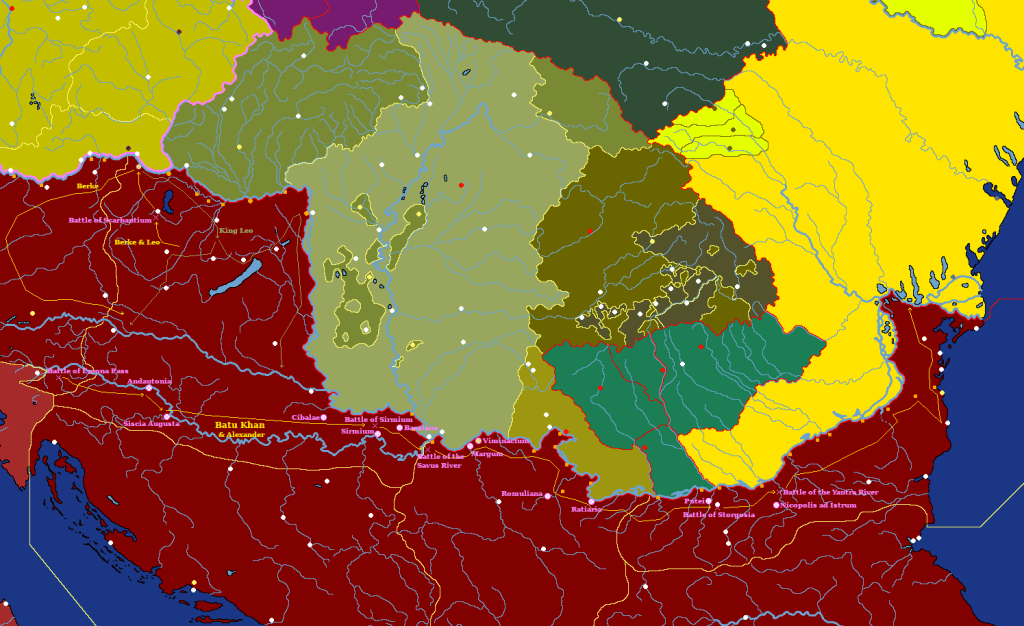
Meanwhile, in northern Pannonia, Berke and Leo take a combined Mongol-Hungarian force of 18,000 men toward Vindobona. At the city of Scarbantium, southwest of Lake Fertő, Agricola makes his stand. Reinforced by men from neighbouring Rhaetia, he now has 12,000 soldiers. Oddly enough, this number includes hundreds German and Czech mercenaries who’ve crossed the border and entered Roman service. This is the first major battle in which Catholic mercenaries will serve Roman paymasters, and it won’t be the last.
Hungarian infantry crash into the Roman shield wall; Mongol horse-archers harass the flanks, but are chased off by the Romans—including German mercenary knights. But it’s no use; Mongol heavy lancers counter-charge with a vengeance, crushing the Roman cavalry and rolling up the infantry. Agricola is killed in the fighting and his skull soon adorns Berke’s dinner table. Vindobona falls swiftly thereafter, the garrison having been emptied of men in the attempt to stem the Mongol advance at Scarbantium.
Once Vindobona is captured, Leo decides to move eastward and consolidate the gains made so far. Berke demands that Leo follow him west into Rhaetia, but Leo points out that his master is Batu, and Batu only ordered Leo to capture Vindobona and left no further instructions on what to do after that. Thus, Leo begins garrisoning all the cities the Mongols have captured so far and begins treating Roman Pannonia as if it’s part of his own kingdom. Everything from the Danube to the Drava River is effectively brought under Leo’s control.
Berke, meanwhile, heads west to continue plundering in Rhaetia. Without any infantry force, however, siege warfare becomes nearly impossible, so he avoids fortified settlements and goes for the easy pickings instead.
Batu Khan smashes his way through Upper Moesia, defeating local Roman forces in two pitched battles and burning all the border forts along the Danube. Continuing into Lower Moesia, he defeats the local governor at the Battle of Storgosia and defeats Servianus at the Battle of the Yantra River. All the cities of Lower Moesia submit to Batu and pay hefty ransoms to avoid being sacked.
This campaign through Moesia takes us into January, 102 AD. By the end of the campaign, Roman power has been entirely ejected from Pannonia and both Moesias. Most of Pannonia has been surreptitiously nabbed by King Leo. Moesia, meanwhile, is up for grabs. Batu gives his son Sartaq the right to distribute land in Moesia. He does this because he knows his health is failing and he hopes to put Sartaq in a good position to be elected khan when he dies.
However, Sartaq’s defeat at the hands of Servianus means many Mongol commanders view him as a failure who contributed little to the conquest of Moesia and shouldn’t be rewarded for it. Most outraged of all is Berke, who returns from Rhaetia to find Leo has taken over Pannonia and Sartaq is in charge of Moesia, leaving Berke feeling like he’s gained nothing from all his efforts. Batu gives him some liquid wealth in the form of a larger portion of the massive loot chest gained from the campaign. Berke voices no further complaint, but envy simmers within his heart.
[Next]

 Lord of Lore
Leave a comment