The Roman Empire—But Also Medieval Europe
It is February, 102 AD.
Upon returning to Italy after his defeat at the hands of Batu Khan, Trajan Augustus has mixed feelings about how Hadrian handled the defence of the Empire’s heartland. One the one hand, he’s furious that Hadrian abandoned his post at the Rhine, used Trajan’s name without authorisation, and took command of an army in an area outside of his jurisdiction. On the other hand, he’s deeply and eternally grateful to Hadrian for masterfully planting false information that persuaded Batu to spare Italy without a fight. For his part, Hadrian demobilised the army when he heard Batu was no longer threatening Italy. When Trajan arrives in Italy, Hadrian meets him and assures Trajan that he has no designs on the throne; he did what he did only to save Rome. Conflicted, Trajan decides to let Hadrian off with a stern warning, but lets him keep his position in charge of the Rhine frontier.
Returning to said frontier in March, Hadrian continues with the project he’s been working on. Many of the borders forts were destroyed during the war against William of Holland. Even now, when no large armies are marching across the land, parties numbering in the hundreds and, occasionally, low thousands have been crossing the river on the regular. These raids are proving troublesome, especially the ones that put roots down, build castles, and don’t leave. As a result, the German and Dutch princes east of the Rhine have managed to set up a number of colonies on the west side of the lower Rhine. In order to ensure a secure line of defence from which Roman military operations can operate, Hadrian builds a new line of fortresses from the shores of the North Sea to the town of Tungri, down to Augusta Treverorum, to Tabernae. He also withdraws the southern “hook” of the Holy Roman frontier to a new line based on the headwaters of the Rhine and the shores of Lake Constance in the region that the Germans call “Switzerland”.
Tip me on Ko-Fi: https://ko-fi.com/lordoflore
Follow me on Bluesky for updates (with teasers!): @lord-of-lore.bsky.social
Or subscribe to my newsletter to get updates via email:
In the process of doing this, Tungri is renamed Hadrianopolis and is fortified, becoming a major legionary base. Augusta Treverorum and Tabernae are likewise expanded, fortified, and become legionary bases.
These new forts are not like the primitive Roman forts of yesteryear. Before the Act of God, the Romans could rely on the fact that the Germanic barbarians across the Rhine were barely acquainted with siege warfare and had awful logistics that precluded them from posing a serious threat to fortified Roman positions in most cases. Now, however, they’re dealing with an enemy who have vastly superior siegecraft to themselves and are no slouches in field battles either. To cope with this, the new forts feature a number of improvements such as beefing up the guard towers (so that they can serve as actual guard towers rather than mere watchtowers, as they were before) and pushing them outward past the curtain wall so that soldiers in the towers can actually shoot at enemies on the ground at the base of the wall. Some of these new forts even benefit from German architects hired to help design the defences, and they add features like machicolations to some of the forts.
However, the Romans still intend to fight the enemy in the field wherever feasible rather than trying to hold out in costly sieges. To this end, Trajan authorises the creation of new legions and auxiliary units. Most of the new auxiliaries are recruited from the native population of the Gallic provinces, with most serving as either cavalry or heavy infantry. However, Hadrian also recruits several units of light infantry from Hispania. Now, Romans do not, historically, do light infantry all that much. But in the highly-mobile small-engagement kind of warfare Hadrian has been dealing with since the Battle of Cow Market, the value of fast-moving light infantry has become clear.
Which brings us to a personal side project of Hadrian’s. Crossbows have proven to be a fascinating and deadly weapon under the right circumstances. Its increased killing power over the bow and relative ease of use make it a weapon of particular interest to the Romans, who are always ready to adopt the weapons and tactics of their enemies if they prove useful. Rome does, of course, already possess weapons that superficially resemble crossbows, but they’re torsion-based, twisting ropes to store energy like a spring, rather than directly pulling back the arms of the crossbow the way Medieval crossbows do. The Romans also don’t really use handheld crossbows in war, but instead use a small, anti-infantry crew-served ballista called a scorpio (larger siege versions also exist).
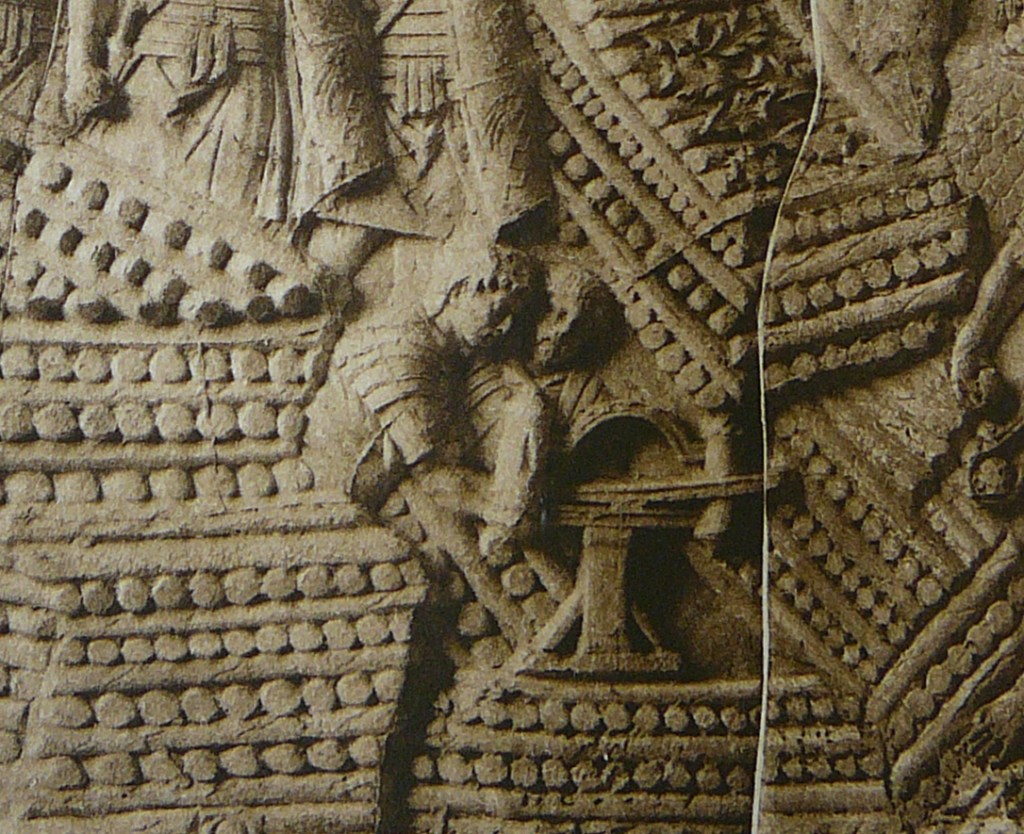
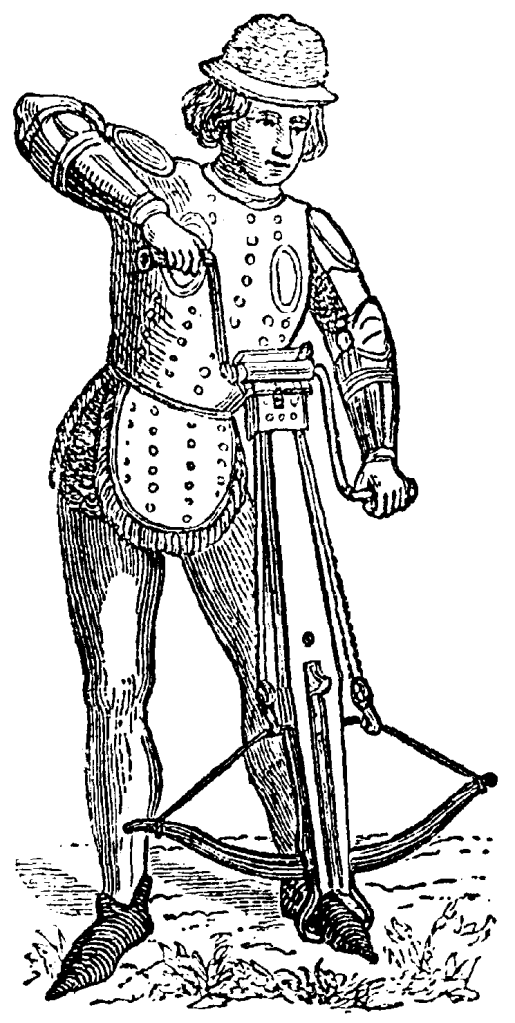
Hadrian decides to adopt the new weapon. He sets up a workshop in Augusta Treverorum and hires some crossbow makers from across the Rhine. Despite the frequent raids and counter-raids across the river, parts of the border are largely peaceful, allowing for the passage of merchants and the hiring of experts from the other side. These crossbow makers take on Roman apprentices and start producing crossbows for their new employer. With these and a number of crossbows captured in battle, Hadrian is able to recruit two new auxiliary cohorts totalling 960 men equipped with crossbows. In Medieval Latin, the word for “crossbow” is arbalista, so the Romans simply adopt this name for the new weapon.
Another innovation that begins taking hold along the Rhine (and on the upper Danube too) is an increase in the amount of armour worn. Medieval soldiers wear padded or mail armour on their arms and legs while Roman arms and legs are bare naked and exposed to attack. Either on their own initiative or by order of their officers, Roman soldiers begin armouring up. Those who can afford it go to a mail smith and get mail sleeves and chausses made . Those who can’t afford mail buy padded armour or even leather vambraces and greaves. For now, this remains an innovation restricted to the frontiers facing the Holy Roman Empire, but arm and leg armour will slowly percolate through the rest of the Empire and become dominant by the end of the century.
A drawback, however, of both recruiting large numbers of new soldiers and giving those soldiers more armour is that there simply isn’t enough chainmail to go around. It’s expensive, it takes a long time to make, and there’s a limited number of smiths who can make it. As a result, new auxiliary infantry are no longer given chainmail, but cheaper padded or leather armour. In some cases, even existing auxiliary cohorts have their mail taken away and given to newly-recruited Roman legionnaires. Even then, padded armour isn’t exactly cheap (just cheaper than mail). Romans don’t have access to spinning wheels (which is a Medieval invention), so every thread of the twenty or fifty layers that a set of padded armour requires has to be spun by hand using a hand spindle and a stick, and that’s an extremely time-consuming process. We’re talking thousands of hours of labour from hundreds of women just to spin the thread alone, nevermind the weaving and stitching—and that’s just to equip one soldier. Ironically, the Romans begin purchasing linen from across the Rhine to make padded armour out of because it’s cheaper than buying fabric made in the Empire.
Meanwhile, Trajan places his other most trusted man, Servianus, in charge of building new frontier forts in the mountains west and south of Pannonia and Moesia. Like the new Rhine forts, these are also significantly superior to the older forts. Placed along highways and in key mountain passes, the new forts will block any casual raids into Thrace, Macedonia, and Dalmatia. Furthermore, the cities of Thrace and Macedonia beef up their own defences, building or repairing curtain walls and increasing the size and professionalism of their city watchmen. Some even build citadels with barracks for hundreds of full-time professional city guards.
Trajan Augustus spends his time campaigning in the former provinces of Pannonia and Moesia. Slowly but surely, he wins a series of minor victories over the Hungarians and Mongols, regaining a slice of land here and liberating a town over there. His budget is constrained by all of the fort-building and recruitment of new soldiers going on, so Trajan campaigns with small armies numbering perhaps 10,000.
_
Beyond the Danube River, in the Kingdom of Bohemia and the wider Holy Roman Empire, the newly-crowned Ottokar II of Bohemia is dealing with the fallout from the death of his father, Wenceslaus. Succession to the throne of Bohemia is his birthright, but becoming Holy Roman Emperor is not. Fortunately, he manages to secure enough support from the electors to win the election in November, 101 AD, soon after which is his coronation. In December, he’s finally able to marry Princess Yolanda of Hungary, as the marriage was delayed by the death of his father.
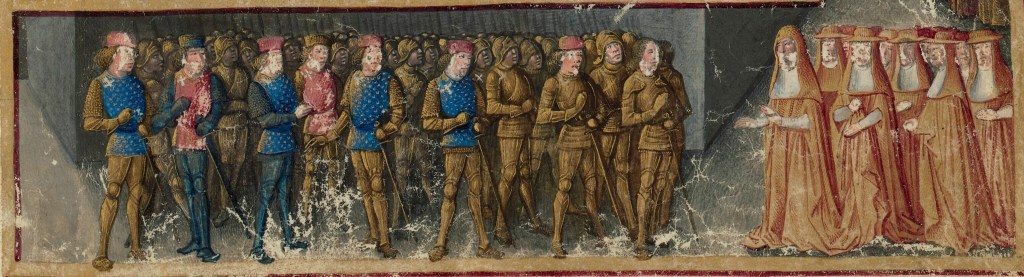
Emperor Ottokar then pours all of his energy into the complex politics of the Holy Roman Empire, the most concerning issue of which is the calling of an ecumenical council of all prelates in the Catholic Church. Working hand-in-hand with Archbishop Wilbrand of Magdeburg, Ottokar presses hard for such a council to be called.
But calling the council is much easier said than done. Bishops from as far afield as Hungary, Norway, and Ireland have to be able to attend. Months pass as a flurry of letters criss-cross what’s left of the Catholic world. At last, a time and place is agreed to. In spring, 103 AD, all the Catholic prelates in the world will meet at Magdeburg.
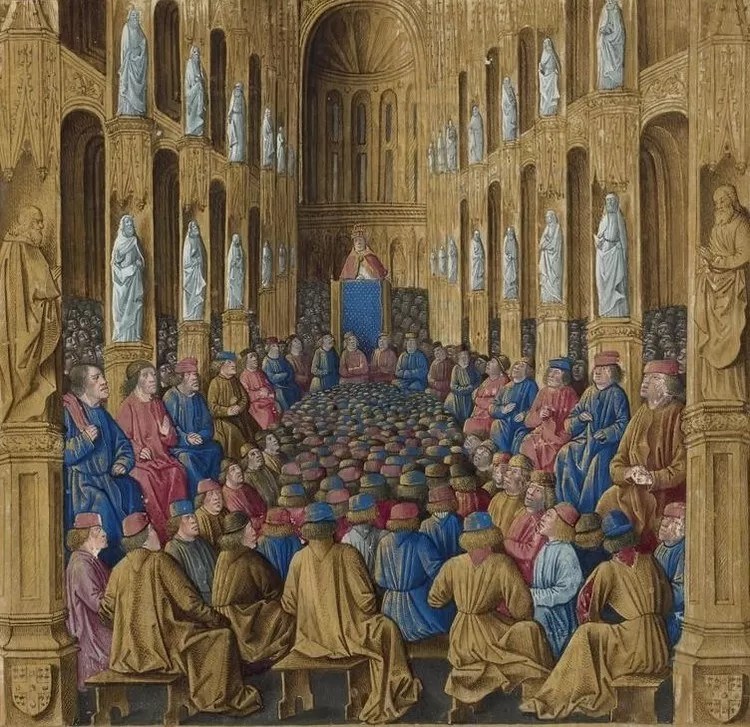
And so we skip ahead to May, 103 AD, when the first session of the Magdeburg Council begins. There are a myriad of issues up for discussion. Most importantly, and most relevant to our narrative, is the election of a new pope. Of course, the actual election of the pope takes place in a papal conclave, but for a conclave to be called requires there be a college of cardinals, and the college of cardinals has been devastated by the Act of God. To be precise, the number of cardinals after the Act of God was exactly zero. A new college of them would have to be selected.
But there’s another problem more pressing than that. Many dioceses are “floating”, cut off from their archbishops and bishops. New bishops need to be selected; in some cases, bishops have already been selected by their own parishioners need to receive official confirmation or be replaced, and, most importantly, whole new archbishoprics need to be created and archbishops appointed for them.
This series of issues looks remarkably like a ladder, so the Magdeburg Council decides to begin climbing it from the bottom.
We won’t be going over ever twist and turn of the Magdeburg Council, as that would get far too dull and repetitive. The upshot is that the diocese map of Catholic Europe is redrawn. Most of the intact existing bishoprics are left as-is, but many new ones are created out of floating territories, while in other cases those territories are annexed to existing dioceses.
Then comes the matter of archbishops. In the aftermath of the Act of God, Catholic Europe was left with just ten archbishops out of the 65-70 there’d been previously. There is one each in Norway, Sweden, Denmark, and Poland, two in Germany, and a surprising four in Ireland. Clearly, many new ones need to be created, but the prelates argue vociferously over which bishops should be elevated to the coveted position. Again, the details need not be recounted here. In short, Scotland manages to secure an archbishopric, while the Baltic region gets two (Prussia and Livonia). Four new archbishoprics are created in Germany, one in Bohemia, and three in Poland. Hungary is a special case since most of its bishoprics were south of the Danube. The diocese map of Hungary has to be completely redrawn, and in the end the kingdom is given three archbishoprics.
In summary, the following is the final list of all archbishoprics in the Catholic world as of the the end of the Magdeburg Council (newly-created archbishoprics are in brackets).
Archbishoprics
Bohemia: (Prague)
Denmark: Lund
Germany (incl. the Netherlands): Bremen, (Fulda), Magdeburg, (Münster), (Utrecht), (Würzburg)
Hungary: (Eger), (Nitra), (Szeged)
Ireland: Armagh, Cashel, Dublin, Tuam
Livonia: (Riga)
Norway: Nidaros
Poland: Gniezno, (Kraków), (Płock), (Wrocław)
Prussia: (Kulm)
Scotland: (Glasgow)
Sweden: Uppsala
With that business done, the Magdeburg Council finally moves on to selecting the cardinals. This is done, at first, by simple acclamation. Candidates put themselves forward and are either acclaimed by the crowd of prelates or they are not. Once they have a list of candidates, the prelates are each asked to rank their nine favourite candidates. The nine men with the most support are chosen as cardinals.
With nine cardinals chosen, they separate themselves from the rest of the council and meet in their own papal conclave. Among them is Wilbrand, archbishop of Magdeburg. Thanks to his own shrewd manoeuvring and the support of Emperor Ottokar, plus the fact that the council is taking place in his own home turf, Wilbrand manages to secure his position. The conclave takes a full month to decide on their final verdict. It takes a two-thirds majority to elect a pope, so six of them must agree. In the end, Wilbrand is the one chosen.
All of this, of course, takes a great deal of time. From the beginning of the first session in May, 103, to the choosing of Wilbrand as pope-elect is nearly a full year. Wilbrand is finally inaugurated in early June, 104, and takes the name Clement IV, in honour of Clement of Rome, who was drowned on the orders of Trajan back in 100, as one of the Seventy and Seven Martyrs.
After the new Pope Clement IV is sworn in, the council moves on to a variety of less important matters. The only one that really concerns us here is the matter of Galicia-Volhynia. Besides all the Catholic prelates, a delegation of Ruthenian Orthodox prelates are also here on behalf of Prince Daniel. Daniel is pursuing closer ties with Catholic Europe in hopes of securing allies against the Mongols, and one of the best ways to do that is to bring the Galician-Volhynian church into union with the Catholic Church. Of course, actually converting his whole realm to Roman Catholicism would be a supremely foolish move, since most of his subjects are very attached to Ruthenian Orthodoxy and the Galician-Volhynian church would never accept it. What he can do, however, is bring his church into communion with the Catholics and, perhaps, even subordinate his church to the pope in Magdeburg rather than the metropolitan bishop in Kyiv.
After some negotiating, the Catholics agree to enter communion with the Galician-Volhynian church, which means that members of both churches will be able to attend mass with the other, although both will continue using their own rites. This doesn’t represent a full shift into Magdeburg’s orbit or a clean break with Kyiv, but it’s definitely a step in that direction.
Additionally, Pope Clement IV gives his assent for Daniel to be crowned king, thereby elevating the Principality of Galicia-Volhynia to the Kingdom of Ruthenia. A crown is made and sent with a papal legate to Halych, where Daniel is crowned king in August, 104 AD. Instead of being happy, Daniel grumbles that he would rather have had an army than a crown.
After running for over two years, the Magdeburg Council is finally called to a close in June, 105 AD. With a new pope, a college of cardinals, and the diocesan maps redrawn, the Catholic Church has finally put its business in order and is prepared to meet an uncertain future in this strange world that God has seen fit to cast them into.
[Next]
Credits:
Last two images: Medieval church council

 Lord of Lore
.jpg)


Leave a comment