[Maps of the West Coast in 1576]
7.1 – Prefect Huế Thành Học (June-July 1576)
Hue City was founded by a man named Huế Huy Bạc in 1469. It was a year after the end of the 3rd Youkuci War, which had opened up vast new tracts of land for settlement in the southern Valley. Huy Bạc was commissioned by then-governor of South Province Bai Zhongqiang to bring settlers in, build a city, and most importantly, to dig canals connecting Oak River to Youkuci River, and connecting the two of them to South River. A huge tract of land was given to Huy Bạc for this purpose, a tract which became known as the Hue Triangle (a name which was later made official, as it became the Hue Triangle Prefecture). At the time, Vietnam was undergoing a population boom so land was scarce. Huy Bạc had no problem recruiting settlers for his scheme.
The deal went like this. Bai Zhongqiang negotiated the purchase of the land from the Youkuci through his wife Lady Meiyou, daughter of a prominent Youkuci warchief who had fought against the Xinguans in the Youkuci Wars. Huy Bạc, in turn, leased the land from Bai on the promise that he would find settlers for it, build a city, and dig the aforementioned canal system. Huy Bạc then returned to Vietnam, where he recruited settlers by promising generous land grants to anyone who signed up. Payment for the land would be in the form of labour, which would go toward building the city and the canals. No cash was required. Thousands of landless peasants rushed to sign on.
Huy Bạc was given twenty years to complete the projects. If he failed, he’d have to pay an exorbitant fee to keep the Hue Triangle or return all of it to Bai Zhongqiang. He just barely fulfilled his obligations: the last canal was officially opened for business the day before the deadline.
From then on, the Hue family kept an iron grip on both land ownership and political power in Hue. Every subsequent prefect was a member of the family, although it didn’t always pass from father to son the way the governorship did.
In 1576, over 100 years later, Hue was one of the most important cities in South Province. Both it and the Triangle as a whole had attracted not only Vietnamese immigrants but people from the Philippines, southern China, and other parts of Xinguo. Huế Thành Học was the biggest landowner in the prefecture and all of the next nine biggest landowners were also members of the Hue family.
And so, when one scion of the family named Bảy Thắng wanted a commission in the army, it was easy for him to use family ties to get exactly that. After a number of years guarding the eastern frontier from hostile Nü tribes, he saw service in the Bay area fighting pirates and fought in the Battle of the Jaw in 1569. After the war, he got himself assigned as commander of South Tooth Fort: a position which he apparently regarded as semi-retirement. That is, until the Silver Syndicate’s warehouse in Dongguang was exploded by Diego Perez y Gomez.
When Bảy Thắng’s frantic letters begging for reinforcements started arriving in Hue, Thành Học didn’t pay them much heed. New Spain was so far away it was unlikely in the extreme that they could launch a major expedition against Xinguo, or so Thành Học told Bảy Thắng in his response letters. Nevertheless, the Hue family always stood by each other, so to keep up appearances Thành Học sent 100 men to reinforce Bảy Thắng. Not 100 men of Thành Học’s personal guard—who were the equivalent of the army’s heavy infantry—but simply 100 volunteers taken from off the rolls of the provincial militia.
It is, therefore, understandable that when news of Bảy Thắng’s death in the Battle of the Jaw in 1576 arrived in Hue, Thành Học felt personally responsible. He had the chance to help his cousin and he blew it through sheer negligence. His first order of business was to declare a period of mourning all across Hue Triangle. For the next year, parties and celebrations were banned along with wearing any flamboyant colours. Instead, everyone had to wear some article of white clothing at all times (which is the East Asian equivalent of wearing black at a funeral, since white is the colour of mourning).
His next order of business, coming directly on the heels of the first, was to mobilise as many armed men as he could muster. This army would be a patchwork force, much like Mao Fulong’s army that he raised while on the banks of Danmian River. Thành Học’s household guards, along with men from the households of his relatives, would form the core of the army, alongside the soldiers of the professional army stationed in the prefecture. Its backbone would come from the provincial militia: the lists of names of those enrolled in the provincial militia were handled at the county level, with copies being held at the prefectural capital. As prefect, Thành Học had the authority to call out the militia in response to emergencies without asking permission from the governor, and so this is what he did. In addition, Thành Học recruited any armed men who wanted to sign on for the pay.
Thành Học began mobilising his army on June 26th, and by July 11th, he was ready to set out with 10,000 men. Marching along the shore of the Hue Canal, Thành Học headed west toward Oak River, intending to march up the coast to Danmian. Sailing alongside the army was a flotilla of river boats carrying supplies, and trailing behind them were 7,000 civilians. Some were handling animals for the army, others were merchants and blacksmiths doing business with the army, and still more were porters and owners of boats and draft animals hired to handle the army’s supplies, not to mention families of the soldiers and militiamen. The army’s purpose was displayed by its clothing: Thành Học ordered that the soldiers and militia dress in all white. As the army passed through the prefectures of Oaken Stone and East Cham, their striking appearance made an impression on the locals. Soon enough, the army became known as Sangjun, the Mourning Army, and its members as Sangyong, or Mourning Braves.
The Sangjun left its supply ships behind in Indrapura, a Cham colony on the coast. There was no way of getting to Danmian by water without going through the Jaw or looping back around through the Hue Canal and passing through Dongguang via South River, so the army had to march onward carrying their supplies on the backs of donkeys and men. They arrived at Danmian on July 22nd, the morning after Mao Fulong seized control of Dongguang. Finding out from the locals that the Mexicans and Coastal Prefecture’s army had left for the capital, Thành Học wasted no time in following them there. He arrived at Dongguang in the early afternoon of July 25th, at which point Alonso Flores and Mao Fulong were in complete control of Dongguang and its sister cities, all except for New Vijaya.
Along the way, Thành Học had heard Dongguang had fallen into enemy hands, but was light on details. Refugees fleeing the fall of the capital had no idea of the big picture and so were unable to provide him with anything other than the bare outline of what had happened. Unsure of what to do next, Thành Học made camp in a field south of Dongguang.
As Thành Học was trying to figure out what to do, Dongguang’s south gate opened. A lone middle-aged man came out wearing rich silk robes. Approaching the Sangjun’s camp unarmed, he introduced himself as Yao Yicaoqi and said that he had a proposition for Thành Học from Mao Fulong. If Thành Học accepted, then he would get the vengeance he sought.
7.2 – Final Sundering (July, 1576)
To explain the Yao Yicaoqi’s proposition, we must back up. On July 21st, after warning Bai Guguan about Mao Fulong’s impending betrayal, Yao Yicaoqi and his older brother Guadimo didn’t want to rejoin Mao’s army for fear he’d discover their tipping off of his enemy and have them executed, so they stayed the night in an inn near the governor’s palace. When the Maomao attack began, they ditched their armour in an alley and attempted to blend in with the civilian population.
However, they were the sons of a powerful magnate, and Yao Guadimo was himself the heir to their father’s estates. As such, they were easily recognisable public figures in Coastal Prefecture, and so of course some of the Maomao recognised them. Mao had noticed their disappearance after he was forced to set up camp outside the city. Fearing the treacherous brothers may have betrayed his treachery to the governor, Mao added the capture of the Yao brothers to the to-do list for his most loyal men, so when the Yao brothers were discovered, they were taken into custody.
On the morning of July 22nd, they were presented to Mao Fulong after he was done organising the occupation of Dongguang, but before the arrival of the Acapulco Expedition. Mao demanded to know where they’d been the night before. They refused to answer at first, but under torture they soon revealed that before leaving with the Mexicans, their mother Mei Nai had made they swear they’d warn Bai Guguan about Mao’s plans. Although he was furious with them, Mao decided to hold onto the pair for the time being, so he locked them away in the governor’s palace.
On July 24th, Alonso Flores seized control of Dongshang Gate and placed guards around the governor’s palace where Mao was staying. This was when Mao decided his alliance with the Mexicans needed to be cut short, so that evening he paid the Yao brothers a visit in their makeshift prison cell. Zhou Xiang records that he laid out the situation for them: the Meixigou People had conquered the Incas, the Tarascans, and so many others—including the Aztec Empire, homeland of the Yao brothers’ own mother. And now they were here to conquer Xinguo.
Yao Guadimo interjected: “Yes, and you play the part of Tlaxcallan!”
However, Mao calmly explained that he only wanted to bring about the downfall of Bai Guguan. Now that the tyrant was gone, it was time to deal with the Mexicans—and the Yao brothers would help him because they were faithful sons who wanted to fulfil their mother’s wishes. And Mei Nai, the three of them could all agree, wanted to see crows feasting on Mexican bodies.
Mao Fulong was, of course, aware that Huế Thành Học was on his way with reinforcements—he’d been informed as much during the Danmian Campaign, though he’d failed to mention it to Alonso Flores—and must have expected them to arrive soon. His proposition, therefore, was simple. When the Hue Army arrived, one of the Yao brothers would make Thành Học an offer he couldn’t refuse: the other would stay with Mao Fulong as a guarantee of good behaviour. It might seem strange to send one of the Yao brothers to make the offer rather than the far more trustworthy Zhou Xiang, but Mao was probably worried Thành Học would take his nephew hostage.
Thus, upon Thành Học’s arrival, the younger of the two went out to meet him. Their exact exchange is not recorded, but the result was that Thành Học agreed to take Mao up on his offer. Yao Yicaoqi returned to inform Mao of Thành Học’s decision.
Next came the tricky part: convincing Flores that the Mourners were here to help. Mao invited Flores to meet him and Thành Học at the governor’s palace. Thành Học declined to come, but sent one of his cousins in his place: a man of no account whose name is unimportant.
When Flores arrived with his entourage—including Mei Nai and Juan de Oñate—Mao greeted them with the Yao brothers by his side. Alonso Flores probably didn’t recognise the Yao brothers, and Oñate doesn’t record their presence in his account. Their presence was a message tailored specifically for Mei Nai: she was to cooperate with Mao Fulong’s plan or her boys would suffer the consequences. She was now in a precarious position: Yao Tuonajiu and his family were still being held hostage by Flores, and now her other two sons were in Mao’s hands. Yet, Mei Nai was not the kind of woman to simply lie down and give in.
For Alonso Flores’ part, it’s fair to say he didn’t trust Mao Fulong—not even as far as he could throw him. So when a new player suddenly appeared on the scene and Mao assured him this stranger who wouldn’t come to the meeting in person was trustworthy, Flores had alarm bells going off in his head like a thousand-gun cannonade (he said as much to Oñate that evening). Even so, by this point the commanders of the Acapulco Expedition were beginning to realise that the soldiers they’d brought with them were insufficient to conquer Xinguo. In the conquests of Mexico and Peru, mere handfuls of Spaniards had succeeded with the help of thousands of natives who were happy to turn against their long-time oppressors. Perhaps that was what Viceroy Martin Enriquez de Almanza had been counting on happening in Xinguo, but instead Flores only had Mao. If he didn’t have enough men to conquer Xinguo on his own, and he couldn’t find anyone else willing to collaborate with him, he’d have to somehow make do with what he did have.
Flores listened while Mao outlined his plan. Ningbo was the target: it must fall and Wei Yonglong must be captured or killed. To do this, the Acapulco Expedition would lead the charge: on both land and sea, the Mexicans would besiege Ningbo while the Sangjun brought up the rear. Together, they would capture Ningbo and with both governors gone, the two provinces would be thrown into complete disarray: Mao and Flores could bring them under control with relative ease.
All three parties agreed to the plan: Flores, Mao, and Thành Học. The meeting, which took place on the evening of July 25th, the day Thành Học had arrived, was adjourned. As soon as the others were gone, Mao Fulong dashed off a quick letter to Wei Yonglong and sent a messenger to carry it by boat to Ningbo via a circuitous route to avoid suspicion on the part of the Mexicans. This is also, presumably, when he made certain other arrangements which would come to fruition the next day.
July 26th dawned, and the armies made ready to leave. Dongguang’s gates opened to allow Thành Học’s Mourning Army to march through the city to Shang, and from there to the northern banks of South River, just a hop, skip, and a jump away from the provincial border. What Thành Học found strange was that, although he’d agreed to bring up the rear, the Mexican army was still inside Shang. After the last of his men left Shang, a single Mexican exited the gate, which closed as soon as he was through. The Mexican handed Thành Học a letter written by Mei Nai informing the Hue prefect that Flores and Mao would soon be joining him, and requesting that he be patient until then.
Meanwhile, Alonso Flores and 200 men paid Mao Fulong a visit. Upon their arrival, Mao met them in the courtyard. Beside himself with anger and confusion (and, perhaps, fear), he demanded to know why they hadn’t left yet. Daylight was burning: they had to go now if they wanted to reach Ningbo today. Flores calmly replied that they would be leaving now: the two of them, together. Mao had a few of his own men in the palace with him, but they were outnumbered by Flores’ men. Oñate, who was present for the event, records that Mei Nai was “smiling devilishly, as if she knew something the rest of us didn’t.” And indeed, she did: Mei Nai knew they were all walking into a trap, and it seems she couldn’t be happier to see the Spanish conquistadors on their doomed path dragging the traitorous Mao along with them.
Seeing no alternative, Mao Fulong agreed to come along. Flores insisted Zhou Xiang come too, along with the Yao brothers. Scowling at Mei Nai, Mao agreed and he, Zhou Xiang, and the Yao brothers all accompanied Flores back to Shang, whereupon the Mexican army marched out the gate to join the Sangjun on the banks of South River. Once there, Flores informed Thành Học that there’d been a change of plans: the Sangjun would be taking the vanguard and the Mexicans would be in the rear. Though he was unsure of what was happening, Thành Học must have decided to play along for now.
Marching ahead, the Sangjun led the way toward Ningbo—a bare nine miles from the northern gate of Shang. New Spain’s army followed along behind while their ships sailed alongside.
7.3 – The Battle of Ningdong Canal (July 26th, 1576)
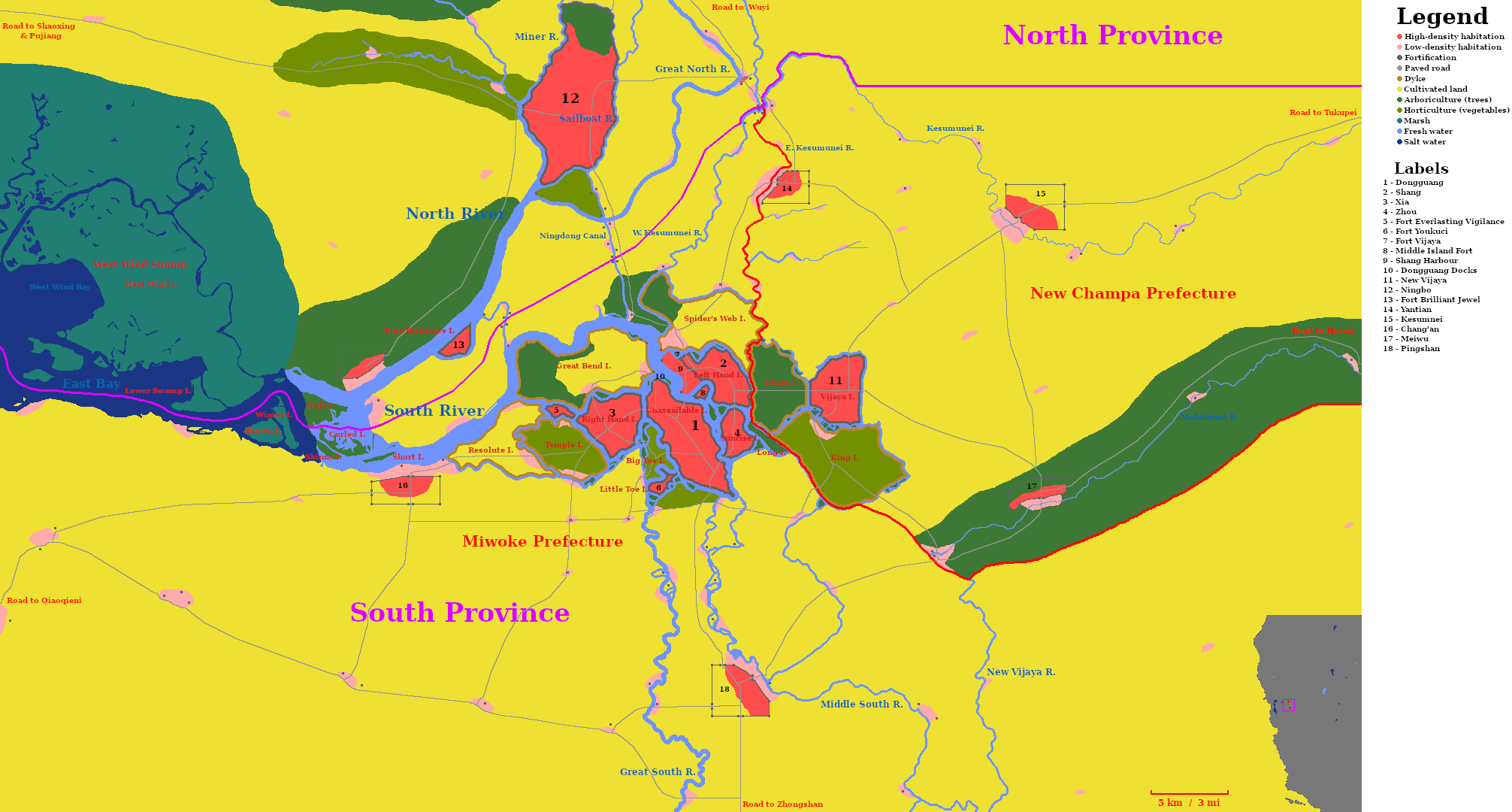
From Shang to Ningbo is a mere nine mile stroll along the paved road between the two. Alongside the road is a canal, called the Ning-Dong Canal, the name being taken from the first syllables of Ningbo and of Dongguang. Lining both sides of the road and canal, both north and south of the border were a series of blockhouses built so the Northerners and Southerners could keep an eye on each other. Bai Guguan had stripped the garrisons of the Southern blockhouses down to a skeleton crew to watch the border. No one had bothered clearing out the border guards since the fall of Dongguang, so these men hid inside their blockhouses and watched as the combined Hue-Mexican army marched on by. Small villages also lined the road, but the inhabitants of these had already fled when they saw the Sangjun pouring out Shang’s gate. North of the border, all the villages and blockhouses were empty. It seemed to be a clear road all the way to Ningbo.
Unlike Dongguang, the Northern capital wasn’t situated on a series of islands, nor was it split up into five administratively independent cities. Ningbo was a single city situated between the Miner and Sailboat rivers, which joined one another at Ningbo’s southern tip and together flowed into North River just south of that. Along the city’s northern edge, a canal joined Miner River to a small creek that flowed into Sailboat River so that Ningbo was surrounded by water on all sides.
Bai Guguan had found the provincial militia’s paper strength wasn’t an accurate reflection of its actual strength; Wei Yonglong had found his own militia to be similarly lacking. However, he could afford to recall his army that was campaigning in the Pit River country. Unlike Bai, Wei didn’t have settlers in hostile territory to protect. His army and fleet were also much closer to home that Bai’s were, given that the Red Rock River was over the mountains and across a desert from the southern end of the Valley, whereas the Pit River country bordered the northern end of the Valley. Wei’s men could simply hop their boats and sail on downriver to Ningbo, which is exactly what they did.
Between recalling the Pit River Expedition and scraping together men from various other sources, Wei had 6,000 soldiers and militia and 20 warships to defend Ningbo. Against this were 10,000 Mourning Braves and 6,500 Mexicans (500 had been left in Shang) with 12 warships—though the Mexican warships were bigger and had more cannons than Wei’s.
Having been warned of the impending attack by Mao Fulong’s messenger, Wei decided to launch an ambush. But where to hide them? The Valley is extremely flat, so there were no hills to hide behind, and all of the land in the Valley Delta region was given over to cultivation, so there were no conveniently-located trees either. There was only one thing high enough to hide behind, and that was the wall of Ningbo itself.
During the night, Wei seized all watercraft in the city and in the nearby villages and anchored them in the bend in Miner River just upstream of where it meets Sailboat River. There, the river bends into the land and then away again so the land forms a hook pointing away from Dongguang. Here, Wei made 3,000 of his men lie in wait starting at sunrise. From the Ningdong Canal, the army would be invisible behind Ningbo’s walls.
The main branch of North River crosses the Ningdong Canal about halfway between the border and the walls of Ningbo. Standing on the walls of the city were two men and a firework. From their vantage point, they could easily track the progress of the invading army.
It was around mid-afternoon when the invaders were where Wei wanted them. Once the Mexican ships had passed into the section of the canal north of the river that crossed its path, the two men lit the firework. It shot into the air and exploded over the city. On cue, Wei’s men lying in wait raised anchors and unfurled their sails or put oars to water. Sweeping out from behind the city walls, they went downstream and then up the main branch of North River to arrive behind the enemy army. Meanwhile, the city gate opened and the rest of the Northern army poured out.
Alonso Flores was not caught flat-footed, however. Knowing something like this might happen, he’d warned his men ahead of time to make sure their muskets were loaded and the matches lit, and to be ready for an ambush. Thus, by the time Wei’s men were landing their boats along the northern banks of the river, the Mexicans were already in something resembling a battle formation. Northerners were leaping out of their boats when a hail of Mexican arrows and bullets tore into them, and they scrambled to return fire.
With his rear secure for now, Flores turned to the van. Thinking quickly, he had his pikemen form up facing the Sangjun—and not a moment too soon. Huế Thành Học was a simmering cauldron of rage being so close to the man who murdered his cousin and he could contain himself no longer. His own men formed up quickly and charged into Flores’ still-forming battle-line. Meanwhile, he personally led a few hundred cavalry around the flank to slam into the Mexican army from the east while Flores’ cavalry rushed into a disorganised counter-charge.
Wei’s men coming from out of the city arrived at Thành Học’s back. Why the governor had chosen to attack from both sides when he’d presumably been told (the letter’s exact contents have not been preserved) Flores would be in the front is not known. Most likely, he didn’t trust Mao much and so opted for a battle plan he believed would work even if he had to fight alone. This had the unfortunate result that the Northerners and the Sangyong started skirmishing. Neither side spoke the language of the other, and the Northerners weren’t entirely sure whose side these soldiers in white were on, which had the predictable outcome that someone—no one knows who—fired a gun at the other. Both sides traded gunshots and crossbow bolts, but were reluctant to charge each other. Fortunately, Wei Yonglong himself was watching the battle from the walls and, seeing the Sangyong were attacking the Mexicans, he sent out a messenger who ordered his men to withdraw back to the gate.
The unfolding battle was a chaotic one. None of the three parties present had time to properly form up, so they fought with half-formed battle lines. It didn’t last long. Even with Flores’ quick thinking, his army was doomed and they knew it. First to break was the cavalry, who tried to gallop through the rice patties toward Shang, but quickly found themselves stuck in the mire of the flooded patties. With the enemy closing in, they abandoned their horses and fled on foot.
So long as Flores remained alive, however, he was able to keep the infantry fighting. There was only one way out: over the bridge behind them and back down the road they’d marched up to get here. Otherwise, they’d be stuck on the wrong side of the main branch of North River. Ordering Juan de Oñate to take half the infantry and break through the lines toward the bridge, Flores took command of the vanguard, which was now fighting a rearguard action against the Sangyong to guard Oñate’s flanks.
Mao Fulong, Zhou Xiang, Benito Aguilar, Mei Nai, and the Yao brothers were sent with Oñate, who kept them where he could see them. Mei Nai was said by Oñate to be grinning like a demon and no longer responding to Benito Aguilar’s attempts to communicate with her.
Meanwhile, an equally fierce and disorganised battle was unfolding in the water of Ningdong Canal itself. Wei’s warships split in half and approached the Mexican warships under the command of Marco Melendez y Vargas from either end of the canal. So long as the Mexicans on shore were fighting, Melendez held his ground—or his water, as the case may be. Subordinates begged him to break through and withdraw, but he refused to consider abandoning his cousin.
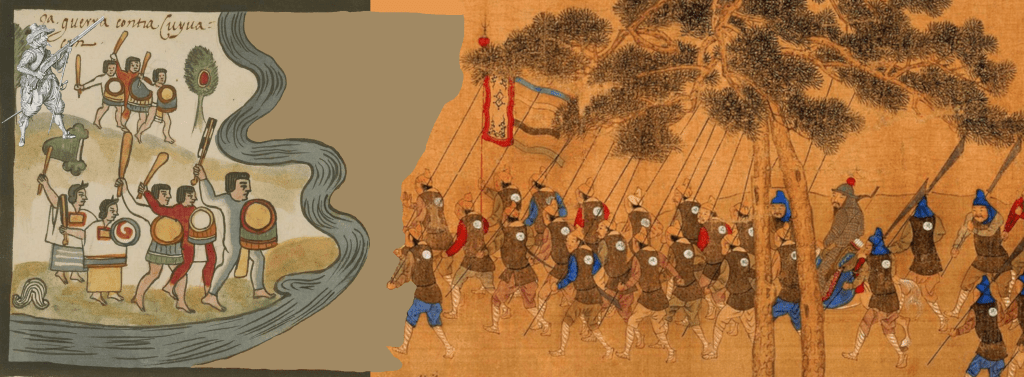
Oñate led a desperate breakout attempt by assaulting the Northern militia on the banks of North River. They resisted at first, but broke under the relentless assault and withdrew into the rice patties to the east. Oñate kept on charging straight across the bridge and never looked back. He said later that he believed Flores would be right behind him, but it isn’t hard to imagine a man faced with almost certain death rushing to get as far from the situation as possible.
The way was clear. They could retreat now. No one bothered waiting for orders to do so. The Mexicans simply ran. Many dropped their weapons and armour to run faster. Wide as the bridge was—it was designed to handle a great deal of daily traffic between the two biggest cities in North America at the time, after all—it wasn’t wide enough to accommodate all the Mexicans at once. Men were crushed in the press, some fell over and were trampled to death, and others fell off the bridge into the water where the current swept them away.
Alonso Flores attempted to maintain some semblance of order and succeeded, for a little while, in convincing a few hundred men around him to keep fighting to cover the retreat of the rest. However, he was shot in the throat by a crossbowman and fell to the ground, never to rise again.
Staying close to Oñate, Mao Fulong and Zhou Xiang were among the first across the bridge. Once they were on the other side, Zhou Xiang’s account of the battle records that Mao Fulong said to him:
“Now’s our chance: the Mexicans are thinking too much of themselves—run!” Before the two of them could run, however, Yao Guadimo plunged a dagger into Mao’s back.
“Tlaxcallan traitors die,” he said as he did so. His brother stood next to him, both of them armed with discarded weapons from the ground. Zhou Xiang was outnumbered and unarmed, so he obeyed his uncle’s last command; he ran.
From the canal, Marco Melendez saw the Mexican army breaking up as it crossed the bridge and fled up the road toward Dongguang. Now, he decided, it was acceptable to withdraw. Giving out orders for the rest of the ships to form up around his flagship, he charged the Northern warships to the south of him. Breaking through the lines, he sailed hard southward, passing the soldiers on the ground as he did so. Before too long, however, it became clear that the fleet wouldn’t be escaping this so easily. After the departure of the Mexicans and Sangyong, the Maomao had seized fishing boats from some of the nearby villages and lined them up across the canal near where it joined South River. Anchors were dropped and the boats were tied together, thereby blocking off the whole canal. Cannons were removed from Dongguang’s walls and now lined the shore along with 3,000 Maomao.
500 men had been left behind in Shang, and when they saw this happening they attempted to send men to warn Flores about it. However, the Maomao blocked the north gate, thereby bottling the Mexicans up inside Shang. The only other ways out of the city by foot were either through Dongguang or through New Vijaya, and any boats attempting to leave the harbour would come under fire from Dongguang’s walls.
By the time Melendez realised the canal was blockaded, it was too late to turn around, since Wei’s warships were hot on his heels. He decided to take his chances with the blockade. Perhaps he believed he could simply ram it and break through, because that’s exactly what he tried to do. The biggest ship in his fleet slammed at full speed into the blockade. This failed to break it, so the sailors armed themselves with axes and jumped overboard onto the blockade, where they started chopping it to pieces. The Maomao tried to get close to chase them into the canal, but the ship’s cannons drove them off. Since they couldn’t get close, the Xinguans decided to do the next best thing: they set the blockade on fire. Flames engulfed the first fishing boat and slowly made its way toward where Melendez’s ship was lodged at the centre of the blockade, which prompted the Mexicans to redouble their efforts at hacking it to pieces.
Meanwhile, Melendez’s other ships duelled with the artillery on land. Flaming arrows loosed by archers on shore pelted the Mexican ships, threatening them with being engulfed in fire: the sailors worked frantically to put out any tiny flame while returning fire with cannons and muskets. Before long, Wei’s ships arrived and caught Melendez between a rock and a hard place. Eight of the Mexican ships turned to fight the newcomers. With one ship lodged in the blockade, Melendez’s options were few. Either abandon that ship and attempt a breakthrough to the north, abandon all his ships and attack the enemy on shore, or surrender. None of these appealed to him, so he chose the fourth option. Another Mexican ship rammed the blockade. This failed to break through, but the sailors jumped out and helped their comrades chop their way through. Two crews working greatly sped up the process and soon they’d disconnected a section in the middle from the rest of the blockade. It still had a Mexican ship lodged in it, and with the wind filling the ship’s sails, the ship began pushing the broken section into South River. A cheer rose among the Mexicans as the first ship made it through the blockade. Soon, the rest disengaged and, one by one, sailed through the blazing blockade. Many of the ships were in bad shape and quite a few sailors had been lost, but the fleet made it back to Shang without losing a single ship. Rather than risk coming under fire from Dongguang by entering the harbour, they sailed over to Fort Vijaya outside the range of Dongguang’s guns, anchored in the river, and used smaller boats to reach the shore.
By this time, the sun was slipping behind the horizon. The Maomao returned to Dongguang and Thành Học set up camp for the night, which enabled Oñate to lead the shattered remains of the Mexican army safely inside Shang’s walls under cover of darkness. Stragglers kept on arriving individually and in small groups throughout the night and into the morning.
7.4 – The Siege of Shang (July 27th, 1576)
July 27th dawned clear and warm with crows feasting on the bodies of the slain. The Mexican army had lost its commander and 4,000 men killed, captured, or missing, along with 1,000 horses captured by the enemy. By contrast, it’s estimated that Wei, Thành Học and Mao’s men took less than 1,000 casualties altogether.
However, Mao Fulong’s death at the hands of Yao Guadimo had left his army leaderless as well. Zhou Xiang was unable to take over because he was hiding in an orange tree on the wrong side of South River. In his mind, everyone wanted him dead or in chains: the Mexicans would kill him for betraying them, Thành Học would kill him for working with the Mexicans in the first place, and the Northerners could never be trusted at the best of times, so he was waiting for nightfall to make his way back to Dongguang. That left the Southern capital in the hands of the commander of the Danmian garrison; a man by the name of Liu Qiangping. Liu had been appointed commander of the garrison by Mao Fulong soon after he’d taken office in 1572. He’d been with the army ever since the evacuation of Danmian and had been closely advising Mao on all of his military decisions since then.
On July 27th, the Sangjun arrived at the north gate of Shang with 10,000 men. Alongside them were Wei Yonglong’s 20 warships and 6,000 men in their commandeered watercraft. Thành Học sent Mei Nai forward under a white flag to invite the Mexican commander to parlay. Soon, Marco Melendez, Juan de Oñate, and Benito Aguilar came out the gate and met Thành Học, Wei Yonglong, and Mei Nai at the landward end of Shang’s northern bridge.
Negotiations quickly stalled because at the outset, there was a rift between the Xinguans present. Wei Yonglong wanted to get the Mexicans out of Xinguo as quickly as possible so he could get back to his war in the Pit River country. Therefore, he was willing to let them leave immediately with all their stuff and even the loot they’d taken while in Shang. Thành Học saw things differently. Alonso Flores may have been dead, but the Hue prefect wasn’t done: Thành Học demanded the Mexicans hand over all their warships and all their firearms, including both cannons and muskets, as well as any loot they’d taken since entering Xinguo. This was too much for Melendez, who said he’d rather die than live with the shame of agreeing to such a deal.
Hours were spent getting nowhere. Melendez and company returned to Shang without anything being agreed to. Oñate records that Wei Yonglong was angry, but Thành Học was smiling and Mei Nai looked happy as well. Thành Học couldn’t have done a better job torpedoing the negotiations if he’d tried—In fact, that seems to have been exactly what he wanted.
Wei set up camp at the confluence of the Ningdong Canal and South River, where he said he’d be keeping an eye on the proceedings but refused to promise any kind of help. Thành Học, meanwhile, prepared the siege lines.
Occupying the northern banks directly across from Shang was a suburb called Little Shang. Buildings would provide cover for Thành Học’s men as they approached the bridge to assault the city, negating the need for trenches. There was a problem, however, namely that he had no siege weapons. No cannons had been brought from Hue because they would’ve slowed him down on the march to Danmian. In lieu of cannons, he had his men begin building a ram to break through the gate.
In the meantime, Thành Học reached out to Liu Qiangping.
Thành Học wrote out a letter and gave it to a pair of messengers who were given a boat to reach Dongguang. Along with the letter, they were also given Mao Fulong’s body, which the Sangyong had recovered from the battlefield. Arriving at the Dongguang docks, the messengers were met by Liu Qiangping, whereupon they handed over the letter and the body. In his letter, Thành Học claimed not to know the identity of the assassin who murdered Mao Fulong. Whether or not this is true cannot be said with certainty. Mei Nai and the Yao brothers were with the Sangjun at the time, but whether they’d informed Thành Học about the details of Mao’s death was never recorded. What can be said with certainty is that Liu Qiangping believed he was being lied to. He told the messengers to get off his pier and if they came back, they’d be shot.
Without Liu’s help, Thành Học was stuck. He could only assault Shang via the northern gate. There was no other way of getting inside without going through or around New Vijaya. Prefect Pâl Karutdrak still had the city locked down tight: the gates opened for a few hours around noon every day to allow farmers and merchants in with essential goods, but they and their cargo were meticulously vetted to make sure no spies or enemy agents were being let in. Thành Học sent messengers to ask for Pâl Karutdrak’s help, but the guards refused to let them in.
There was only one thing left to do. Assaulting a fortified city at only one point and without any cannons would be insane, regardless of how shattered and exhausted the defenders were. To make a new way in, Thành Học sent squads of men to all the villages and towns in the area to commandeer as many boats as they could get their hands on before bringing them all back to the Sangjun’s camp.
This process was partway done when European-style ships flying the Cross of Burgundy sailed past the Sangjun and docked in Shang harbour. A wave of dread washed over the Sangyong, who believed their enemy had just received reinforcements and would therefore be a much harder nut to crack.
Nothing could be further from the truth. Inside Shang, the relief was palpable at first, but quickly gave way to despair. To understand why, we must back up all the way to 1557.
7.5 – Sailing for Home (June-July, 1576)
In March, 1557, refugees fleeing the devastating earthquake that hit China in 1556 began arriving on their new plots of land in the Red Rock River country. The Red Rock is a mighty river that flows through mountains, canyons—including Grand Canyon—and deserts before emptying into the gulf between Long Peninsula and what would later become northern Mexico. Typically, the Red Rock country is understood to refer only to the lands below Grand Canyon. It was inhabited by the Cloudy Tribes, a collection of Hokan-speaking peoples (and one Nü tribe) who made their living by hunting, gathering, and fishing on the Red Rock and its tributaries. Also present at the time was Lake Tahuise, a large, shallow lake through which the Red Rock flowed, that provided an abundance of fish for those who lived on its shores. It no longer exists due to shifts in the Red Rock’s course.
This was where the bulk of South Province’s navy had been since 1572. With the Wokou no longer a serious threat to Xinguan shores, Bai Guguan sent his navy to patrol the waters of the Red Rock. For the four years from 1572 to 1576, they sailed up and down the river and its navigable tributaries denying water access to any Cloudy Tribal villages who were not on friendly terms with South Province. That is to say, whenever they came across a village that wasn’t flying the red banner of South Province—given to them by local authorities to signal their friendship with the Southerners—they blasted it with their cannons, no questions asked, until they didn’t see anyone moving in the village. Then they burned the remains to the ground and enslaved any survivors who hadn’t fled.
Any villages who wouldn’t sign treaties with the Xinguans on the Xinguans’ own terms were thereby denied access to water—and fishing spots—except in sections of rivers that the Southern warships were unable to reach. This was calculated to force them into signing treaties where they would sell most of their land and agree to sit quietly in some out-of-the-way place where they could safely be forgotten.
Harsh as the strategy was—and people throughout history have indeed been unkind toward to the Southerns for adopting it—it worked. By 1574, most Red Rock tribes below Grand Canyon had either signed treaties or moved somewhere out of reach. In 1575, settlers could breathe easy. For the first time in nearly two decades, they could go relieve themselves without having to take a loaded crossbow.
Everything changed when, on June 21st, 1576, Bai Guguan received news of the Acapulco Armada’s presence just offshore, sailing hard for the Jaw. That was when he began trying to raise an army to fight them, but quickly found it was hard to get enough armed men together who were willing to follow his orders; thus, his hopes were pinned on the Southern Fleet patrolling the Red Rock. That same day, June 21st, he sent a messenger to recall the fleet.
This messenger had to sail up South River, take the Hue canals to Oak River in order to reach the ocean, then sail down the coast and around Long Peninsula to reach the mouth of the Red Rock. Once there, it took around a week for the Southern Fleet to recall all its ships out on patrol. Leaving only a handful of warships behind, 30 ships set sail for the Jaw in the second week of July. Because they were all flying the Southern red banner, they were called the Red Banner Fleet. Also onboard were 1,000 men of the provincial militia who’d been stationed along the Red Rock, plus a few hundred marines attached to the fleet.
In command was a man in his mid-forties named Bai Xunqiu, half-brother of Bai Guguan. Bai Shunyong, the previous governor, had struggled to have a son: Guguan was born to Shunyong’s wife Lady Zhan in 1511, when Shunyong was 41. Late in life, Shunyong took a much younger concubine by the name of Lady Xin, who gave birth to Bai Xunqiu in 1532. Since South Province was run like an autonomous client state of the Ming Dynasty, and since the Bais were kings in all but name, Xunqiu was raised like the younger brother of a crown prince would be. He lived in the lap of luxury, was given the best education, and when he grew up, he was given responsibilities the family couldn’t entrust to other people. Yet, he was always kept just out of reach of true power. Xunqiu would never be governor and he knew it.
When settlement of the Red Rock country began, Xunqiu was eager to join in. To him, it was a chance to take control of a major project somewhere far away from the meddling influence of his brother. There, he could rule like a little king in his own right. Bai Guguan was happy to let him get involved because it would place him far, far away from the centre of power in Dongguang. Xunqiu went to the Red Rock country in 1559 as an officer in the army. Slowly working his way up the ladder, he finally got himself appointed as commander of the fleet in 1572, just in time to begin the campaign of terror against intransigent villages on the Red Rock.
Upon leaving for Dongguang in 1576, he couldn’t have imagined what lay ahead of him.
Predictably, however, having the fleet abandon the theatre along with a sizeable chunk of the local garrison had the effect of eliciting violence in the Red Rock country again. Villages that had signed treaties under duress repudiated them and began joining a new pan-tribal alliance instead, one that promised all things would be restored to the way they used to be if the Xinguans were expelled from their lands. But that’s another story for another time.
On July 26th, the Red Banner Fleet arrived at the Jaw. The Spanish officer in charge of the Mexican garrison left behind at the Tooth Forts immediately realised he had no real chance against 30 ships of varying sizes and capabilities with the 4 warships Flores had left him with. Even if he could hold the Red Banner Fleet off on land, he’d be stranded with no hope of resupply without his ships. During the trip from Danmian to Dongguang, Flores had informed the Tooth Forts’ garrison of where he was going, including instructions on how they could get there too. After some brief skirmishing, the Mexicans withdrew and fled for Dongguang to link up with the main force. They arrived in the middle of the afternoon on July 27th and delivered the devastating news: they’d failed to secure the expedition’s rear, the Tooth Forts had been lost, and an enemy fleet was hot on their heels.
Marco Melendez, having taken overall command after the death of Alonso Flores, made preparations to shore up his defences. Weapons stored in Shang by the Xinguans were taken out of storage to replace the ones dropped along the banks of the Ningdong Canal. Ships damaged during the battle had to be repaired, but for that they needed to be docked in the harbour. Across the river, the Maomao occupying Dongguang hadn’t fired on the ships from the Tooth Forts as they entered the harbour, so Melendez took a chance and had the rest of his ships dock there too. No shots were fired from Dongguang.
Meanwhile, Liu Qiangping decided to reach out to the Mexicans for help. Even though he was well aware that Mao Fulong had betrayed them and was responsible for the ambush and Alonso Flores’ death, and he figured Melendez had probably worked out what’d happened, Liu calculated that given the situation they were in now, it was impossible for them to refuse to work with him. Therefore, he resolved to find someone who could speak Nahuatl.
Unlike in Danmian, this wasn’t hard to do in Dongguang. This was the headquarters of the Dongguang Silver Society, after all: it’d be far easier to find an interpreter willing to work with him just by sheer dint of how many Nahua-speaking merchants lived in the city. So he found one; none other than Zhang Tangyang, former manager of the Spanish Silver Syndicate’s warehouse in Dongguang. Ever since his workplace had been blown up, he’d been unemployed and in desperate need of work to feed his children. As soon as Liu Qiangping put out the word he needed an interpreter who spoke Nahuatl and/or Spanish, Zhang pounced on the opportunity. Liu sent Zhang under a white flag to parlay with the Mexicans in Shang Harbour late in the afternoon. Melendez agreed to meet Liu on Dongshang Bridge right away.
In the light of the gathering sunset, both sides agreed that holding onto Dongguang and her sister cities was no longer feasible. Evacuation was no longer merely an option: it was a necessity. Liu offered to bring the Mexicans back to Danmian overland. Since the Sangjun was stuck north of South River, they could simply march out the southern gate of Dongguang, be back in Danmian in three days, and no one could hinder them. Melendez wasn’t prepared to agree to this, however, since it would mean abandoning his ships. Liu urged him to reconsider, but couldn’t change his mind.
Both parties then spent the rest of the night packing up supplies so as to be ready to leave on a moment’s notice.
At dawn on July 28th, the Red Banner Fleet entered South River and stumbled upon an incomprehensible situation. Dongguang and her sister cities were all flying the Cross of Burgundy, which was an unwelcome shock. Across the river was the Hue army—recognisable by their banners—all dressed for a funeral and camped on the opposite side of Dongguang from their home city. That they were besieging the city was clear from their positioning and the trenches they were digging. Just downstream was an army and fleet flying the black banner of the North, but they were just sitting there. Bai Xunqiu had no conception of how to begin processing what was happening.
Fortunately for him, Wei Yonglong decided not to leave him hanging. As soon as he spotted the Red Banner Fleet coming upstream, he sent out a messenger in a boat to inform the admiral of what was going on. Armed with a basic run-down of the situation, Xunqiu decided to meet with Huế Thành Học to decide on a course of action. Anchoring his ships next to Thành Học’s camp, Xunqiu went ashore and was quickly ushered into Thành Học’s command tent. Thành Học filled in the details of the situation as he saw it and requested Xunqiu’s help in liberating the capital. Xunqiu agreed.
Preparations for the first assault began immediately.
7.6 – The Battle of Shang Harbour (July 28th, 1576)
The Battle of Shang unfolded in two parts. Huế Thành Học would assault the northern gate with the ram they’d built, but the main thrust would come via Shang Harbour. Ships from the Red Banner Fleet would keep the guns of Dongguang and the Mexican fleet busy while thousands of Sangyong would cross over into Shang Harbour. Of course, between the harbour and the city stood a section of the curtain wall preventing them from just strolling in, and they didn’t have any rams or ladders to assault them with. But that would only have been necessary if getting past the wall had been the point.
It was around ten o’clock when Red Banner ships pulled up their anchors and turned toward the harbour. Earlier that morning, Marco Melendez had left command of the ground forces in Juan de Oñate’s hands and took those of his warships that were still in fighting condition—which was eleven, including the four that came from the Tooth Forts—outside the harbour ready to respond to a riverine attack. When the Red Banner ships came toward them, the Mexican ships responded in kind and battle ensued. While the Mexican ships were occupied, smaller boats were launched from the northern shore and swarmed across the river.
Five thousand Xinguo-Vietnamese braves dressed in white robes under their armour waded through the water alongside the 1,000 men of the Southern provincial militia, all of them armed with swords, halberds, pikes, and crossbows. Some of them lined up facing the gates into the city, ready to cover the flanks of the rest in case the Mexicans reinforced the harbour.
Meanwhile, the main thrust of the attacked head down to the piers. Mexican sailors were working on repairing the damaged ships under the guard of a few hundred soldiers. All of them grabbed their weapons and were ready for an assault when the Xinguans arrived. Fighting was fierce; the Mexicans knew these ships were their only way home. Nevertheless, the 1,000 or so sailors and a few hundred soldiers were outnumbered nearly four-to-one. They were slowly pushed back. As soon as they were able, squads of Xinguans broke off from the main group and headed for the ships docked at the piers. Upon boarding the ships, they gathered whatever kindling they could find—or simply dumped a pile of gunpowder on the deck—and set it on fire before beating a hasty retreat back to land. Soon, half the Mexicans’ ships were engulfed in flames.
By this time, Juan de Oñate was exiting the city at the head of a column of troops headed for the docks. Immediately coming up fire from hundreds of rocket arrows, the column had to split up and take cover among the buildings.
Before street fighting could break out, however, the call for a withdrawal went out amongst the Xinguans, who duly fell back to the northwestern corner of the harbour district. Here, they dug in and waited for the Mexicans.
Fighting continued for the rest of the day. Multiple assaults were launched on the northern gate, all of which failed to capture it. Neither could the Mexicans dislodge the Xinguans from their foothold in Shang Harbour. Meanwhile, fire from the burning ships spread until half of the harbour had become a towering inferno. Finally, Thành Học ordered his men to abandon the foothold for fear that the fire would succeed where the Mexican soldiers failed.
When night fell, the inferno cast an eerie orange glow over the scene of the battle. Hundreds had fallen on both sides, their bodies now consumed by the flames. Four Mexican ships had sunk to the bottom of the river taking many sailors with them. To their credit, they gave worse than they got, having sunk seven Xinguan ships—although part of that was thanks to the guns of Dongguang, which aided their allies throughout the battle.
Huế Thành Học looked on the scene with satisfaction and announced to his subordinates that now the invaders and their treasonous allies would be forced to surrender or abandon their fortified position. And indeed, the latter is exactly what happened. Once the Red Banner ships had withdrawn and the sun set, the Mexican warships docked at the Dongguang docks. Dongguang’s docks were a rather modest affair, consisting of a few piers jutting out from the dyke at water level. Stairs led up to a precipice on top of the dyke, and from there a gate led into the city. Marco Melendez, who’d been wounded in the fighting, was carried into Dongguang on a stretcher to the governor’s palace. From there, he sent men to Shang with orders to withdraw. Now that their transports had been destroyed, there was no other choice: they had to escape by foot. Of course, getting to Shang necessitated the messengers first go east to Zhou before going north to Shang.
Whatever the Mexicans could carry with them was taken. Everything else of value was destroyed. Cannons on the walls were spiked. Meanwhile, the same process was being carried out in Dongguang, Zhou, Xia, and the island-fortresses. Explosions rocked the island-fortresses and the cities themselves as gunpowder that had to be left behind was torched. The remaining seven Mexican warships were also torched. Just before dawn, after a sleepless night of preparations, an exhausted army of Mexicans and Maomao marched out Dongguang’s south gate and headed down the road toward Danmian.
7.7 – The Aftermath of the Delta Campaign (1576 – 1589)
On June 28th, 1576, Spanish diplomats departed Cadiz on a mission from King Felipe II himself. On November 15th, they reached Beijing. They performed the kowtow to the Wanli Emperor as Chinese court etiquette demanded and gave him a gift of Spanish silver. In exchange, the received silk and porcelain of the finest quality for Felipe II. Afterward, they spent several months in Beijing hashing out a peace treaty. Peace was signed in January and was taken back to Madrid to be ratified. Effective April 12th, 1577, China and Spain were at peace.
China agreed to concede the Philippines as part of Spain’s sphere of influence, and in exchange a Spanish embassy would visit China every two years to offer tribute to the emperor. Thus added to China’s tributary network, Spain was officially given permission to trade in Chinese ports—including those of Xinguo. Restrictions on their movements were heavy, but Xinguan merchants couldn’t be happier to welcome them with open arms, and Xinguan governments had always been more open to foreign trade than China typically was. What this meant was that despite having the right to trade in Chinese ports, Spanish merchants mostly traded in Xinguan ports, where they had far more leeway to act as they desired. Tariffs were also generally lower.
And so it is that our story draws near its end. Once news of the peace treaty arrived in Xinguo in July, 1577, thriving trade resumed between North Province on the one hand and New Spain and Peru on the other. Armed conflicts would continue in South Province for quite some time, but from here on they are no longer Xin-Mei wars so much as they are Xinguan civil wars and they are therefore beyond the scope of this work. That being said, I cannot simply leave my readers hanging. I will endeavour to summarise the events of the following decades in as succinct a manner as I can without glossing over too much.
Following the Battle of Shang Harbour, Wei Yonglong withdrew to Ningbo. From there, he went back to prosecuting his war against the Pit River tribes—although he always kept a standing army of 3,000 soldiers stationed in Ningbo in case of emergency. Aside from recruiting more soldiers into the army, he also began looking for ways to reform the provincial militia so that its actual strength would match its paper strength.
Defeated, the Maomao and Acapulco Expedition withdrew on foot to Danmian. On the way, Marco Melendez y Vargas died of his wounds, leaving Juan de Oñate in command. Left in a foreign land with no way of getting home, Oñate signed on with Zhou Xiang as essentially a mercenary. Since China and Spain were still at war at the time, Oñate explained this to his men as merely another phase of the war. After news of the peace treaty reached them in late 1577, the Mexicans slowly filtered northward, where they gained passage on merchant ships back to New Spain. Other Mexican adventurers replaced them, working for all sides of the civil war as mercenaries, but most worked for the Maomao. Juan de Oñate himself didn’t leave Xinguo until 1588, remaining in Zhou Xiang’s service the entire time.
Speaking of Zhou Xiang, he eventually did make it back to Coastal Prefecture. Liu Qiangping was happy to leave political leadership of the prefecture to Zhou Xiang as long as the latter put Liu in charge of military affairs.
Huế Thành Học pursued the Maomao and Mexicans into Coastal Prefecture, where he quickly captured Danmian and several other major towns, but soon found himself bogged down in a guerilha war against fifty or so militia groups organised to defend the prefecture against him—and in addition to that, the Mexican army was still at large. Although much reduced in number, the Mexican army was still a force to be reckoned with. Lost in a foreign land far from home, they had nothing to lose and every reason to stick together.
Bai Xunqiu took control of Dongguang in the absence of any other authority. Early in August, he was joined by Bai Guguan’s widow Lady Jiang and her son Junli. Bai Guguan had sent the two of them away from Dongguang for safekeeping when the city was under threat of siege, and it was a good thing he’d done so or they likely would’ve ended up as dead as Guguan did. Although Junli was a man in his thirties, he was timid and mentally handicapped. Lady Jiang, by contrast, was a strong-willed woman.
The sudden death of Bai Guguan and return of Bai Xunqiu placed Lady Jiang and her son in a difficult position. Traditionally, the son of the previous governor had to travel to China to kowtow before the emperor in order to be confirmed as the next governor. It was something of a humiliation ritual to remind the governors of where they stood. However, with Coastal Prefecture in open rebellion and New Champa Prefecture dedicated to radical neutrality (Pâl Karutdrak was still refusing to let people from outside his territory into his city and was rigorously enforcing closed borders on the whole prefecture), Lady Jiang was unsure of where the rest of the province stood. Control of the situation balanced on a razor’s edge and leaving on a year-long trip to China could result in everything falling apart.
Bai Xunqiu assured her that he’d take care of everything in her absence. But Lady Jiang decided she would not go to China and neither would her son. Instead, she sent Bai Xunqiu to China to kowtow to the Wanli Emperor and receive confirmation of Bai Junli’s ascension to the governorship. Her exact reasons for doing this are unknown. She may have been afraid the emperor would declare her son unfit to govern if he saw Junli in person, or she may have believed Xunqiu would consolidate his own hold over South Province while she was gone.
Whatever the case may be, Xunqiu was sent on a year-long trip to China while Lady Jiang consolidated her hold on the province. Getting hold of the situation was no easy matter, however. Huế Thành Học suffered a major defeat and lost control of Danmian in late 1576. Skirmishing broke out along the New Champa Prefecture border in early 1577, which prompted Lady Jiang to send the provincial militia to force compliance on Pâl Karutdrak. Pâl raised the flag of rebellion, crushed the militia sent to arrest him, and began launching raids into Miwoke Prefecture. Rebellions broke out among the Youkuci and Miwoke peoples. The Toumoluo people (who lived on the coast just across the mountains from the southern tip of the Valley) went to war with the Southern merchants and settlers operating within their territory. Ethnic strife broke out in June in the Hue Triangle between the Xinguo-Vietnamese settlers and more recent immigrants of Chinese and Filipino descent, who felt they were being treated as second-class citizens. Militia from the neighbouring East Bend Prefecture invaded the Hue Triangle in support of their Chinese kin, which forced Thành Học to abandon his campaign in Coastal Prefecture and return home to break the siege of Hue City.
Then, in August, 1577, Bai Xunqiu returned to Dongguang laden with gifts from the emperor and accompanied by 8,000 soldiers sent to pacify the rebellions in South Province. These soldiers had been placed under the command of the new governor, whose authority was confirmed in a document carried by Xunqiu. The only problem was that the man chosen as governor was Bai Xunqiu himself.
Lady Jiang fled Dongguang with her son and went to her home town of Zhongshan, capital of New Guangdong Prefecture. There, she raised the flag of rebellion, crying for the downfall of the usurper Bai Xunqiu and the ascension of the rightful governor to power. Zhou Xiang, meanwhile, claimed to represent the interests of the common man and named himself governor.
Civil war continued in this fashion for quite some time. All three major factions dug in deep and were unable to dislodge one another. Years of intense fighting raged until eventually an uneasy stalemate fell over the province. Routine incursions were made to raid each other’s territory, but no major invasions took place after 1582.
Up in North Province, Wei Yonglong watched with interest. Occasionally, the fighting would spill over into his domain. He would push the miscreants back across the border and launch a punitive expedition to punish whoever was responsible, but otherwise remained neutral. Weapons and mercenaries flowed from North to South, much to the chagrin of the Southerners, who complained often and loud that Wei Yonglong was breaking neutrality by supporting their enemies. He didn’t care. He was making money taxing weapons merchants who sold to all sides of the conflict.
Back in China, General Qi Jiguang fell out of favour with the emperor due to the death of his patron at court in 1583. Qi Jiguang was a general made famous by pacifying the pirate-infested coasts of China one province at a time in the 1560s and ’70s. During this time, he was one of the foremost proponents of the matchlock musket, which until then had not been used by Chinese soldiers. Later, he fended off several Mongol invasions. His experiences led him to write a military manual called the New Treatise on Military Efficiency. Copies of this book made it to Xinguo, where it was read by Wei Yonglong, who was impressed with its doctrines.
Events took an unexpected turn when Qi Jiguang arrived in Xinguo in 1584. Dishonourably discharged by an ungrateful emperor, he had decided to make a new life for himself in Xinguo as so many Chinese and other Asians had done before him. Wei Yonglong welcomed the ex-general warmly. Qi was immediately appointed commander of the Northern armed forces and given the task of reorganising, re-equipping, and re-training them.
Under Qi Jiguang, the provincial militia swiftly became something resembling a proper military. In 1576, they’d been a lacklustre force with antiquated weapons whose actual strength was probably one-sixth that of its paper strength. By the middle of 1586, their rolls had expanded, their equipment updated, and their training had no peer except in the professional army.
Use of the matchlock musket which Qi tried to force on them was controversial. These men were used to using their own equipment in their own way. Hand cannons (called dragon lances in China) had served their fathers and grandfathers very well in the wars of the 15th and 16th centuries against indigenous tribes and pirates alike. Nevertheless, Qi was adamant that matchlocks were far superior.
This, coupled with Qi’s draconian disciplinary standards, led to a mass demonstration in Ningbo, where armed militiamen camped outside the governor’s palace for two days and demanded he hand Qi Jiguang over so they could lynch him. Wei Yonglong stood on top of the wall surrounding the palace and placated the crowd by promising to remove Qi Jiguang from command of the militia. They still wouldn’t leave, so Wei gave every militiaman in the province a one-time monetary bonus. Most went home with bonuses in hand. A few tried to keep the mutiny going, but were arrested by the army.
Qi Jiguang was furious at Wei’s leniency. He demanded the ringleaders of the mutiny be executed. Wei calmly explained that the provincial militia made up the bulk of his armed forces—and they were only a fraction of the armed population of the province as a whole. If they rebelled en-masse, both Wei’s and Qi’s heads would be decorating the walls of Ningbo before the year was out.
Qi Jiguang continued as commander of the army and navy, but was relieved of any authority over the militia. Under new management, disciplinary measures were rolled back (which mostly meant far fewer men being executed for infractions) and equipment was largely left as it was. Despite that hiccup, both the professional military and the militia of North Province were better trained and better equipped than ever before.
Another area of friction between the general and the governor was that of archery. In Qi’s experience, matchlocks were of limited benefit against the all-time number one threat to China’s territoryial integrity; the horse-archer. Therefore, skill in archery must be maintained for times when matchlocks simply weren’t the best tool for the job. Wei assured him that the only horse-archers in America were the descendants of the Jurchen and Mongol princes who’d been recruited by the Ming to help settle Xinguo n the 15th century. As such, the only horse-archers in all of America were on the Xinguans’ side. This was true, since none of the Plains nations had acquired horses yet. The nightmare of the horse-borne Comanche raider had yet to be conceived. Qi convinced Wei to keep on a skilled regiment of archers, but Wei refused to make archery a major part of the training regimen for the whole army.
March, 1587, was when Wei Yonglong initiated the invasion of the South with 80,000 men. For the first time ever, after over a century of heated rivalry, Northern and Southern armies would clash in open battle. Eleven years since the civil war’s beginning, and still no end was in sight. Factions had risen and fallen, but the two principal contenders were still Bai Xunqiu and Bai Junli—who was by now under the influence of his wife Lady Ya, because his mother had long since passed away.
By April, Dongguang was already in Wei’s hands. Faced with the overwhelming superiority of Wei’s army, the two Bais signed a truce so they could both fight the Northerners, though there was no coordination between them. Altogether, there were probably something like 120,000 men under arms in the South. A third were loyal to Xunqiu, a third served at Lady Ya’s command, Zhou Xiang commanded one-sixth, and the rest were divided between various other factions.
Since none of these factions could coordinate with each other after eleven years of civil war, all were crushed by Wei Yonglong’s army under Qi Jiguang’s command. Bai Xunqiu and his family were captured: all were beheaded under Wei’s orders. Zhou Xiang tried to negotiate with Wei, but Wei refused to negotiate with the man who’d helped Mao Fulong sell them all out to Spain. Danmian was brutally sacked. Zhou Xiang was captured and boiled alive in 1588.
Juan de Oñate managed to lead the remaining men under his command to the coast, where they seized some ships and sailed home. In 1590, Oñate published his account of his experiences, which he titled Twelve Years in California. The name California came from the name of a fictional matriarchal queendom from a popular Spanish novel, The Adventures of Esplandián. The name is something of a misnomer, since Oñate spends two-thirds of the book exclusively recounting the first year while the rest is almost entirely focused on the Northern invasion with very little about the intervening years.
In 1589, Lady Ya committed suicide during the siege of her last stronghold. Bai Junli and their son were captured and beheaded. Their daughter, Bai Xiarong, was spared only to be forced into marriage with Wei’s son, Wei Ruzheng. On the day the wedding was to be held, she hung herself in her bedroom.
7.8 – Denouement
And so ended the War of the Provinces. The worst outcome the emperors of China feared had come to pass: one man was in firm control of all of Xinguo. Wei made a flag with a strip of Northern black above a strip of Southern red. However, he didn’t dare stop sending tribute to China. In fact, he sent more tribute than China had been receiving when Xinguo was two provinces. He also sent enough tribute to pay off the debt accrued by South Province while civil war was tearing it apart. More than likely, it was all this tribute—which nearly bankrupted Xinguo—that convinced the Wanli Emperor to overlook Wei’s conquest of his southern neighbour. The post of South Province governor remained unoccupied after the death of Bai Xunqiu.
Wei Yonglong died in 1591, but power transferred seamlessly to his son Wei Ruzheng. Ruzheng continued sending sending tribute to China and even increased the amount his father had been sending. Never once did he visit China, however, not even to be confirmed as governor. As a result, the Wanli Emperor never did confirm him: the office of North Province governor remained legally vacant from then on, even though Wei Ruzhong and his descendants continued calling themselves governors.
At last, the first volume of the Xin-Mei Wars comes to a close. Ah, but that very sentence betrays something, doesn’t it? Xinguo and Spain would go to war again, but not for another century. During that time, China suffered a change in dynasty and Xinguo was rocked by not one, not two, but three earth-shattering shifts in power that would fundamentally change the political landscape forever. That story, however, is far beyond the scope of this work. And so, until next time, this has been Sir Reginald Bacon of the Order of King George III, signing off.


 Lord of Lore
Leave a reply to Reginald Bacon, KoKG3 Cancel reply