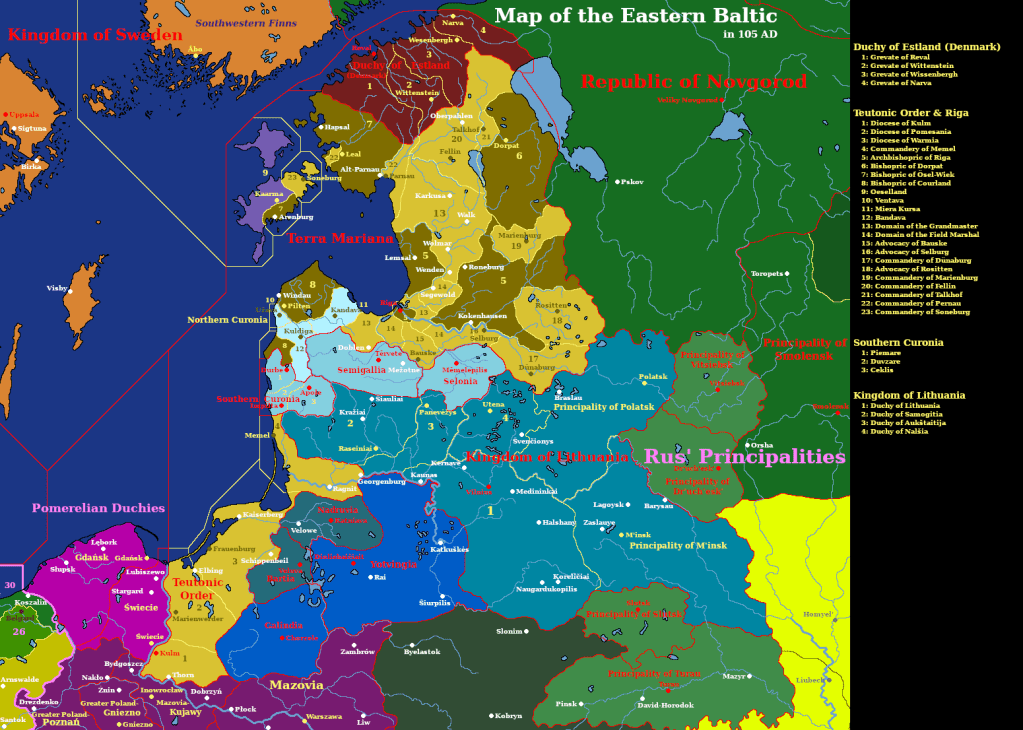
It is April, 109 AD. South of Samogitia, on land traditionally belonging to the Prusso-Lithuanian tribe called the Skalvians, lies the Teutonic fortress of Georgenburg. Pointing like a dagger at the soft underbelly of Samogitia, Georgenburg was intended to serve as a springboard to launch invasions into that intractable territory. But it also stood vulnerable to being cut off from the wider Order, and that’s exactly what the Samogitians have done. Now, they tighten the noose by blocking off the Neman River with a boom made of logs tied together. Over the winter of 108-109, the garrison Georgenburg slowly starve. In the spring, knowing of the resounding pagan victory at Durbe and losing all hope of relief, the garrison sets fire to their own castle and marches downriver, intending to break through Samogitian lines and join the garrison at Memel.
A Samogitian fort standing on a hill not far downriver is all that stands between them and freedom. Attempting to take the fort by storm, the Teutons are first repulsed and then struck in the back by Samogitian reinforcements, who crush the Teutons and kill a dozen brothers of the Order.
Tip me on Ko-Fi: https://ko-fi.com/lordoflore
Follow me on Bluesky for updates (with teasers!): @lord-of-lore.bsky.social
Or subscribe to my newsletter to get updates via email:
Meanwhile, further downriver is the formerly Skalvian fort of Ragnit, now occupied by Teutons. Local Skalvian converts to Christianity approach the fort pretending to want to sell them some food. The garrison opens the gates and comes out to negotiate with them, but the merchants reveal hidden weapons and charge inside the fort, where they overwhelm the defenders and reassert Skalvian control over Ragnit. Soon, a Lithuanian-Samogitian army jointly led by Treniota and Alminas marches through the area and the Skalvians join them. Their target is the main Teutonic castle in this part of the Baltic: Memel.
Built in 101, Memel has grown rapidly into a thriving frontier city. Calling it city is, perhaps, a bit generous, considering its population is only a few thousand people, which is small even by Medieval standards. But it is, nonetheless, a city, because it has a constitution modelled on Lübeck law and has its own Rat (city council), which enjoys a great deal of freedom despite the city being a subject of the Teutonic Order. There are, therefore, two different groups defending the city: the city militia, under the control of the Rat, and the garrison of Memel Castle, under the command of a Teutonic knight.
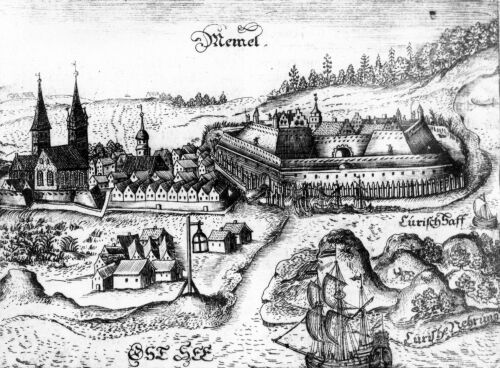
Memel sits on the coast of the Curonia Lagoon, just inside the mouth of the lagoon where it meets the Baltic Sea. When the Lithuanian-Samogitian-Skalvian army arrives in early June and lays siege to the city, they are unable to properly block off its sea access. As a landlocked kingdom, Lithuania has no fleet; only the Skalvians have brought any naval power, and theirs consists of a few fishing boats which lack the capacity to prevent ships from northern Germany coming to resupply Memel.
The problem is resolved in July, when the Samogitians build a boom across the lagoon’s mouth, cutting off access to the sea. However, in September, the defenders succeed in sneaking out to the boom at night and cutting it loose, sending the logs off into the sea. Seeking to secure it once again, Alminas calls upon the Southern Curonians to send their fleet. Skaisdis agrees, but compels Alminas to swear by the gods to help Skaisdis capture Windau after Memel falls. Alminas does so and Skaisdis sends what’s left of the Southern Curonian fleet to blockade Memel.
The siege continues over the winter and Memel’s supplies quickly dwindle. Soldiers are given half-rations while civilians are reduced to eating stray dogs and rats. In the spring of 110, the Curonians and Skalvians both build additional ships and send them to reinforce the besiegers. Birger Magnusson of Sweden, meanwhile, returns to Curonia. Hearing that a large part of the Curonian fleet is at Memel, he sends a detachment of his own fleet to Memel while he himself campaigns in Northern Curonia.
The Swedish fleet arrives in July. Approaching the mouth of the Curonia Lagoon, the larger Swedish fleet is forced into the narrow passageway, where the Curonian and Skalvian ships await. Curonian and Skalvian ships advance like a solid mass, boarding the front rank of Swedish ships. Bunched up with no room to manoeuvre, the Swedish ships in the rear are unable to help the ones in the front, which swiftly fall to pagan boarders. The pagans then turn the captured Swedish ships around and set fire to them before sending them careening toward the rest of the attacking fleet. The fire ships crash into the Swedish fleet, causing mayhem and spreading fires to the other ships. Those in the rear turn around and flee into the open sea while those caught in the middle turn into blazing hulks. Their crews jump overboard and swim ashore, where the Samogitians are waiting for them. Some fight for their lives and are killed; most surrender and are enslaved.
So the siege continues. The Lithuanians have more experience in siegecraft than other Balts, having been engaged in warfare against the Rus’ for decades. As such, they build a siege tower and ladders and make a number of assaults on Memel through August and September. Finally, in early October, 110, the starving defenders give way and the pagan alliance breaks inside the city.
Memel is sacked and many of its people are killed. Many, however, survive. Treniota takes command of the city and offers to let Christians stay if they’ll swear an oath of loyalty to him. Some leave the city behind while others take him up on the offer. Treniota installs a garrison in the castle and leaves one of his own men in command of it before returning to Lithuania to deal with matters there. Alminas, meanwhile, returns to Samogitia for the winter, promising to help Skaisdis besiege Windau in the spring.
[Next]
Credits
Memel (called Klaipėda in Lithuanian) via Wikipedia


Leave a comment