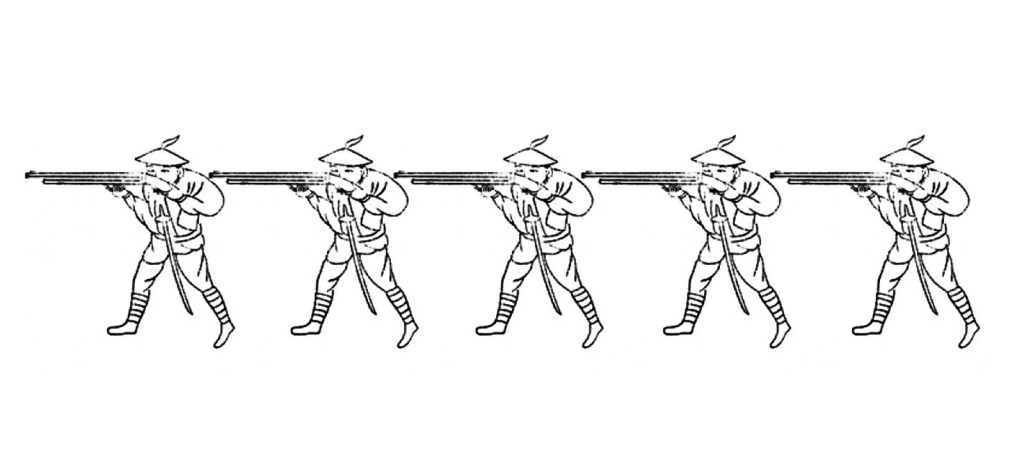
9.1 – The Battle of Indrapura (July 19th, 1612)
Sentries on the walls of Chalong Fort scanned the horizon with boredom in their eyes, as they did every day. Nothing much ever happened at this post apart from the occasional pirate attack, and those had been rare ever since the pirates suffered defeat in the Second Battle of the Jaw forty-three years earlier in 1569. None of the men now garrisoning Chalong Fort had taken any part in the Anti-Piracy War. Most had not yet been born. About a month ago, orders had come down from the very top of the chain of command to be on alert for an invading fleet coming over the ocean. Rumours abounded about why: a Ming armada had supposedly arrived in Xiaweiyi and was on its way to Xinguo, but no one knew when or where it would arrive, or even if it was a military expedition or simply the Treasure Fleet resuming its normal functioning after its failure to arrive the year before.
To put it bluntly, the garrison of Chalong Fort were not at all prepared for the hammer blow that was about to fall on that fateful afternoon. They’d received modest reinforcements in the past few months; Wei Qiangfang, Master of Two Provinces, was concerned about a potential Chinese invasion, but he had not yet called for a general mobilisation. Chalong Fort had not seen action since 1569, and the only maintenance it had received since then was a modest refurbishment in 1576. Now, in 1612, it was only a small ring of walls atop an artificial hill about a mile inland from the beach, sporting about a dozen cannons and a hundred men in the garrison.
Tip me on Ko-Fi: https://ko-fi.com/lordoflore
Follow me on Bluesky for updates (with teasers!): @lord-of-lore.bsky.social
Or subscribe to my newsletter to get updates via email:
The first sign something was wrong was that fishing boats and general bay traffic were sailing toward shore or scattering out into the bay at a frantic pace. Soon afterward, the sentries caught sight of the reason why. Visible first were the banners of the Ming Dynasty. Ming had no official flag, so the banner designers were free to mix and match symbols of imperial power how ever they pleased. Some were triangular, others rectangular, most were gold, some had red trim, some were decorated with dragons, but most were decorated with a white spot and two characters written in black: 大明, for Dà Míng, the Great Brilliant light of Chinese civilisation.
Next came white sails marked by long wooden battens spanning their width. Finally, the ships themselves came into view and the garrison’s mouths dropped. Two 500-ton warships sailed up to the fort. Unsure of what to do, the garrison watched in stunned silence. Then the warships opened fire, blasting off chunks of the rammed earth wall and obliterating the bodies of those garrison members unlucky enough to have been in the sights of the ships’ gunners. The rest dropped to the floor of the ramparts and held onto each other in terror, too shocked and afraid to even return fire. Meanwhile, two transport ships dropped their anchors near the shore and a swarm of rowboats disembarked, carrying some 2,000 men ashore. The bombardment ceased as the soldiers approached the fort. The fort’s commander, who’d been in his office when the bombardment began, wasted no time in lowering North Province’s black banner and raising a white sheet instead.
The Armada’s soldiers marched on past the fort and headed for Indrapura. Others could take the fort’s garrison into custody. About an hour later, they reached their target. Indrapura was in an uproar. With the almost perfectly flat ground of the Oak River valley, people in the city saw what happened to the fort from rooftops and upper windows, and were panicking, believing their city was about to be plundered. However, no one had any time to escape before the Armada’s soldiers were on top of them. The city’s garrison consisted of fifty Black Banner Guardsmen and two hundred militia. The militia were a mix of Northerners serving a tour of duty in the South and local Chams pressed into service. The local prefect ordered them to take up a defensive position along the river bank, but at the sight of 2,000 soldiers of unknown origin marching toward them in perfect unison, Indrapura’s defenders were shaking in their boots.
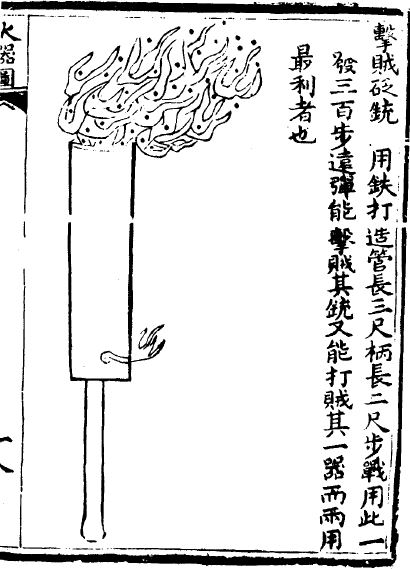
A few brave militiamen took aim with their fire lances. Holding the shaft of the fire lance under their left arms, the men pointed the small cannon at the end of the shaft in the general direction of the enemy, then with their right hands, they pressed a smoldering match into the touch hole at the back of the cannon. A volley of shots rang out, sending bullets flying harmlessly into the ground in front of the advancing soldiers. In their panic, the militiamen had fired too soon and aimed too low.
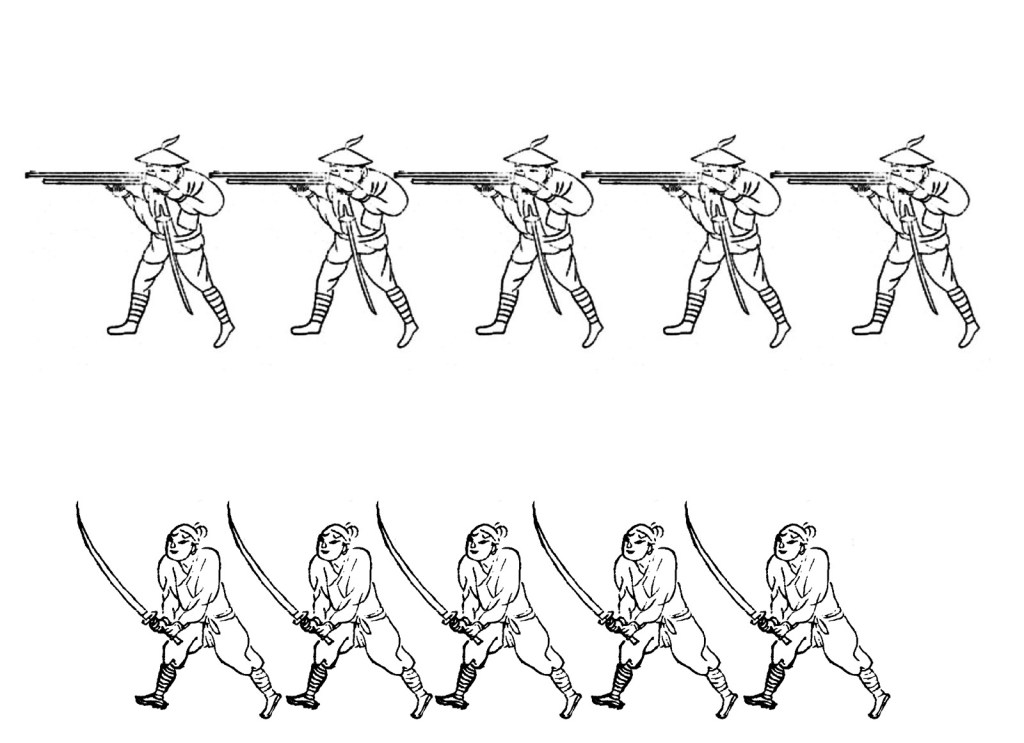
In response, the advancing soldiers stopped and 500 of them stepped forward. With muskets in one hand and a bifurcated pitchfork-like bipod in the other, they set the bipod on the ground and held it in place while inserting the barrels of their muskets between the bifurcated forks. Then, with musket butts firmly pressed against shoulders, they aimed down the barrels of their weapons at the militiamen and pulled the triggers. A mechanism linked to the trigger automatically pressed smoldering matches into the touch holes and a second volley of shots rang out. With the musket’s superior range, the bullets had no trouble hitting their intended targets. A dozen men crumpled like paper onto the ground: the rest didn’t wait to see what a second volley could do. All of the remaining defenders fled without further ado, scattering in a fan away from the Armada’s soldiers as every man sought to save his own life.
Thus began the War of the Matches.
9.2 – The Indrapura Declaration (July, 1612)
With Indrapura and the local prefect securely in the Armada’s hands, the slow work of disembarking the main portion of the army began. Contrary to the fears of the people, very little looting took place, and punishments were meted out to soldiers who abused the locals in any way. Meanwhile, two splinter portions of the Armada visited Mucuo and Ruansen, both of which surrendered without a fight. At Indrapura, Shui Jiakai set up his headquarters in the prefect’s house and seized control of the local print shop. Printers who normally printed intricate patterns on blankets and rugs were now contracted to print off hundreds of copies of an edict that Shui Jiakai had written on the passage from Xiaweiyi. Promulgated on July 21st, the Indrapura Declaration, as it came to be known, read as follows:
“From the Wanli Emperor’s appointed commissioner, Shui Jiakai, to the good and loyal subjects of Great Ming: salutations. By order of the Emperor, the Grand Armada of Ming is here in Xinguo to restore order to the two rebellious provinces of North Province and South Province, to overthrow the wicked bandit Wei Qiangfang and any who ally themselves with him, and to re-establish proper order and governance to the Two Provinces of Xinguo.
“All loyal subjects of the Wanli Emperor are hereby ordered to assist the Grand Armada in any way they can. Men should provide food, open their homes to quarter soldiers in, and volunteer for service in the army. Those who serve the Grand Armada in combat will be provided with weapons. Women should mend and wash clothing for soldiers and provide for those who lack anything.
“The Grand Armada is not here to make war upon the good people of Xinguo; our only enemies are the bandits who cause disorder and misery in the country. Loyal subjects will not be harmed or abused in any way, but all bandits with be crushed, executed, or driven out of the country.”
Copies of the edict were posted around Indrapura, Mucuo, and Ruansen and read aloud to the people there and in the surrounding villages. A detachment of soldiers heading up the Oak River toward Pattaya and another detatchment sailing down the coast toward Tall Rock both carried copies as well, and would soon be reading them in those towns. Townspeople and peasants who heard the Declaration carried news of it further afield than the Armada could hope to reach at this stage of the invasion so that news of its contents quickly spread all across the Valley, the Burning Coast, and the Golden Mountains over the course of the next few weeks.
The Indrapura Declaration served as a manifesto of Shui Jiakai’s intentions in Xinguo and legitimised the ongoing People’s Revolt. Rebels all over South Province were quick to declare their allegiance to the Grand Armada, and in so doing they were no longer rebels. Now, the shoe was on the other foot; former rebels now thought of themselves as soldiers of the emperor and pointed accusations of rebellion back at their oppressors. Wei Qiangfang was no longer granted the courtesy of being called Master of Two Provinces; the rebels and those who sympathised with them now called him the Bandit Governor.
‘Bandit’, for those who are unaware, is a word commonly used by Chinese governments of the imperial era to refer to rebel movements in order to delegitimise them. Rather than a dismissal of the threat they may pose, referring to them as mere ‘bandits’ dismisses whatever ideological platform they may be putting forward, reducing them instead to the level of mere outlaw gangs and mocking the idea that they may be able to pose a viable alternative to the powers that be.
In no time at all, people were flocking to the Grand Armada’s banner. Hindu warrior-ascetics, Cham rebels, warriors of the Coastal people, and members of militias associated with the Western Children and White Lotus poured into Indrapura, Mucuo, and Ruansen to sign up for the army. They were given official ranks and insignia, but the Armada didn’t have time to properly train or re-organise them, so they retained their own homegrown units and chains of command. Whenever militia groups or even bandit gangs signed up, the whole group was given an official designation, but otherwise operated largely identically to how they’d already been operating as rebel militia. As promised, those who lacked proper weapons were equipped from out of the Armada’s armouries. Most importantly, thousands of matchlock muskets were handed out almost gratuitously. That was, in fact, the reason why the Emperor had seen fit to equip the Armada with 50,000 excess muskets. With muskets in hand, the rebel-fighters-turned-imperial-soldiers were suddenly better equipped than the provincial militia loyal to Wei Qiangfang.
9.3 – The Ningbo Declaration (July, 1612)
Wei Qiangfang received news of the invasion on July 21st, the same day Shui Jiakai published the Indrapura Declaration, which Wei heard about two days later. He immediately mobilised all militia forces and began moving troops around. He had a few thousand soldiers and militia garrisoning Ningbo and a few thousand more at Dongguang, just in case something like this happened, but he wasn’t prepared for an invasion of this magnitude. Nevertheless, he was confident that clever manoeuvring by forces already in South Province could slow down the Armada enough for him to mobilise the Northern provincial militia and put together an army that could go toe-to-toe with the Armada’s army.
In the meantime, he decided to publish a response to the Indrapura Declaration. Quickly dubbed the Ningbo Declaration, Wei’s response read as follows:
“My fellow countrymen, I write to you because of a dire catastrophe that has befallen our beautiful coasts. There is a man across the ocean who would rule over us, to command us to join his wars but who will give us no relief when his enemies knock on our door. This man has sent a gang of robbers and mercenaries to kill your sons and violate your daughters! To seize your towns, steal your livestock, and possess your land! These robbers claim they are here to restore order, but it is they who have disrupted the peace by making war upon us. It is they who have travelled across the Eastern Ocean to attack us when we were sitting in our homes doing nothing at all to provoke them. These robbers have joined forces with the bandits in the South responsible for the disorders in your country for these past years.
“My fellow countrymen, I am a Xinguan just as every one of you is. I do not wish to see my country trampled down and ruled over by a man across the ocean, and I know every good and true Xinguan is with me. I call upon every Xinguan to assist the Black Banner Guard and the provincial militia in their righteous fight against the hordes of outlaws and brigands who despoil our country!”
In contrast with the Indrapura Declaration, which emphasised the togetherness of the Armada from China with the people of Xinguo, the Ningbo Declaration amounted to a nationalistic screed that sought to draw a line in the sand between Xinguans and Chinese. After all this time of separation from China, the people of Xinguo were indeed becoming a separate people, developing their own cultural traditions and dialects that differed from those in China, and increasingly longing to be able to set their own foreign policy without China holding them back.
However, as much as Wei Qiangfang tried to raise solidarity among Xinguans, the appeal of his declaration was limited. Over the next few weeks, it became clear that the Ningbo Declaration resonated among Wei’s fellow Wu-speaking Northerners, but it fell flat on its face when it came to rousing support among the Min-speakers of Redwood and Magala prefectures, as well as the Xinguo-Koreans of Ulnala, and the Prior nations all across North Province. In Redwood Prefecture, the Oligarchy advised the prefect to stay out of the conflict while the prefect of Ulnala outright declared neutrality and the prefect of Magala excused himself from sending any support by claiming he was already doing his part by keeping watch over the frontier.
9.4 – Splitting of the Armada (August, 1612)
By the end of July, the cities of Pattaya and Tall Rock had been secured by the Armada, along with the surrounding countryside. At this juncture, Shui Jiakai took counsel with his top subordinates, General Gao Jianjie and Admiral Ning Fenhe, on how best to proceed. Three paths lay before them leading to their primary goal of Ningbo.
One was to sail up the coast, while the second was to march up that same coast. The obvious choice here was to do both at the same time, capturing coastal cities and towns as they went. Coastal defences were light, so Shui Jiakai wasn’t expecting much of a fight until they reached the Jaw, which by all accounts was well-defended. With the wake-up call that was the Acapulco Expedition fresh in their minds, the Xinguans had renovated and expanded the Teeth Forts in the 1580s and ’90s and had kept them well-maintained ever since. Capturing them wouldn’t be easy, but it had to be done in order to clear the way for the fleet to enter the Bay. Admiral Ning Fenhe insisted that taking this path was crucial to enable maximum freedom of movement for the fleet and thereby guarantee dominance of the sea.
The third path before them was to march over the Coast Mountains into the Valley. No immediately-relevant goals lay in the southern Valley, but clearing the Northerners out of there would both weaken them and provide the opportunity to recruit more locals into the army. Gao Jianjie advocated strongly for this option, reminding the others that the Northerners were estimated to have at least 80,000 braves when fully mobilised, which, if given time, would utterly overwhelm the Armada’s comparatively modest 30,000 men.
Shui Jiakai ultimately decided it would be best to split his forces. Admiral Ning would sail up the coast in support of Shui, who would take command of 15,000 men on a march toward the Jaw. Meanwhile, General Gao would take 10,000 men over the mountains and liberate the southern Valley from the occupying Northerners. Finally, a smaller force of 3,000 men would march south to take control of the southern Burning Coast and secure Maliwo Prefecture. The remaining 2,000 men would stay behind and guard the Oak River Valley.
[Next]

 Lord of Lore
Leave a comment