2.1 – The 2nd Silver War (1546 – 1548)
In 1546, Governor Bai Guguan of South Province resumed his policy of sponsoring pirates to wage war on Spain, specifically in the form of raiding shipping around Mexico and launching strikes against settlements on the Pacific coast. Bai offered to pay a bounty in silk and other goods in exchange for any silver the pirates acquired. So began the Second Silver War.
But even with pirates seizing what they could, South Province couldn’t meet its quota for the annual tribute in 1546, which elicited an angry letter from the emperor in 1547. Bai Guguan pinned the blame on Governor Wei Chengjia of North Province and requested help in the Second Silver War.
Now, as a rule, the emperors preferred not to intervene in the north-south conflict in Xinguo. Whenever they did, however, they always intervened on the side of the province in the weaker position. Therefore, the emperor sent a 6,000-man expeditionary force to South Province under the command of General Lin Weishi. They arrived in Dongguang alongside the Treasure Fleet in August, 1548. Bai added 3,000 men of his own to the expedition, a mixture of Xinguans and indigenous allies, and prepared for an invasion of Acapulco.
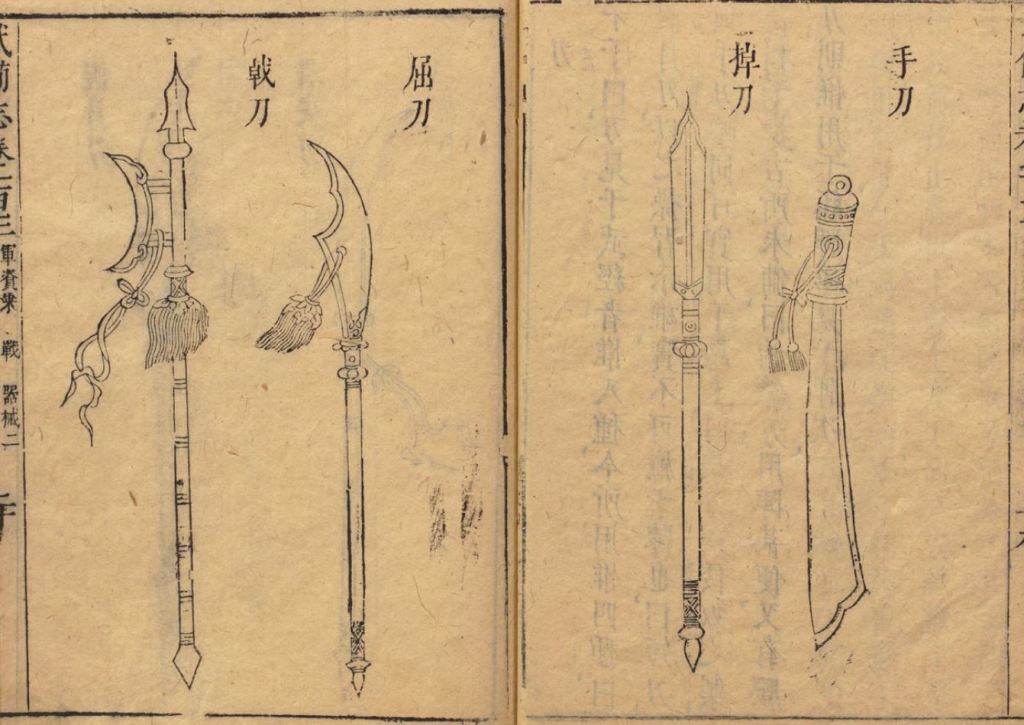
Although General Qi Jiguang’s famous reforms were yet to begin, Ming armies were already relying on a combined-arms approach to warfare using four categories of weapons: polearms, swords, bows (including crossbows), and gunpowder weapons. Polearmers kept the enemy at a distance or pinned him in place, swordsmen closed in for the kill, archers and crossbowmen peppered him from afar, and gunpowder was for firepower and nasty surprises.
In general, Ming and Spain had roughly equal levels of weapons technology, but there was one exception. Matchlock muskets and arquebuses were common in Spanish armies by this time, but Ming armies were still relying on older fire arrows and fire lances.
Fire arrows came in two types. First were those which had gunpowder in a paper bag tied to the shaft of the arrow just below the head. Lit and loosed from a bow, these fire arrows were used to set things on fire from a distance. Mostly used in sieges and ship-to-ship combat, they forced the enemy to divert resources to fire-fighting or face dire consequences. Second were those which used gunpowder as a propellant, effectively turning them into rocket-propelled arrows. We call them rocket arrows in this document to distinguish them from the first kind of fire arrows. They had greater range and penetration than an arrow loosed from a bow, and many could be fired at once by linking the fuses together.
Fire lances had begun as a bamboo tube stuffed with gunpowder attached to a spear that could fire a blank into the face of the enemy just before striking with the spear. By the 16th century, they’d developed into the Chinese equivalent of European hand cannons. Now made of metal, they fired lead balls at the enemy just like a matchlock musket: unlike a matchlock, however, they lacked a trigger. One had to ignite the powder by hand with a match while simultaneously aiming the weapon.
Ningbo and Dongguang are not far from each other. Despite all the bluster and heated rivalry, there was always travel and commerce between the two. This made it impossible for Bai Guguan to conceal the arrival of 6,000 Ming soldiers. Wei Chengjia wasted no time in sending agents to warn Spain of the impending invasion.
The news could hardly have come at a worse time. Mexico, which at the time was officially called the Viceroyalty of New Spain, was already embroiled in a costly war with the Chichimecs in the Bajio region. There was also a measles epidemic ravaging Mexico’s indigenous population. Additionally, Spain was then under the rule of Karl V of the Holy Roman Empire (Carlos I of Spain). His primary concerns lay in central Europe where he was embroiled in religious wars against Protestants and Muslims alike. He had no time or spare resources to devote to the New World.
Command of Acapulco was handed over to a conquistador named Cristobal de Oñate. Oñate was an experienced soldier who’d made a fortune investing in silver mines in the area around the future city of Zacatecas. He’d been making preparations to settle there permanently when the order came to take over the defence of Acapulco. His attempts at getting out of it failed, so he had to travel there and take command of the assembling army.
Viceroy Mendoza pulled together all the reserves he could on short notice, which amounted to 700 Spaniards and around 8,000 indigenous allies. Only 200 men were Spanish regulars, while the other 500 Spaniards were from Acapulco’s own militia. The 8,000 indigenous warriors hailed from diverse backgrounds. Some were Tlaxcallans, who always accompanied Spanish expeditions in Mexico at this time, others were the descendants of Aztec warriors who’d found new employment in the armies of the conqueror. Another native contingent came from the Yopis, who lived in the area of Acapulco itself. More than half of the Indigenous warriors, however, were Zapotecs from the neighbouring Oaxaca. There were also eight warships converging on Acapulco Harbour with around 400 sailors. By late August, the army was ready and waiting.
And waiting.
A week passed, during which there was no sign of the invaders. Wei Chengjia’s agents kept on insisting the invaders would be here soon, but none came. At the start of the second week, a wave of the ongoing measles epidemic washed over Acapulco. Half the army was dead or confined to bed by the end of the week.
Finally, in the middle of September, while the measles outbreak was beginning to subside, the Ming Expeditionary Force arrived.
2.2 – Acapulco: Battle of the Boom (Sep. 15-16, 1548)
Map of Acapulco, September 15-16, 1548:
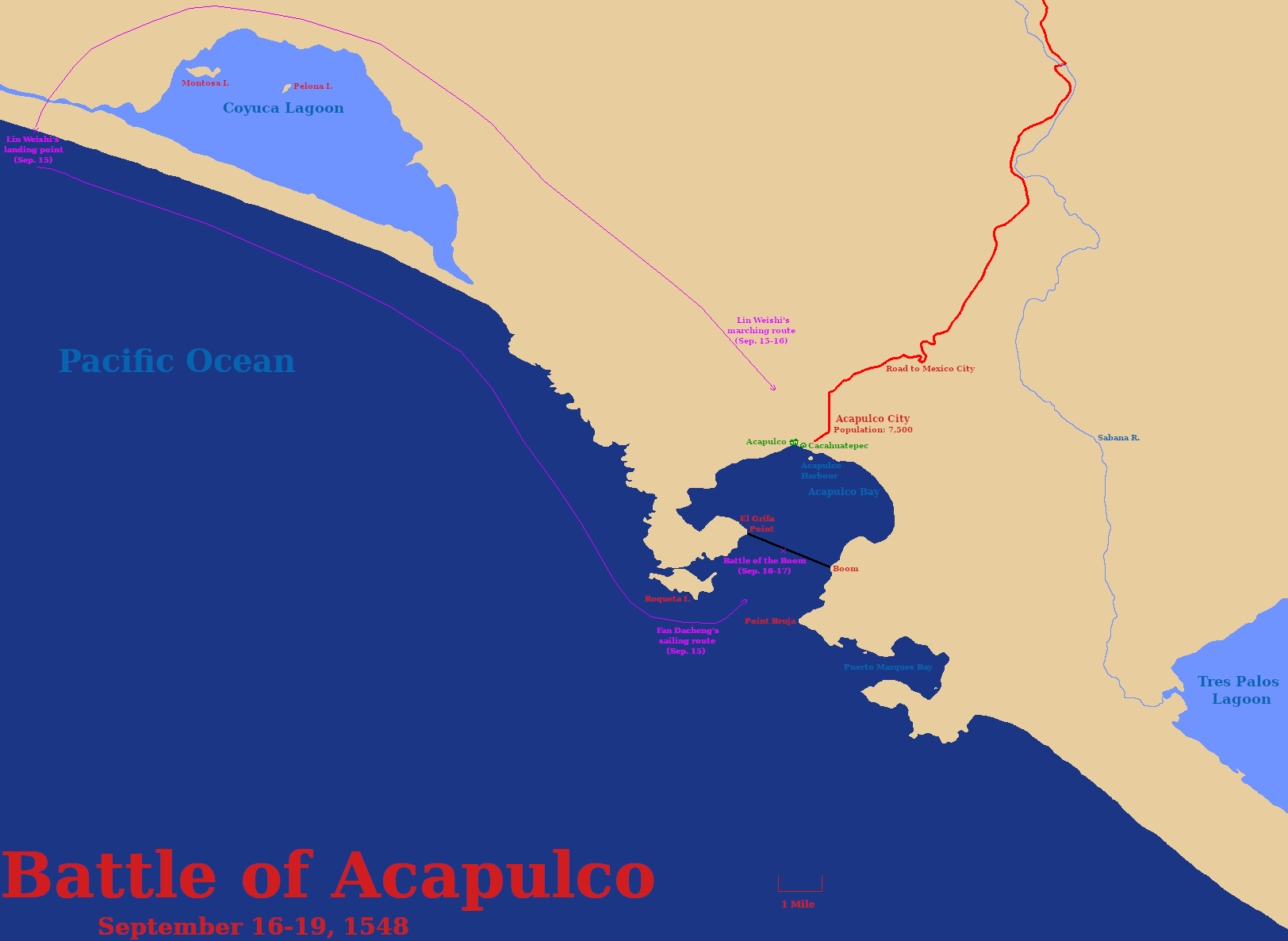
In 1548, Acapulco was a European city established next to an indigenous settlement called Cacahuatepec. Actually, calling it a city might be an overstatement, as it was still quite small. As the only port through which the silver trade with Xinguo could be conducted, however, it was growing rapidly. When Cristobal de Oñate arrived, it was estimated to have had 7,500 people living in it, but that was before the measles outbreak.
The soldiers defending it were a diverse lot, as it usually went with armies in Mexico’s early history. Of Oñate’s original 8,700 men, only about 4,700 remained, and some of those were sick and barely capable of fighting. He had only 8 warships and a shore battery of 6 guns to defend the harbour.
Facing them was the Ming Expeditionary Force and its Xinguan allies. Like Oñate’s army, Lin Weishi’s forces were a diverse lot. At least eleven different languages were spoken in the Ming army. Junhua was used as a lingua franca among the soldiers from China, who may have spoken three or four different dialects, while the Xinguans spoke Yue, Cham, Vietnamese, Tagalog, and Hakka, which contrasted with three different indigenous languages as well as Mongol and Jurchen. Lin had been expected to arrive with up to 9,000 men, but in fact had 7,000 men and 34 ships with 1,800 sailors.
As to the commanders themselves, they had little in common. Cristobal de Oñate was a self-made man, a conquistador who’d come to settle in a faraway land, a land in which he’d become one of the wealthiest inhabitants through a combination of luck and pouncing on the right opportunities. Others had cleared the way for Spain to claim Mexico. Oñate was a cog in the machine, if you will. A highly successful cog, to be sure, but even so he was only one of a flood of opportunists who’d come to make a name for himself by launching from the platform built by men like Columbus and Cortes.
Lin Weishi, by contrast, was a man with a job to do. He was a soldier because he’d been born into a family of soldiers in Shandong province. He’d come to the New World because he’d been ordered to. His orders were clear, and once he’d seen them through to completion, he fully intended to return to the land of his birth.
Command of the Chinese fleet fell to a man named Fan Dacheng. Born into a family of fishermen on the coast of Shandong province, he was a simple man, a pragmatic man, a man unburdened by excessive concern for military decorum. A man used to operating on his own, finding his own solutions to problems.
On September 15th, 1548, Lin Weishi went ashore with his army west of Coyuca Lagoon, which was west of Acapulco. From here, he estimated a day and a quarter of marching to reach his target. Once he began, he’d be out of contact with his fleet, so he and Fan made a plan of attack prior to Lin’s departure. Fan would arrive first and blockade Acapulco Bay. Lin would arrive on the 16th and establish his siege camp, and on the 17th both would assault the city from opposite directions.
When Fan arrived at the mouth of Acapulco Bay on September 15th, he discovered the Spaniards had flung a wrench in his plans. Despite the devastating illness ravaging the army, they’d managed to build a boom across the mouth of the bay, made by roping floating logs together. This was quite the feat, considering the mouth of Acapulco Bay is almost two miles across, but it had been worth it since it was now impossible for the fleet to sail into the bay and make their assault on the 17th as planned. Therefore, Fan reasoned, the boom would have to be taken apart before Lin arrived.
At dawn on the 16th, Fan’s ships were lined up, prepared to begin the attack. Although he had 34 ships and 1,800 men under his command, it must be said that 12 of these ships were troop ships and supply ships which were unfit for combat, leaving him with 22 warships
Inside the bay, eight Spanish warships awaited them while Spanish soldiers lined the shores with arquebuses, bows, and cannons. Shortly after sunrise, Fan ordered him men into the smaller assault boats, initiating the Battle of Acapulco. Naked except for loincloths and armed with knives and crossbows, Fan’s men rowed for the boom. They approached the centre of the boom to be out of range of the soldiers on shore, but they still came under fire from the ships in the bay. At this, they dove in the water and swam the rest of the way. Using the boom itself as cover, they began sawing at the ropes that held the logs together while cannonballs flew overhead as their own ships and the Spanish ones duelled each other.
Meanwhile, Oñate ordered his own men onto the boom. Seeing as his ships couldn’t target the Chinese without hitting their own boom, they’d just have to drive the Chinese off the old fashioned way: with obsidian-studded war clubs. Running across the narrow boom was extremely dangerous, since they had to do so single-file and soon came under fire from Fan’s ships. However, most of Oñate’s men were from inland areas and so were incapable of swimming, unlike Fan’s coast-dwelling sailors. Some of Oñate’s men dove in the water anyway: those who could swim swam, and those who couldn’t clung to the boom and simply pulled themselves along. Soon, warriors converged on the Chinese sailors from both sides and a fierce melee ensued. Sailors jumped on the boom and jabbed at the enemy with their knives but the Mexicans, with club and shield in hand, were at a significant advantage.
That was until the Chinese assault boats returned. Now that the Spanish ships had ceased fire for fear of hitting their own men, the assault boats could get close enough that men with spears could attack the warriors on the boom. With their reach advantage, the spearmen could attack with little fear of reprisal. Even landing a hit on the enemy’s shield still held the potential to knock him off his balance and send him into the water.
However, the Spaniards had smaller boats of their own. Soon, boats were launched from the ships crewed by men with arquebuses and bows. They closed in on the boom and began a withering fire on the Chinese boats, forcing them to fall back. Without the support of their boats, the men at the boom had to retreat as well.
Several more assaults were made during the day, all of them repelled. Although the boom was beginning to look frayed—a few logs had come loose—it was far from allowing Fan’s ships to sail through. As light dwindled toward the end of the day, Fan had to break off the attacks. 100 bodies floated lifelessly on the shifting waves. So ended the fighting on the first day of the Battle of Acapulco, which was quickly dubbed the Battle of the Boom.
2.3 – Acapulco: the Camp Fight (Sep 16-17, 1548)
Map of Acapulco, September 17, 1548:
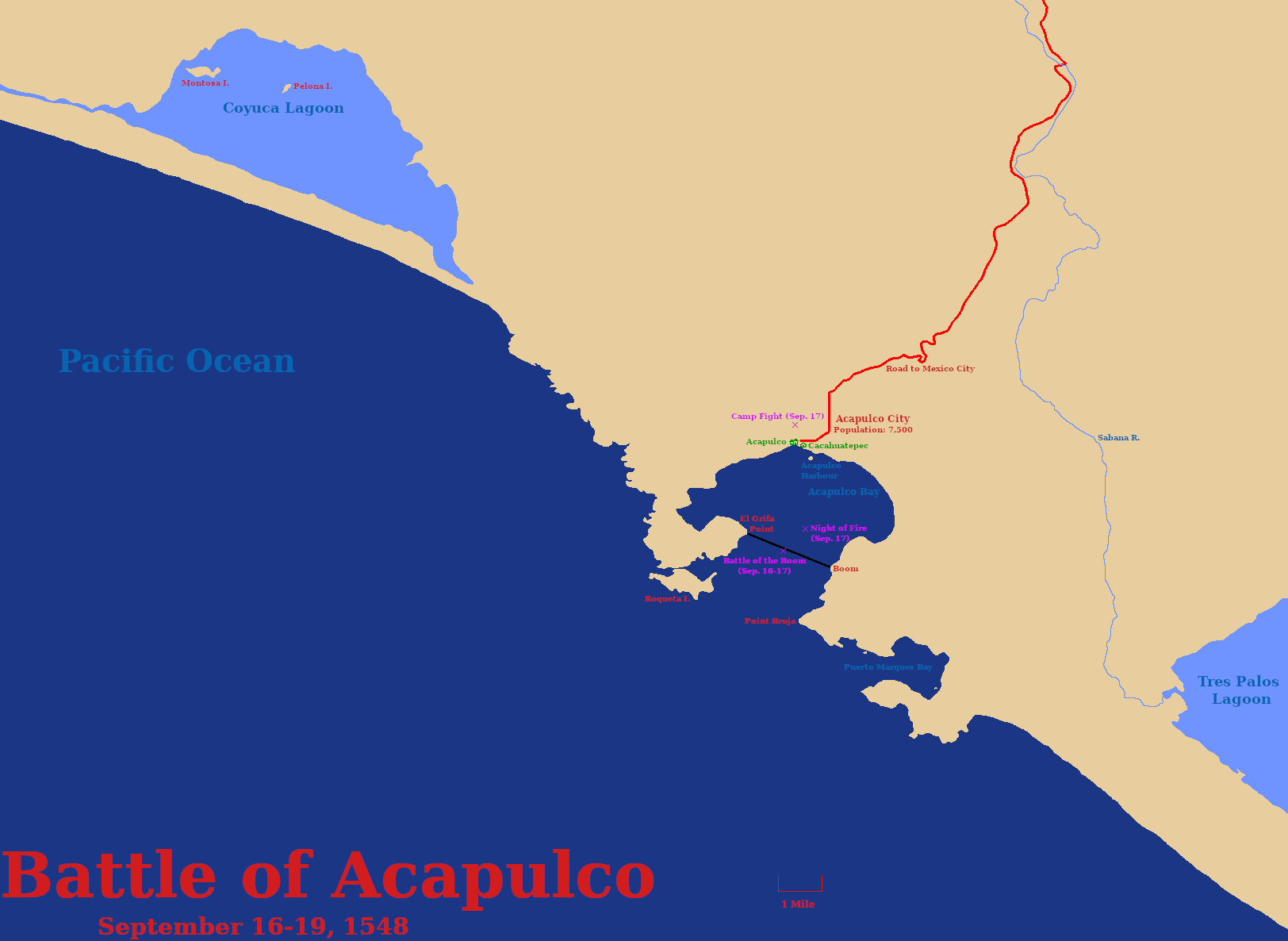
Lin Weishi’s army came within sight of Acapulco late on the 16th. It turned out the country around Acapulco is hilly, wooded in places, and at the time there were no good roads. Even if there had been, Lin had no guides who knew where any hypothetical roads would’ve taken him. Thus, the overland trip around Coyuca Lagoon had taken longer than expected. As sunset’s glow lit up the sky, the two armies caught their first glimpses of each other.
A Chinese summary of the battle described the army of New Spain thusly (referring to white Europeans as ‘ghost men,’ and to arquebuses as ‘fire lances’):
“North of the city of Acapulco, the enemy had erected their tents and surrounded them with barricades that bristled with Meixigou soldiers. Ghost men sat astride magnificient steeds or stood in ordered ranks, looking very fine in rounded helmets and polished breastplates with sword, buckler, and fire lance in hand. Beside them stood savages wearing padded leather or cloth, some wearing animal faces on their heads or feathers in their hair and on their shields. All had obsidian-studded clubs, spears, or bows, except those who had gained favour in the eyes of their masters, who had given them sword and buckler, fire lance and halberd.”
A Spanish soldier described the Chinese army in a letter to his brother (Referring to the Jurchens and Mongols as ‘Tatars’):
“What can I say of the Chinese army? Shall I speak of the burning arrows that rained down on us like brimstone from heaven? Should I describe the wicked glaive that took my comrade’s head clean off? Stand in line behind the barricade with me and watch the enemy approach.
“The first thing you see is the flags. So many flags, triangles, rectangles, and odd shapes I can’t describe. They were all emblazoned in all kinds of colours covered in dragons, and suns, and symbols that I guess are writing, and most of them have frilly borders.
“Next you see a forest of polearms. They come in even more shapes and sizes than the flags. Every kind of pike, spear, halberd, and glaive you can imagine.
“Finally you see the men, grim-faced with long moustaches and well-trimmed beards. Cavalrymen wear robes covered in overlapping armoured plates and the infantry wear padded armour. Polearms come first and following them are the swordsmen carrying long shields that curve and taper at both ends. Then come men with bows, crossbows, rocket arrows, and hand cannons of every description. Beside them march Indians, all but naked, with bows and war clubs in hand. On the wings come Tatars, each one riding his horse and wielding his bow like extensions of his own body.
“It was the most impressive army I’ve seen in my short life, and I must admit the sight of it made me wonder if our small band stood any chance at all, given the sorry state our own forces were in.”
When Oñate first arrive with 8,700 men, his army’s population outnumbered that of the ‘city’ of Acapulco. Therefore, he elected to pitch his tents some distance north of the town and fortify it with barricades, knowing that was the direction the Chinese would have to approach from. He also erected barricades on the outskirts of town as a second line of defence.
Lin’s men spent the first evening setting up their own camp. Oñate let them get comfortable. After all, time was on his side. Despite taking attrition to the measles outbreak still affecting his men, Oñate knew his enemy was in an even worse long-term situation. Lin had only taken so many supplies of food and ammunition with him, and couldn’t easily obtain more in this foreign land, about which he knew next to nothing.
Oñate estimated the Chinese couldn’t afford to keep up a siege for more than a few days. He and his soldiers were also fighting with a renewed hope in their hearts: a messenger arrived late at night on the 16th and informed Oñate that Viceroy Mendoza had assembled a relief force of 5,000 men who were expected to arrive on the 19th.
Now, Lin Weishi had arrived in Dongguang with 6,000 soldiers. Of these, 4,000 went to Acapulco with him (we’ll get into what the other 2,000 were doing later). Ming China’s military was not what it had been in the 14th century when it had risen to dominance, however. 16th Century Chinese armies often recruited whole gangs of bandits or pirates into their ranks to pad out their numbers. These men lacked discipline, not to mention any sense of loyalty to emperor or nation. It’s impossible to know the exact composition of Lin’s army, but it’s likely half or more of his 4,000 ‘Chinese’ soldiers were in fact recruited from among the wokou pirates who infested the Chinese coast in the mid-16th century. It’s possible as many as half were actually Japanese.
Late in the morning of September 17th, Lin ordered the first assault on the Spanish camp. At first, he sent only a few men so that he could judge the strength of the enemy. Around noon, the assault began in earnest. Bamboo frames were laid on the ground aimed at the camp and filled with rocket arrows while the vanguard stood ready. At Lin’s order, two hundred rockets were touched off at once, screaming as they tore through the air and embedded themselves in the barricades, the ground, or in Spanish soldiers and their indigenous allies.
Without waiting for the arrows to hit home, the vanguard charged with war cries on their lips and banners streaming in the wind. The defenders had time to loose one volley of arrows and bullets before the vanguard was on them. Polearmers kept each other at a distance while men on both sides with swords and clubs closed in for brutal close-quarters fighting. One assault was repelled. Lin ordered his men in a second time, only to be repelled again. Chinese casualties were heavy, but the Spanish barricades were looking rather thinly defended now. Lin ordered a third assault, and this time the enemy gave way. Abandoning the barricades, Oñate’s men fled through their camp toward Acapulco.
Seeing his chance, Lin ordered all of his soldiers forward. He personally led the cavalry around the west side of the camp before swooping left to catch the fleeing enemy on the open ground between the camp and the town.
Meanwhile, the Chinese soldiers in the camp had no intention of pursuing the enemy. Greed took over at the thought of all the valuables stored in the camp. Gold and silver coins, weapons, clothing, all sorts of personal belongings of the soldiers as well as the army’s supplies lay ensconced in unguarded chests, waiting for the first man to claim them. A rush of humanity surged into the camp, tearing open tents and upending the contents searching for anything they might like to keep.
Like mice to the cheese, they’d taken the bait. Explosions shook the ground as fuses lit by retreating soldiers reached mines hidden in chests, under beds, or underground. At the same instant, the seemingly broken and fleeing Mexicans being pursued by Lin’s cavalry suddenly stood their ground and fought. Worse, a flood of reinforcements emerged from behind the houses at the outskirts of Acapulco and charged the now faltering Chinese.
Immediately sounding a retreat, Lin turned on his heels and fled for his own camp. The cavalry made their escape, but the infantry weren’t so lucky. Those infantrymen who had been pursuing the enemy were quickly overwhelmed by the reinforcements while Spanish cavalry thundered through their now burning camp killing the disoriented looters with gleeful abandon.
What forces remained made a panicked retreat back to the Chinese camp. The Spanish let them go, not daring to come within range of the enemy camp. 2,000 men lay dead or dying in the Spanish camp and on the outskirts of town, most of them Lin’s.
So ended the second day of the Battle of Acapulco, dubbed the Camp Fight.
2.4 – Acapulco: the Second Boom Battle (Sep 17-18, 1548)
While the Camp Fight was raging on September 17th, Fan Dacheng assaulted the boom a second time. Once again, his men stripped almost naked, dove in the water, and sawed away at the ropes holding the boom together. This time, there were no shore-bound reinforcements to fight them off, since Oñate needed all of his ground forces for the Camp Fight.
The Spanish ships launched boats to try driving off the boom-cutters with pikes and arquebuses, and Fan responded by launching his own boats with polearms and crossbows. A polearm duel ensued between the boats with arquebusiers and crossbowmen picking each other off. In this fight, the Chinese crossbowmen had the upper hand in one way: their repeating crossbows had a much higher rate of fire than the Spanish arquebuses. On the other hand, their bolts often failed to penetrate the leather armour worn by some of the Spanish sailors.
After an hour of hard fighting, the Spaniards retreated. With the boom becoming unsalvageable, it was clear a ship-to-ship battle would follow, and the Spanish ships needed all their crewmen to man the guns. They couldn’t afford to lose more crewmen duelling the Chinese over the boom.
A few dozen more bodies floated in the water after the Second Boom Battle. However, it was only a matter of time before the boom was picked apart. Soon, logs were being rolled out of the way, and a path into the bay opened up. However, the boom was surprisingly robust, and pulling logs out of it created a mass of logs floating around that would present a hazard to ships trying to sail through. Pulling logs out and rolling them somewhere out of the way was a time-consuming process. It took until nightfall to clear out a relatively small section in the middle of the boom. Fan sent six of his ships ahead to secure the outer portion of the bay while the rest of his ships remained in reserve.
September 17th, 1548, just so happened to be the night of the new moon that month. In Acapulco Harbour, there were around half a dozen fishing boats. Oñate had pressed them and their crews into service, but they had no weapons and hadn’t seen any combat yet. Now, however, he saw his chance to use them and as the eager opportunist that he was, he pounced on it. The fishermen didn’t much care for his plan, but he swore by all the holy relics in Spain that he’d reimburse them twofold out of his own pocket with compensation if any man got wounded or killed.
So it was that, after the sun had gone down and darkness embraced the scene, the fishermen got in their boats and rowed out into the bay. They set course for the indistinct shapes which they knew to be Fan’s ships, unfurled the sails, and jammed sticks into the steering wheels to keep them on course. Finally, they set fire to piles of palm branches on deck and abandoned ship.
If one or two Chinese night watchmen had heard something that sounded like an oar slapping the water that quiet night, none bothered reporting it. When half a dozen or so pillars of flame ignited before their very eyes, there was no rationalising it away as some water fowl. Alarms were sounded and men leapt out of bed to stare slack-jawed in horror at the approaching fire ships.
There was still some time to react. The ships were anchored in two rows: three ships were directly in the fire ships’ path with the other three behind. Ships in the rear cut their anchors and hurriedly brought the ships about and rowed hard for the bay’s mouth. With no time to coordinate a response, the other three ships’ captains each reacted to the situation as he saw fit. The one closest to the bay’s mouth followed the example of the ships behind him: he cut the anchor and beat a hasty retreat. To his right, the next ship turned about and opened fire on the approaching boats, hoping to blast them to pieces before they could close the distance. The last captain, farthest from the bay’s mouth and with his neighbour remaining stationary, simply abandoned ship with his crew.
Then the blazing boats were in amongst them. Naturally, the abandoned ship went up in flames, but her crew got away safely. Of the rear row ships, one was unable to make it far enough in time: she caught fire when one of the fishing boats rammed her hull, and the captain gave the order to abandon ship.
By some miracle bestowed by Heaven, the one captain who’d decided to stand his ground managed to keep his ship and crew safe. One boat had been headed directly for him, but his gunners blew it to bits. Other boats came close, but sailors with long poles pushed them away. Pieces of burning debris were caught by the wind and sailed into the air: Heaven’s providence alone kept them from setting the rigging alight. With burning wreckage all around him, however, the captain didn’t dare move an inch, so the crew spent a restless night praying to gods of wind, water, and fire to keep the ship safe.
By morning’s light, the damages became clear. Two ships had been destroyed, but only a handful of crew were lost. The men who’d abandoned their ships were picked up by their comrades and the lone standing ship was eventually able to navigate the still-smouldering wreckage and rejoin the rest of the fleet. Overall, it could’ve been worse.
2.5 – Acapulco: the Town & Harbour Fight Pt.1 (Sep. 18, 1548)
Map of Acapulco, September 18, 1548:
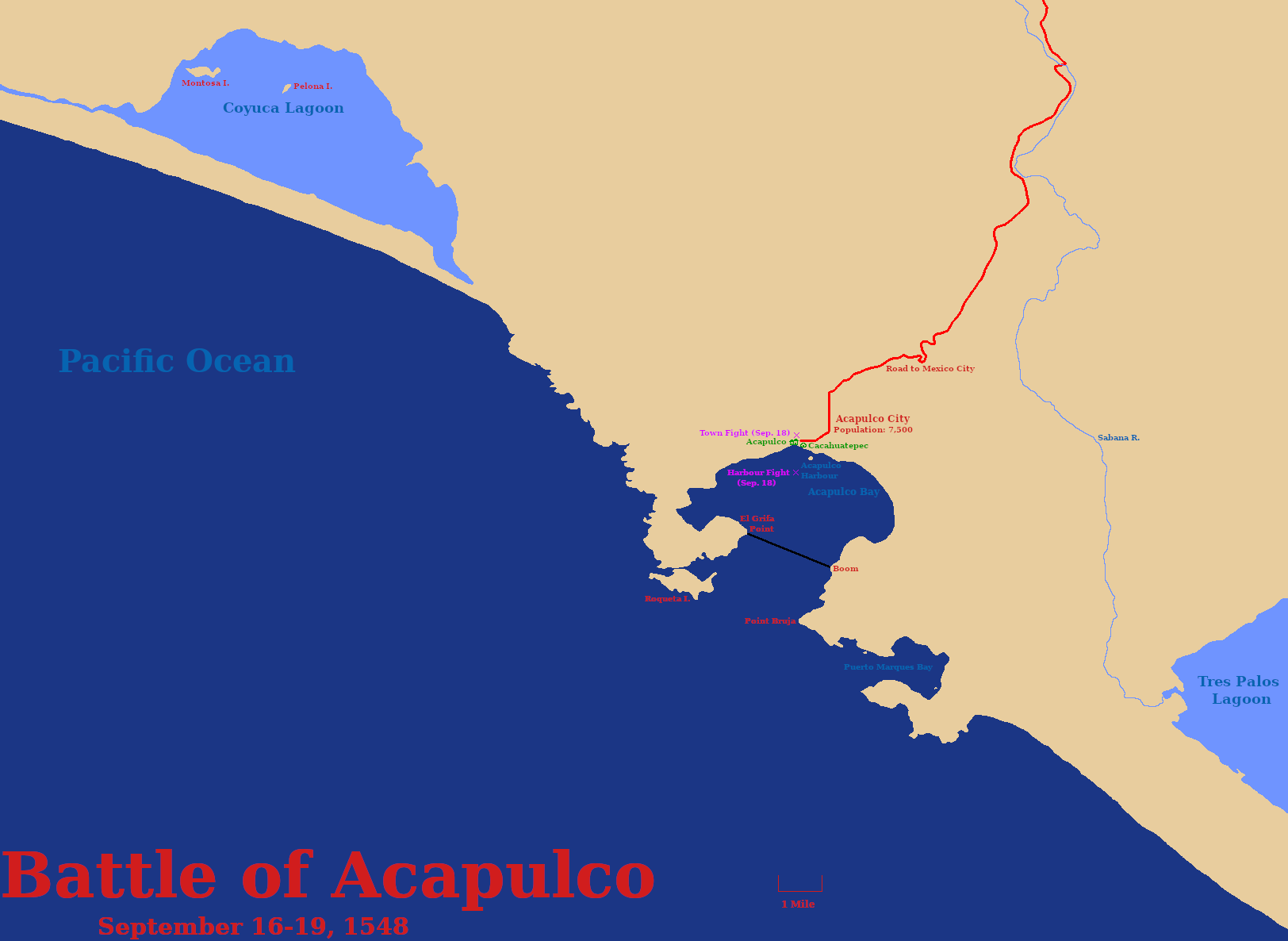
During the night, Cristobal de Oñate had conscripted the town’s inhabitants to build more barricades on the outskirts. Women, children, and old folks worked through the night helping to make the town as defensible as possible. With the army camp destroyed by yesterday’s explosions, the town itself was where he planned to make his final stand. Every man who could stand and hold a weapon was conscripted to fight. Even if they were armed with a pitchfork and a prayer, Oñate needed the numbers. According to his information, he only needed to hold out for one more day before Mendoza’s reinforcements would arrive.
Early in the morning of the 18th, Oñate had the local Catholic priest celebrate mass with the Catholics among his soldiers and the civilians. He also encouraged the pagans to pray to their deities and perform whatever pre-battle rituals they believed might help. Oñate felt the hardest part of the battle was about to commence, and he was willing to take any help available, no matter the source.
Among Lin Weishi’s Xinguan soldiers were 200 horse-archers, a mixture of Mongol and Jurchen colonists in the New World who still practiced the ways of their forefathers. On the morning of September 18th, Lin sent them to scout the surrounding area for food and sources of fresh water. Despite taking heavy casualties the day before, Lin’s army still outnumbered the town’s defenders. Even so, he needed to make preparations in case the siege outlasted his meagre supplies.
After breakfast, Lin had his men check their weapons and armour and took stock of what was left. Ammunition stocks weren’t looking great, but he still had plenty to make the Mexicans bleed. When the preparations were made, he ordered his men forward.
Rocket arrows came first. No casualties were inflicted, since the Spanish could simply duck behind cover, but it did force them to keep their heads down. Under cover of their fire, the soldiers advanced. Fire arrows came next, soaring through the sky into the town, where women and children ran to and fro with shovels desperately dumping dirt on the fires before they spread out of control. More kept on raining down and soon several small fires were starting to grow.
Finally, the infantry advanced on the barricades. Before they reached them, the Mexicans came out of cover and unleashed a devastating volley of bullets and arrows at near point-blank range. They ducked behind cover again as the Chinese fired a volley of their own. Then the infantry were on the barricades. Mounting logs and furniture piled up in their way, the Chinese lashed out with halberds and glaives while the Mexicans responded with sword and club. With pikes too, as they tried to keep the Chinese at a distance or push them off the barricades.
Two armoured Chinamen with rocket arrow launchers mounted the barricade and fired a volley at the exposed Tlaxcallans on the other side, cutting a swath of them down. This opened a gap in the Spanish lines which the Chinese were quick to exploit. In minutes, a hundred Chinamen had poured into the gap and were rolling up the rest of the Mexicans behind the barricade, widening the gap for their comrades following close behind.
At this critical juncture, the battle might have ended. However, that was when Oñate arrived on the scene with 300 cavalrymen. Lances lowered and sabres raised, they charged into the melee. Harvesting Chinese soldiers like wheat, they turned the tide and forced the Chinese back over the barricade. Seeing his momentum broken, Lin Weishi called a retreat.
Meanwhile, Fan Dacheng’s warships opened fire on the harbour. He’d spent most of the morning picking up sailors who’d abandoned ship the previous night and dealing the wreckage of his two destroyed ships. When he heard the battle commence on the northern outskirts, he rushed to prepare his own assault.
8 Spanish warships were ensconced in the harbour, overlooked by 6 cannons on the shore. This rendered Fan’s number advantage less important, since it left him with no room to manoeuvre. If he brought all his warships, they’d only get in each other’s way. Therefore, he left the troop and supply ships with several warships anchored outside Acapulco Bay between Roqueta Island and El Grifa Point. They were left there with skeleton crews watching over them while most of the crew joined the assault.
Finally ready, Fan Dacheng led the assault on the harbour with 15 warships. By this time Lin Weishi’s men were already retreating, but Fan didn’t know that. With the whole town between him and the ground forces, it was almost impossible to see what was happening on the northern outskirts. 14 ships opened fire on the harbour, the shore guns, and the Spanish warships. They formed two lines: one line passed the harbour and pounded it with cannonfire while the other hung back. Then the first line fell back while the second took their place.
Meanwhile, one ship hung back and launched assault boats brimming with 200 armed men who swiftly rowed ashore. While Chinese ships carried on their drive-by cannonade, the shore party made their way toward the battery of Spanish guns. The gun crews saw them, turned their guns on them, and fired. The shore party scattered at the blast, but kept coming. They fired once more, and then the shore party pounced. Leaping into the fray with swords and glaives, half the gun crew were cut down in seconds and the rest ran for their lives.
Just as the shore party was about to disable the guns, however, they heard the thundering of hooves and looked up to see Oñate leading another cavalry charge straight for them. Completely unprepared for this outcome, the shore party instantly broke and fled for their boats. Spanish horsemen charged through the mass of sailors, spearing and slashing them to ribbons. Not far away, the ship from which the shore party had come aimed her guns, but with the cavalry in amongst her own men, she dared not fire. A few men were able to make it to the boats and row for the safety of their ship, but most of the shore party was killed or captured.
Several of Fan Dacheng’s ships had been damaged and by this point it had become clear the fight on the northern outskirts had ended. He decided to withdraw for the time being. One Spanish ship had been severely damaged by cannonfire and had to be beached lest she sink. A second ship had been set alight by fire arrows and soon became a blazing wreck.
2.6 – Acapulco: the Town & Harbour Fight Pt.2 (Sep. 18, 1548)
When Fan Dacheng withdrew after his first assault, it was already past noon. Soldiers and civilians were busily repairing and reinforcing the barricades on the northern outskirts when they saw Lin’s men drawing up for another assault. Civilians fled into town while a runner was sent to get Cristobal de Oñate, who was overseeing the execution of the prisoners taken from the shore party. He had nowhere to keep them, nothing to feed them, and couldn’t spare the men to stand guard over them. Execution, therefore, was the only way to deal with them, from his perspective. Once the messenger arrived with news of and impending second attack, Oñate rushed back to the barricades in time to see it commence.
Rocket arrows pelted the barricades to give the men the chance to charge them while fire arrows rained down on the settlement. Several houses were by now caught in a conflagration barely kept under control by impromptu firefighters. Men struggled desperately to keep the attackers out. Once again, however, the Chinese fought their way in. This time half a dozen men with two-handed sabres stripped to the waist, tied vermillion bandanas around their heads, and mounted the barricade in leaps and bounds. They jumped over the top and carved a path through the Zapotec warriors on the other side. All six were killed of course, but they opened up a gap big enough for others to pour in.
Oñate gathered his cavalry and the Tlaxcallan infantry he’d kept in reserve and charged into the widening gap, intent on pushing the Chinese back over the barricade. As he closed the distance, two Chinamen stood up from in front of the barricade and fired sixty-four rocket arrows into the charging mass. A dozen men fell writhing to the ground and another two dozen horses were injured, many of them stumbling and throwing their riders into the air. Oñate himself was wounded, but kept charging.
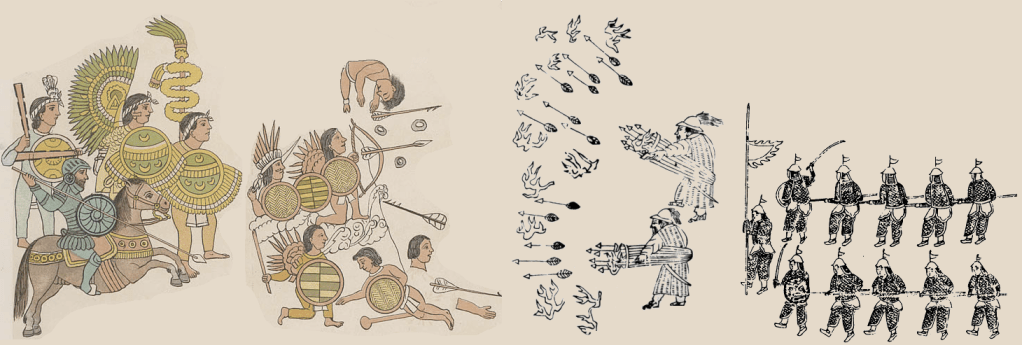
As the cavalry cut into the Chinese, more enemies climbed over the barricade. Clad in lamellar armour from head to toe, these were Lin’s elite infantry. Each one was from a family with a long history of military service back in China and each one had trained for this since the time he could walk. One man held their banner high while the others beheaded men and horses alike with their glaives.
Realising the barricades were lost, Oñate sounded the retreat. There was only one place left to go now. Soldiers withdrew toward the town hall and the church at the centre of town or fled into the nearest of the huts which lined Acapulco’s dirt streets. Women and children who were still outside fighting the spreading fires ran for the church or barricaded themselves in the closest house. With the northern outskirts now abandoned, Lin Weishi led his own cavalry over the barricades and through the streets, cutting down as many retreating Mexicans as he could until he reached the town hall, where arquebusiers firing from the windows drove him off.
At this point, half of Lin’s army lost discipline. Fed up with the hard fighting the enemy was putting them through and eager to get their hands on whatever they could, the less-disciplined soldiers in the army stopped listening to orders from their officers. Indeed, many lower-ranked officers joined them as they broke into houses to rape and pillage. Some of the houses held out as Mexican soldiers drove the attackers away. Even the women grabbed whatever dangerous objects were at hand and fought back as best they could.
Lin Weishi collected all the men who were still following orders and laid siege to the town hall and church, where most of the defenders were now concentrated.
Out in the bay, Fan Dacheng heard the sounds of renewed battle. It took time for him to switch out his damaged ships for undamaged ones that’d been in reserve, but once this was done he was ready to continue the fight. Once again, he drew up his ships in two lines that carried out a continuous cannonade of the harbour. Reasoning that the Mexicans would be too busy fighting Lin for another miraculous cavalry charge, Fan once again sent 200 men ashore to capture the guns. This time, the gun crews simply spiked their own guns and fled for the town hall.
Surrounded and with their own ground forces seemingly about to be slaughtered, the Spanish ships saw only one way out. Gathering in a wedge, they unfurled the sails and charged the Chinese lines. They waited until they were at point-blank range before firing all guns, dealing out severe damage to two of Fan’s ships before they broke through the lines and sailed out of the bay. Not yet willing to give up, they hung around the area but stayed out of range of Fan’s ships.
For his part, Fan was happy enough to let them go. He kept a dozen ships in his rear to keep an eye on them while he himself went ashore. There, he was met by Lin Weishi, who invited Fan to join him in a talk with the Meixigou commander.
Oñate was holed up in the town hall with the majority of his remaining soldiers. Next door, the church was packed with civilians and a handful of soldiers. From the windows, he watched as Chinese soldiers looted the town and skirmished with Spaniards and their indigenous allies holed up elsewhere. Still, he was determined to see this through to the end. Tomorrow, reinforcements would arrive and Acapulco would be saved. All he had to do was hold out until then.
2.7 – Acapulco: The Town Fight Pt. 3 (Sep. 18, 1548)
At length, four men approached the town hall under a white flag. One was Lin Weishi, the second was a merchant from Ningbo whom he’d hired as a guide and interpreter, the third was another interpreter, and the fourth was just some guy to hold the flag and stand in front of Lin in case the Mexicans decided to open fire. Fan Dacheng stood at a distance and watched while Oñate leaned out a second-storey window.
What followed was a negotiation which took place across four languages. Lin spoke Mandarin, but the Ningbo merchant only spoke Wu and Nahuatl. Lin’s second interpreter translated between them. Thus, Lin spoke in Mandarin, which was interpreted into Wu for the Ningbo merchant. The Ningbo merchant translated into Nahuatl. One of Oñate’s Tlaxcallan subordinates listened and translated it into Spanish for his commander, who gave his response in Spanish, which was translated into Nahuatl, into Wu, back to Mandarin, and round and round it went. Negotiations were mercifully brief.
The following conversation is recorded in the Chinese summary of the battle.
___
Lin: “Soldiers of Meixigou, you have fought like men with hearts made of steel. Now, as you can see, your town is under our control. General, I suggest you spare your people needless bloodshed by laying down your weapons and coming out now.”
Oñate (recorded as ‘Ghost Man General’): “I am honoured by your magnanimous offer of surrender, general. However, I beg you realise that this is a weighty decision. I ask you give me the night to think it over and I will answer you in the morning.”
Lin: “Perhaps I have not made myself clear. You will surrender now or there is nothing else for us to talk about.”
There was a pause in the conversation.
Oñate: “Unfortunately, my men and I cannot do as you ask. However, I request that you respect the sanctity of the church next door,” Oñate indicated the building next to the town hall. “It is full of civilians who pose no threat to you.”
Lin fixed Oñate with a grim stare. He then turned his back and returned to his army.
___
With Oñate’s attempt at stalling for time failed, he and his soldiers redoubled their efforts to fortify the town hall. They barricaded all the doors and windows on the main floor, checked their equipment, and ate a quick, cold supper while standing at the windows ready for what could be the final fight of their lives.
Meanwhile, Lin prepared to assault their position. In order to do that, he had to gather up enough men. Even some of his more disciplined soldiers had slipped off to join in the looting, so Lin sent squads of elite soldiers to round up as many looters as they could and corral them back to the town hall. They also picked up civilians and enemy prisoners and set them to work trying to keep the fire under control. Started by Lin’s own fire arrows, the fire was ravaging the northeastern section of town and was threatening to spread out of control.
Fan Dacheng spent the time taking six cannons off his warships and pulling them into position around the town hall.
Finally, around two hours before sunset, Lin had gathered enough soldiers to make an assault. Soldiers charged both the town hall and the church and tried to hack and saw their way into the buildings. Behind them, soldiers with fire lances and crossbows hid behind makeshift barricades and kept up a steady stream of fire at the second-storey windows. Likewise, Fan Dacheng pounded the walls with his artillery. Still, the defenders were able to drive off the first assault. A second assault was made, and a third.
Between the second and third assaults, Fan focused his artillery on the front door of the town hall and blew a hole in the wall. When Lin ordered the third attack, his soldiers used the hole to get inside the town hall, but the unyielding defenders threw them back out again.
During the third assault, as the sun began to slip under the horizon, Lin’s soldiers broke into the church. Only a hundred Acapulco militiamen were defending it. Most of the people inside were civilians who’d fled into the church in the hopes that even these pagans would have some respect for holy ground, but no respect was given. Militiamen and anyone else who resisted was killed immediately. Seeing that most of the remainder were women, many of them young and attractive, the soldiers forgot about emperor and nation and took their time indulging themselves.
When Lin was told what his soldiers were doing in the church, he shrugged and said, “there’s no more time for another assault anyway.”
2.8 – Acapulco: The Final Fight (Sep. 19, 1548)
Map of Acapulco, September 19, 1548:
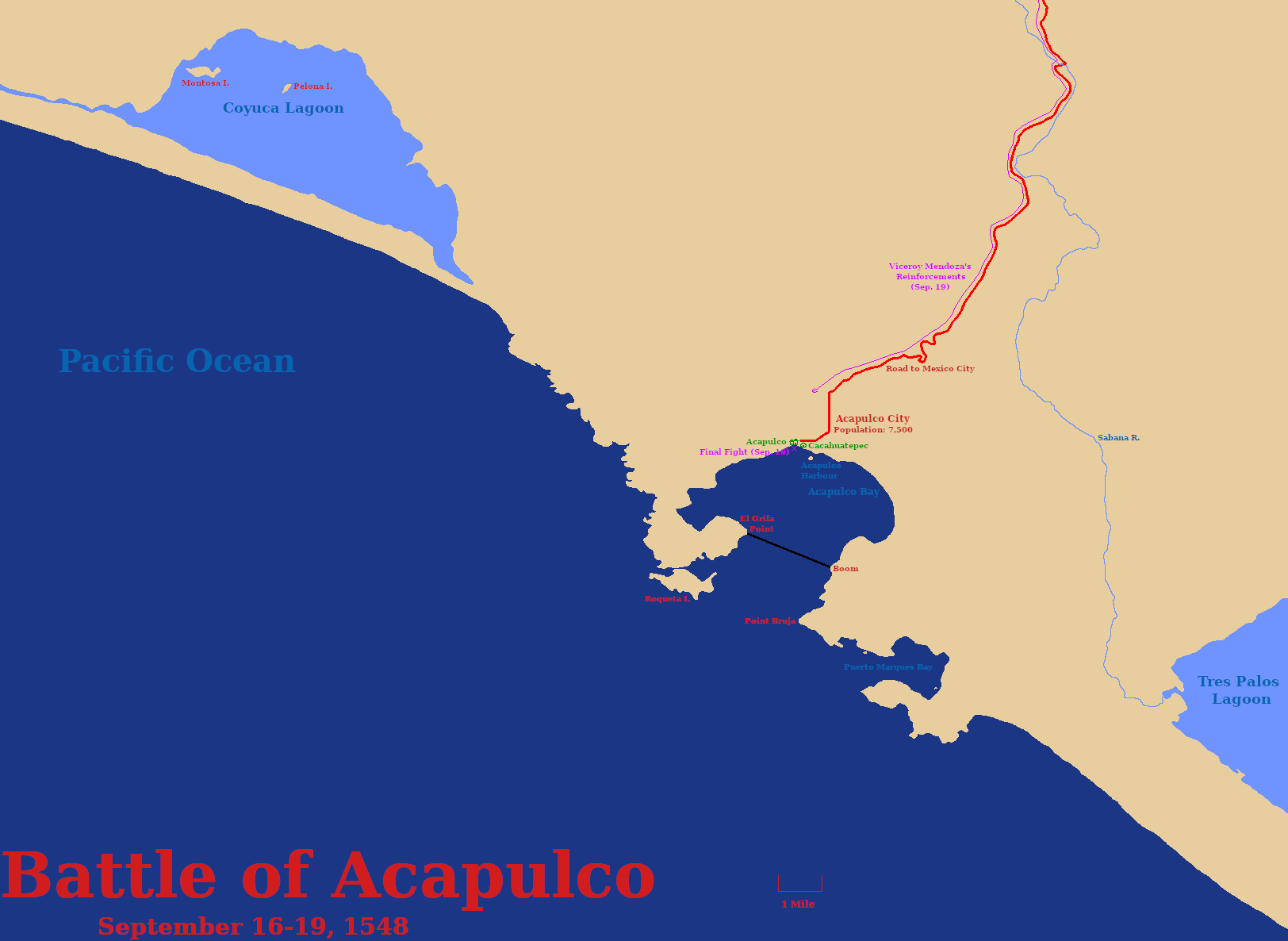
Dawn rose on a crippled city on September 19th, 1548. A section of Acapulco was in smouldering ruins, the fire having largely died down overnight. Soldiers in the church had gotten tired of indulging themselves and were sleeping it off in the churchyard and in the street. Lin Weishi set out sentries to keep watch on the enemy while the rest of his soldiers slept.
Inside the town hall, Cristobal de Oñate and his soldiers repaired their barricades and spent the rest of the night in a restless sleep. Less than 1,000 armed men were left, all packed into the town hall with a few hundred civilians. No more sounds of fighting came from the rest of the city. All the small holdouts elsewhere had been dealt with, only the town hall was left now.
Outside, the Chinese soldiers rose from their slumber still tired from the previous day’s fighting, but eager to see this whole thing finished. After breakfast, they lined up at Lin’s command and prepared for one more assault. The Spaniards and indigenous Mexicans prayed they could hold them off just one more time, and Oñate reminded them all that reinforcements would be arriving later that very day.
And then their prayers were answered.
From the hills around Acapulco came the sound of hoofbeats. The previous morning, Lin had sent 200 Mongols and Jurchens to scout the surrounding area for sources of fresh water and food. Now, on the brink of the assault, they returned and informed the general that they’d encountered an enemy force numbering in the thousands headed down the road from the north. They’d arrive in a few hours.
Lin Weishi stared at the town hall in silence. He betrayed no emotion, but his rage must have been roiling internally. Thousands of fresh soldiers would turn the battle against him. Of his original 7,000 men, he had less than 5,000 left, and Fan Dacheng’s sailors had taken heavy casualties as well. If there’d been more time he could’ve set up a defensive perimeter with barricades and cannons from the warships, but that was simply impossible.
At last, Lin Weishi gave the order to fall back. He gathered all his soldiers, including as many malingering looters as he could, sounded the retreat horn, and withdrew to the harbour. Fan’s men spiked their cannons—there was no time to bring them back aboard the warships—and hurried back to their ships. Messengers ran to the Ming army’s camp north of town and told the soldiers still stationed there to withdraw. Almost everything in the camp was abandoned.
As the Chinese and Xinguans withdrew, a cheer rose from within the town hall. Civilians and prisoners who’d been captured by the Chinese were abandoned. Now they all rushed to the town hall in fear that the enemy might return.
The Chinese transport ships, which until now had been sheltering outside Acapulco Bay between El Grifa Point and Roqueta Island, were now called into the harbour. Boats were launched and Lin’s men began to board them and head back to the ships.
All this took time, however; and in time, Viceroy Antonio de Mendoza arrived at the head of 5,000 fresh soldiers. Typical of New Spain’s armies at the time, most of the soldiers were Tlaxcallans, Aztecs, and other indigenous warriors using traditional weapons and armour while only a few hundred were Spanish soldiers and militia. As they reached the outskirts of Acapulco, a cheer arose from the town hall. Soldiers and civilians alike ran outside to welcome the reinforcements with unrestrained joy. Oñate let them have this moment of celebration, realising he couldn’t put a stop to it even if he wanted to, but he himself walked calmly out to meet Mendoza and give him a quick run-down of the situation.
Lin Weishi was still on the beach directing the evacuation. Half his soldiers were on the ships or in boats headed toward the ships when Mendoza and Oñate formed up with their soldiers looking down at the harbour. Even though their enemy was already leaving, they had to attack. It was a matter of honour. Lin and his men had destroyed half the town, killed many men, and violated many women. Allowing them to escape unopposed was simply not an option.
Mendoza gave the order and his men advanced. Lin rushed into position with his rear guard to oppose them while Fan Dacheng brought his cannons to bear and opened fire. Mendoza’s men broke into a run and slammed into Lin’s defensive line. It didn’t hold for long. Demoralised by the appearance of new enemies and tired from the previous three days of fighting, Lin’s men broke and ran for the water. Doffing armour and weapons, they jumped on whatever boats were close by or dove in the water and tried to swim for it. Lin himself had a boat waiting for him guarded by his best men, so he was able to make it back to the ships safely, but many of his remaining soldiers were killed on the beach or drowned in the water. To make matters worse, Mendoza charged with his cavalry the moment they broke and trampled fleeing Chinamen and Xinguans under hoof.
Fan Dacheng had ceased firing for fear of hitting his comrades, but with the Ming soldiers broken and scattered, he now decided the beach was clear enough he could open fire again. Cannons booming was Mendoza’s cue that he’d done enough. Honour had been satisfied, so he sounded the retreat and fell back out of range of Fan’s guns. This allowed the ships to send out more boats and pick up the stragglers still in the water and on the beach.
Finally, before the sun had even risen to its noonday apex, the Ming Expeditionary Force turned around and set sail for Xinguo. All in all, it’d been a disaster. Although they’d nearly destroyed Oñate’s army they’d taken heavy casualties themselves, on both land and water. Worse, there was almost nothing to show for it. Even most of the loot had been left behind, along with almost everything in the camp.
On the way to Xinguo, Lin Weishi considered how he was going to explain this failure to the emperor back in China.
[Next]


Leave a comment