3.1 – Hostile Takeover (1548-1549)
Back in August of 1548, Lin Weishi had arrived in Dongguang with an army of 6,000 men. His orders had been twofold. Most importantly, he was to aid Governor Bai Guguan in the 2nd Silver War against New Spain, but before that he had something else to take care of. Sailing with Lin was a man named Peng Chao’an, and he was the new governor of North Province.
Wei Chengjia was the great-grandson of Wei Shuifu, the man who’d discovered the New World for China. Ever since Wei Shuifu’s time, the Wei family had ruled the north like it was their own private property: a feudal domain all their own. Wei Chengjia, therefore, was well-entrenched in his position. Local gentry supported him, merchants got along with him, and the militia was in his pocket. Removing him would be no simple matter, but the emperor didn’t want to spark a province-wide revolt.
Therefore, it was decided to remove him in a coup de grace and install Peng Chao’an before anyone knew what’d happened. This was accomplished when Fan Dacheng, with three ships, sailed into Ningbo Harbour one evening in late August, pretending to be a merchant. As previously stated, there was a constant stream of commerce between Ningbo and Dongguang in spite of the rivalry between them, so merchants from one city showing up at the other shortly after the arrival of the Treasure Fleet was a common occurrence. But instead of trade goods, Fan’s ships were packed with 2,000 soldiers. That night, Lin Weishi led his men out of the ships’ holds and marched on the provincial governor’s palace.
City watchmen saw them coming and ran ahead to warn Wei Chengjia. At the prospect of 2,000 armed men already inside his city and prepared for battle, the governor decided discretion was the better part of valour. He collected a few of his most valuable belongings and fled the city with his family and a handful of retainers.
Lin found the governor’s palace empty except for a few servants who informed him of Wei’s flight. Peng Chao’an took up residence in the palace that night and the next morning announced his assumption of the governorship throughout the city. Lin and Fan remained in Ningbo for some time to establish Peng’s position. This is why they ended up arriving at Acapulco much later than New Spain had been expecting, and probably doomed their attempt to capture the city.
When Lin departed for Acapulco, he left 2,000 soldiers in Ningbo at Peng’s disposal. While Lin Weishi was away, Peng Chao’an spent his time further consolidating his position. Knowing how weak he was, he called upon Bai Guguan for help, and Bai sent him another 2,000 southern militiamen in case the northern militia revolted against Peng.
Meanwhile, Wei Chengjia bided his time in hiding somewhere in the northern coastal mountains.
After Acapulco, Lin decided he couldn’t return to China without something to show for his efforts. Fortunately, he spent the voyage back to Dongguang coming up with a plan. Upon his return, he met with Bai Guguan and Peng Chao’an to get their support before setting things in motion. And that plan was…
Guilds. They were a vital part of the Xinguan economy. Commonly called a ‘society’ in the Xinguan context, they were an association of merchants or tradesmen that served a number of essential functions. They provided a support network for members in need, they helped members keep their products competitive, and ensured a minimum degree of quality. The government also liked guilds because they made taxation simpler.
In all of Xinguo, the two most important guilds were the Ningbo Silver Society and the Dongguang Silver Society. Established eighty years prior, only members of these two guilds were permitted to engage in the silver trade with the Aztecs, Tarascans, and Incans, and now with the Spaniards. This made their continued operation a matter of vital importance to the respective provinces in which they were based. Thus, while they’d always been independent, they were subjected to heavy government regulation. In 1548, the government of Spain only permitted members of the NSS to purchase its silver, shutting the southerners out of the market entirely, which is what had led to this whole mess in the first place. Lin Weishi had a solution, however.
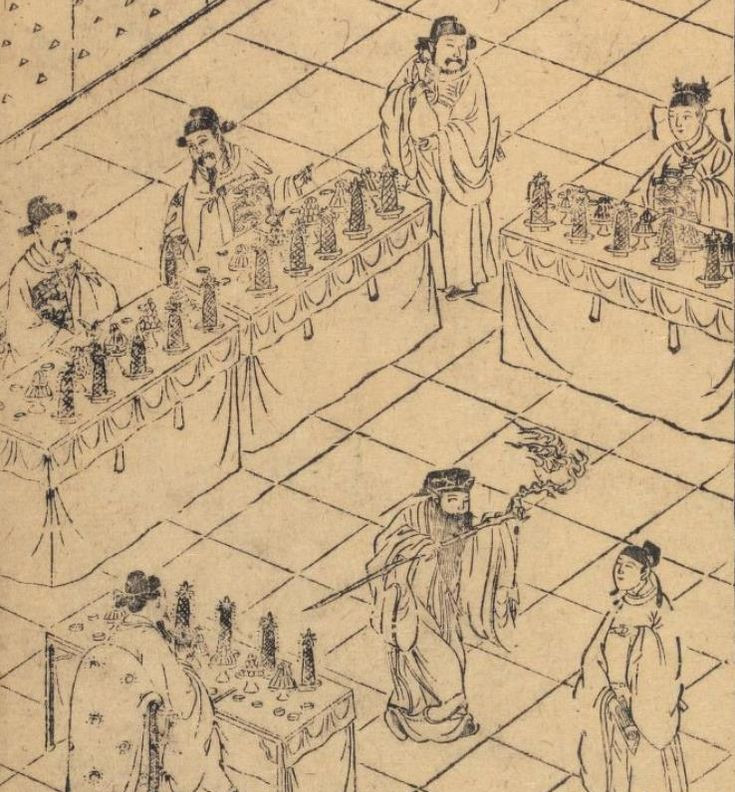
On January 21st, the Ningbo Silver Society was having its year-end meeting (in accordance with the Chinese lunisolar calendar, which begins in February). All the top brass in the guild were present at the guild hall, which was a magnificent suite of buildings a little ways downriver of the outskirts of Ningbo. Merchants in splendid robes with huge hats and long, well-combed hair done up in topknots (as was the custom for men in pre-Qing Dynasty China) were meeting in the great hall. Discussion revolved around the preceding year’s profits and what the plan for next year was to be.
That was when General Lin Weishi arrived at the gate to the walled compound with 2,000 men at his back. Mercenaries in the employ of the NSS wer standing guard outside, but at the sight of Lin’s column they simply handed over their weapons and stood back. Lin and his men strode across the grounds as if they owned the place and marched right into the great hall. Flanked by two towering men wearing full armour and wielding huge two-handed swords, Lin informed the merchants that they would now be taking a vote.
Traditionally, the NSS and DSS were as much rivals as the cities they were based in. They loved blocking each other’s deals and outmanoeuvring one another. Obviously, membership was exclusive: members of one guild couldn’t obtain membership in the other. Now, however, Lin Weishi was ‘politely’ asking the good masters of the NSS to open up membership to members of the DSS—meanwhile, his bodyguards playfully swung their swords around while staring solemnly at the assembled merchants. They voted then and there, and it passed unanimously. They took out the guild’s charter on the spot and made an amendment to it, removing the exclusivity clause against DSS members joining.
No sooner had the exclusivity clause been removed than a gaggle of DSS members were escorted into the great hall by more of Lin’s soldiers and applied for membership. Grumbling filled the great hall, but Lin and his soldiers were so friendly and persuasive that they easily overcame what little opposition was voiced out loud.
The end result was that the entire board of directors of the Dongguang Silver Society were now members of the Ningbo Silver Society. In the following weeks, high-ranking NSS members were pushed out of business, pressured to resign their memberships, had family members go missing, or were found murdered in back alleys. Those who were left moved their businesses to the remote Redwood Coast region to the north. All the while, more and more DSS members gained membership in the NSS.
Months passed. DSS merchants, now carrying badges proving NSS membership, sailed south and purchased all the silver their hearts desired (or, at least, all they could afford). In New Spain and Peru, the colonial governments were aware that some kind of hostile takeover had taken place, but they had only the vaguest notion of the details. Old faces they’d grown to recognise over the past several years disappeared, replaced by new faces who always dodged any questions about what’d happened to their predecessors. Still, they had proof of NSS membership, so the Spaniards sold them the silver.
Things could not have been going better for Bai Guguan. He had enough silver to pay all he owed the emperor and then some. He even stopped paying pirates to harass the Spaniards, signalling the end of the 2nd Silver War in 1549.
For Wei Chengjia, things had gotten completely out of hand. Hiding out in the Redwood Coast region, which was only loosely under Ningbo’s influence, he was able to evade the manhunt looking for him and was planning on biding his time until he was able to figure out a way of reclaiming his rightful place. With the takeover of the NSS, the situation was more dire than he’d imagined. Wei knew the only way to reclaim what rightfully belonged to him was to return to China and convince the emperor to reinstate him as governor. To that end, he resolved to make his way to Mexico City to inform the viceroy of everything that’d happened so he could enlist Mendoza’s help in getting back to China.
In July 1549, Wei, together with a few retainers and some former members of the NSS, booked passage on a ship from Jigegeduolixi (Jige for short) bound for Acapulco. Later that month, the Treasure Fleet arrived. Lin Weishi, Fan Dacheng, and most of their men linked up with the Treasure Fleet for the return trip. Lin took personal responsibility for the ships carrying the emperor’s tribute from South Province. Upon his return to China in October, he escorted the ships back to Beijing and presented the emperor with the full tribute for 1549, plus all the back-tribute South Province owed, and a little extra as a gift from Bai Guguan. All this, Lin Weishi explained, was thanks to his own efforts. He described the Battle of Acapulco as a great success and was light on details about what happened in Ningbo afterward. Lin received awards and was sent to help deal with pirates on the coast of Shandong province.
3.2 – Wei Chengjia’s trip (1549-50)
Wei Chengjia arrived in Acapulco in late July, 1549, together with some retainers and former Ningbo Silver Society members. Not only had the city recovered from the battle in September, it was actually growing again. There, he requested, and managed to receive permission for, a meeting with Viceroy Antonio de Mendoza. Wei travelled to Mexico City and informed Mendoza all about everything that’d happened in Xinguo since Lin Weishi’s arrival, and asked for the viceroy’s help in getting to China. Mendoza was angered by the success of Lin Weishi and Bai Guguan, the men responsible for the destruction of Acapulco, and fearful that a united Xinguo would present a major threat to New Spain in the future. He arranged for Wei to be transported to Tondo in the Philippines, where he’d be able to book passage to China. First, however, Mendoza made Wei swear that once he was back in power in North Province, he’d to do everything in his power to convince Bai Guguan to negotiate a peace deal with Spain.
Wei agreed and thus, on August 1st, he and his companions set sail for the Philippines. Though it must be mentioned that the archipelago wasn’t called the Philippines yet—not by anyone other than the Spaniards, anyway. At the time, there was no consensus on the name of the islands. Different languages had different names for it. In China, it was called Dongdu, a name derived from Tondo, since that city had been a tributary of China since the maritime expeditions of the 1430s, and was thus the primary conduit of commercial and political activity between China and the many polities of the Philippines. Once in Tondo, passage to China was easy.
China was ruled by a man called the Jiajing Emperor, who reigned in the years 1521-1567. Although he was intelligent and capable of working hard when he wanted to, he spent most of his reign neglecting matters of state in order to pursue personal projects. These included spending lavishly on Daoist temples, suppressing Buddhism (which prompted thousands of Buddhists to emigrate to Xinguo), and the pursuit of immortality. He refused to meet with his ministers and eventually secluded himself in a country house outside Beijing, where only a select few people were permitted to see him. All this gave rise to fierce competition for his attention in court. In the 1540s and ’50s, that competition was defined by the rivalry between two men: Xu Jie and Yan Song. For our purposes, we need only touch on the part of the rivalry that involves Xinguo.
In 1548, Xu Jie was senior grand secretary of China, which was equivalent to being prime minister. It was he who authorised the expedition to Xinguo and chose the personnel. This meant that Lin Weishi and Peng Chao’an were politically connected to Xu Jie and were therefore enemies of Yan Song. When Lin returned in 1549 to discover Xu Jie had been replaced by Yan Song, he was duly disturbed. Yet he presented the tribute to the emperor’s representatives—the emperor himself refused to meet him—and went on to his new post in Shandong. This was a major coup for Xu Jie. Xu’s man had returned from Xu’s expedition with all the back-tribute which had been collecting since 1542 and then some. Surely this would allow him to displace Yan Song and regain his position as senior grand secretary.
Then, a few weeks later, Wei Chengjia showed up and changed everything. Wei liked to keep abreast of political changes in China, even if his information was always at least two months out of date. Still, he had ascertained that Yan Song was in the ascendancy, and so he went to Yan with a plan. Wei informed Yan about the truth of what’d happened in Xinguo. Lin had described the Battle of Acapulco as a resounding success: Wei divulged it’d been a miserable defeat. Lin had said Peng Chao’an was now firmly in control of North Province: Wei revealed the North Province militias had no loyalty to a man from across the ocean whom they didn’t know, and that Peng was reliant on soldiers given to him by Lin Weishi and Bai Guguan to keep a lid on things. A single word from Wei Chengjia was all that was needed for the militia to rise en masse against the man calling himself their governor. Finally, Lin had claimed the Ningbo and Donguang silver societies had reconciled their past differences and were now on friendly terms, working toward the betterment of China and Xinguo alike: Wei’s associates from the NSS described how Lin had forced a merger and implied summary execution for any who resisted.
All in all, what Yan Song got from all this was that the worst possible outcome had come to pass in Xinguo, the very outcome which the imperial court always strove to prevent: one man had seized control of Xinguo. Peng Chao’an was in an untenable position without Bai Guguan’s help, which gave Bai an unacceptable level of influence over North Province. Peng would have to comply with any demands Bai made of him if he wanted to keep his position. In addition, the two silver societies had been formed as separate entities with the intention that they would remain separate. Yan took all this information to the emperor, whom Yan was among the privileged few with the ability to see in person, and told him everything. Loathe as he was to deal with matters of state, the Jiajing Emperor was no fool. He understood the implications of what Yan was saying perfectly well. Thus, a new expedition was outfitted and planned to depart in May, 1550, this time with 2,000 men and 24 ships with Wei Chengjia himself in charge of it. It seemed rather small, considering they may have to fight a war to reinstate Wei, but he insisted it was enough. Once they reached Xinguo, the North Province militias would rise en masse in Wei’s favour, so there was no need for lavish expenditure on a larger force. It was a gamble, since Wei had no way of knowing how much would’ve changed by the time he got back to Xinguo, but in truth he was right to be so confident.
Ever since the founding of Ningbo in 1449, settlers in North Province had always had to be armed. Back then, warfare was constant on the frontiers. Batewan, Wentu, Maidu, the Braves, Yana, the Eel River tribes, the Bear River tribes, the Pit Trappers, Washishu, Maodou, Magala, various Northern Nü bands, and more: each of them had their turn as an enemy of North Province. Therefore, it was required by law for every second household to provide a man between the ages of sixteen and fifty for militia service, while the other household would pay for his equipment (in some cases, two or three other households would pay for the equipment, if one was too poor to afford it). Horses for cavalry, armour for heavy infantry, and gunpowder weapons were typically subsidised in whole or in part by the province or by local magnates.
Militias were organised into battalions and trained twice a year, sometimes more often. With an estimated population of 1,000,000, this meant North Province had a theoretical maximum military strength of 62,500 (assuming one man from every two households with an average of 8 people per household). In reality, it was unlikely even a third of that could be mobilised all at one time. It was expensive and pulling so many men away from their jobs would create a labour crisis. Even then, a 20,000 man army would only be contemplated if they were needed for a full-scale war.
Another thing to consider was that, at the time, North Province included areas on the Redwood Coast north of the Valley which would later split off and form a new province. Immigrants there were mainly from Fujian province in China (along with some from Korea and other places). The Fujianese were mostly Min-speakers, which was a whole set of dialects of its own, unintelligible for the Wu-speakers of North Province and Yue-speakers of the south. Wei Chengjia himself had limited influence there: Peng could only make suggestions about what they should do. Wei could be confident they’d be either neutral or on his side, either of which was an acceptable outcome as far as he was concerned.
Contrasted against all this, Peng Chao’an had 2,000 soldiers from Lin Weishi’s expedition whose loyalty he could count on, plus whatever South Province militiamen Bai was willing to loan him.
Considering the odds, Wei Chengjia was confident of success when he set sail from Suzhou with the Treasure Fleet in May, 1550. According to experts in Suzhou, the city of departure for the Treasure Fleet, the round trip across the Pacific and back should take 125 days, accounting for lay-overs at the various ports they stopped at. In reality, it usually took several weeks longer than that.
In any case, Wei reached Xiaweiyi in early July. When the Treasure Fleet moved on, he split off the main convoy and headed for the Redwood Coast, landing in Jigegeduolixi (Jige for short) in the middle of July. There, he spoke to local magistrates and merchants and drummed up support for his return to power, showing them all the papers he carried—signed by the Jiajing Emperor himself—decreeing that he be reinstated as governor. He soon gained the support of the Redwood militias. On July 27th, he crossed the mountains and descended into the Valley with 6,000 men at his back. Word of Wei Chengjia’s return spread rapidly from city to town, town to village, village to homestead. Reactions were mixed, but mostly positive. Although the common man didn’t care very much about Peng or Wei, most of the upper class were still staunch Wei-supporters. The result was that Wei’s supporters flocked to him while the rest adopted a wait-and-see attitude. Knowing time was on his side, Wei took his time ponderously meandering down the North River toward Ningbo. By the time he neared the capital on August 15th, he had 20,000 men with him. Against this, Peng Chao’an had 10,000 men, half of whom were northern militiamen whose loyalty was questionable at best. On August 16th, while considering whether or not to make a stand, Peng received a visit from Bai Guguan in person, who informed him in no uncertain terms that he would withdraw his militia if it turned out Wei did, in fact, have a decree of reinstatement signed by the emperor. Bai was ambitious enough to reach for control of the north, but not enough to raise the flag of rebellion.
And so they waited. Wei arrived on August 17th, 1550, and requested entry into his capital. There was some discussion back and forth and Peng resisted surrendering the city, but eventually both sides agreed to meet in a field outside the walls. Wei Chengjia, Peng Chao’an, and Bai Guguan met and Wei showed the other two the decree signed by the emperor. That was more or less the end of the matter. Bai promised to withdraw his militia: Peng knew he stood no chance without Bai’s support, so he agreed to turn the city over to Wei as well. Two days later, Peng and his Chinese troops marched out of the city alongside Bai’s militiamen. Following quickly behind him were all the Donguang Silver Society members who’d joined and taken over the Ningbo Silver Society. With the return of Wei, they knew their days in the north were numbered.
Wei Chengjia settled back into his position as governor of North Province. He distributed land, titles, and monetary rewards to those who’d helped him regain power, and he ensured his loyalists were reinstated to their positions in the Ningbo Silver Society and that DSS members were once again excluded from NSS membership.
Along with the decree reinstating him as governor, Wei Chengjia also carried a letter from Yan Song ordering Peng Chao’an to return to China. Peng did so, and upon his arrival in Beijing both he and Lin Weishi were banished to the Gansu Corridor in western China. Gansu was far from anything important, much less anything interesting. It was a remote post with little chance of promotion. They could, however, count it a blessing that they still possessed their lives. Fan Dacheng, meanwhile, managed to fly under the radar and escape any punishment. He went on to a successful career as commander of the naval escort for the Treasure Fleet, a post which he held for twenty years from 1552 to 1572. Afterward, he decided to settle in Xinguo permanently.
3.3 – The Confused Envoy (1551 – 1552)
The Treasure Fleet of 1551 arrived in the last week of July that year. One ship was particularly large, well-armed, and well-decorated with Ming imperial insignia. Onboard was a man named Cui Hejing, an envoy on a mission given to him directly by the Jiajing Emperor (though not in person, given how reclusive the emperor was). Cui was politically unconnected to either Yan Song or Xu Jie, meaning that he was, theoretically, neutral in the rivalry between them, and this is why he was chosen for this mission. His orders were clear: these ‘Meixigou People’ would have to be brought into China’s orbit. During its heyday, the Chinese overseas empire had included tributaries from all over the western Pacific and the Indian Ocean too. Things had deteriorated since then, but the Ming’s self-confidence had not. Surely, after the thrashing they received at Acapulco, Meixigou would be all too happy to send a tributary embassy to Beijing to talk things out and make a deal that would allow for the unimpeded flow of silver into China (and other goods as well: Yan Song was fond of a good cup of hot cocoa in the morning).
Any deal made with the Meixigou People would need to have the support of both Wei Chengjia and Bai Guguan in order for it to hold. It didn’t please the emperor to have North Province and South Province sponsoring pirates to raid each other’s shipping. Actually, to be honest, the emperor didn’t care as long as he got the full tribute from both provinces every year—but currently that wasn’t happening.
The first order of business, then, was to meet with the two governors.
Dongguang was the eastern terminus for the Treasure Fleet in those days, so Cui met first with Bai in Dongguang, then with Wei in Ningbo. Finally, the three met in Dongguang and hashed out what they could agree to. Without the NSS under his control, Bai Guguan had turned to piracy once again to obtain the silver he needed, and was still falling well short of what he owed the emperor (This was called the Third Silver War, a conflict on the high seas that began in 1550 with Wei’s reinstatement). That would have to stop, Cui told him. Bai was happy to cease sponsoring pirates if Cui could convince the Meixigou People to let DSS members purchase silver. Cui asked Wei why he hadn’t done more to convince the Meixigou People to remain peaceable, to which Wei responded by pointing out that Bai had sent a military expedition to wreck a Meixigou port. Bai countered with the accusation that Wei started the Silver Wars by attacking the Cabrillo Expedition under false flags, which Wei denied.
Cui Hejing sighed.
Negotiations carried on for several days in the first week of August, with Wei and Bai frequently arguing while Cui played the peacemaker. Wei Chengjia agreed to support South Province’s right to trade with Meixigou in exchange for a concession near and dear to Bai Guguan’s economic policy.
In 1450, the Treasure Fleet had officially been established as an annual convoy sailing between Xinguo and China, sanctioned by the imperial government and given a naval escort. The Jingtai Emperor who ruled China at the time set the fleet’s terminus at Dongguang in order to hurt Wei Shuifu, whom the emperor deemed to be too powerful already. As the discoverer of Xinguo and the biggest proponent of settling the New World, Wei Shuifu had immense influence in the early colonisation period. Having the Treasure Fleet stop in Dongguang was of profound importance for the city’s economy. Establishments such as hotels and pubs thrived on the business brought by the Fleet, farmers and fishermen sold their products to restock the Fleet for the return trip, and even Ningbo had to come to Dongguang to deliver its annual tribute to the Fleet, while NSS merchants had to come to purchase Asian wares for resale in Xinguo. All this gave Dongguang a significant edge over its rival. Over the years, the fleet had occasionally stopped in Ningbo instead, when emperors felt they needed to send a message to Dongguang, but they always switched it back to Dongguang within a few years. In 1551, however, Wei Chengjia’s requirement for his support of a deal with Meixigou was that Ningbo be set as the permanent terminus for the Treasure Fleet. Bai Guguan agreed to this, albeit begrudgingly. Both men shook hands and signed a paper agreeing to these terms. Two copies were made of the paper, one of which was kept by each governor while Cui Hejing kept the original. No chances were to be taken on either man reneging on his side of the deal.
The hard part was done. Now it was time to deliver a message to the foreigners requiring their presence in Beijing at the earliest possible time.
Cui Hejing sailed his ship down to Acapulco, arriving on August 18th, 1551. Fortunately for him, Chinese ships arriving at Acapulco were an everyday occurrence so soon after the Treasure Fleet’s arrival. Pirates were on a campaign of plunder all around Acapulco and the Spaniards still couldn’t tell the difference between a North Province freighter, a South Province freighter, and a Wokou pirate ship. Sometimes, pirates pretended to be merchants until they got close, then opened fire. This made the Spaniards rather trigger happy for most of the year, wary as they were of ambushes. With so many North Province merchantmen showing up in the preceding week, however, Cui made it into the harbour without difficulty. The harbour was now overlooked by Fuerte de Oñate, a newly-constructed star fort on the west side of the bay named for Cristobal de Oñate himself. Colloquially, it was called Fuerte del Vasco, or Fort of the Basque, in reference to Oñate’s heritage. In 1551, the fort was rather bare-bones and parts of it were still under construction, but eventually it would be expanded into a sprawling defensive network, making Acapulco the most heavily fortified city on the Pacific coast of Spanish America. It was home to a permanent garrison of 1,000 men and 8 warships, who were constantly on the lookout for pirates. Bai Guguan’s privateers often ambushed ships exiting the bay or even sneaked into the port at night for a little moonlit robbery. The Spaniards had already picked up the word ‘Wokou’ from their North Province trading parters as ‘Oacao,’ which they applied indiscriminately to all pirates or privateers originating from north of Mexico and operating in the Pacific Ocean. In later centuries, ‘Oacao’ would even be applied to British, Portuguese, and Russian privateers in the Pacific.
Upon Cui Hejing’s arrival, he introduced himself and his mission to the mayor of Acapulco. This was conveyed to Mexico City, where it was received by Viceroy Antonio de Mendoza. Mendoza invited Cui to the capital. Upon arrival, Cui Hejing delivered a letter inviting Meixigou to send a tributary embassy to Beijing so that they could establish diplomatic ties with the Ming Dynasty. This was standard Ming practice. No one could have diplomatic ties with China without bringing tribute for the emperor. The emperor would respond to the tribute with a gift of his own, although this part doesn’t seem to have been communicated clearly enough.
The viceroy, however, didn’t have the power to authorise such a mission on his own, so he penned a letter to Madrid and sent it, along with Cui’s invitation (together with a Spanish translation), to Spain. Two months was the minimum time in which to expect a reply, but three was more realistic.
Cui Hejing was incensed upon being told he’d have to wait for three months, give or take. He decried this as an outrage—how dare a mere king like the ruler of Meixigou make the emperor’s envoy sit and wait? Mendoza reminded Cui that he, Mendoza, was just a viceroy, and that he needed authorisation from Madrid to get such a thing done. Then he told Cui again to settle in and wait. Cui was given comfortable lodgings, but simply couldn’t contain his anger at being forced to wait. Every day, he sent complaints to the viceroy’s office along with requests to see the king of Meixigou.
In truth, Mendoza had no patience for Cui Hejing’s antics. He was preoccuppied with making a choice he’d been given by Emperor Karl V of the Holy Roman Empire, who was also King Carlos I of Spain. Since the viceroy of Peru had been killed by rebels in 1546, Peru needed a new one, a position which had been offered to Mendoza. In fact, a week after Cui’s arrival on the Pacific coast, a man from Spain arrived on the Atlantic coast with orders to take up whichever viceregal position Mendoza turned down.
There were plenty of other, more pressing matters on Mendoza’s plate as well. The Chichimec War was still blazing, cutting into New Spain’s potential silver output. The war was so expensive New Spain kept having to beg Madrid for money to pay for it. In addition, conquistadors were still pushing the frontiers ever northward and southward, Maya city-states on the Yucatan peninsula were giving them trouble, and there was the matter of the New Laws. When a conquistador conquered a new area, he effectively installed himself as feudal lord of that area. Madrid gave a stamp of approval to this practice by creating the encomienda system, which converted the indigenous population of the area into the conquistador’s serfs. Madrid dislike the practice, however. Unlike China, Spain took an active role in colonial administration and was loathe to allow conquistadors to establish hereditary control of large swathes of the New World. Therefore, they’d introduced a series of laws in the 1540s in the hopes of curbing the power of the encomenderos. Enforcement of these laws in Peru led to the viceroy being killed. In New Spain, Antonio de Mendoza adopted a policy which he described thusly: “I obey, but I do not comply.” In other words, he applied the New Laws very carefully and very selectively, so as to avoid the fate of Peru’s viceroy.
All in all, Cui Hejing had come at a bad time. Furthermore, he seems to have been profoundly confused by the situation. As discussed previously, ‘Spain’ was referred to by the Xinguans as ‘Meixigou’, or some variation thereof. This was taken from ‘Mexica,’ which was the Aztecs’ name for themselves. Xinguans saw the Spaniards as being akin to a new dynasty ruling the same land that’d long been one of their prime sources of silver. The land was still Meixigou, and its people were still Meixigou People, regardless of who was ruling there. Thus, officials back in China were given the impression that ‘Meixigou’ was a kingdom existing in the New World presided over by a viceroy, whom they interpreted as the equivalent of a prime minister. Meixigou’s king was, presumably, residing in Mexico City, or in a country house somewhere nearby. They had no concept of Meixigou’s connection to Spain—not that they would’ve known what Spain was anyway. Despite an overwhelming air of superiority over all others, China has traditionally been a rather insular place that prefers to deal with its own matters and doesn’t pay a lot of attention to things far from its own borders. Europe was very far away indeed, so China had little idea of the political geography of the continent. Europeans were likewise rather ignorant about Asia in the mid-16th century.
Hence Cui Hejing’s angst. He seems to have been under the impression that Mendoza was making up a story about a capital city (Madrid) on the other side of another ocean purely to snub to Cui. There was no reason in Cui’s eyes why he shouldn’t be allowed to see the king of Meixigou, and it was making him madder by the day. Mendoza wasn’t helping things either. He was busy with other matters and anyway, he was pretty confident Karl V wasn’t about to send tribute on demand to another emperor on the other side of the globe (Mendoza also doesn’t seem to have caught the part where the Jiajing Emperor would reciprocate the tribute with a gift of his own—or perhaps he simply didn’t care).
On August 29th, Cui Hejing announced he wasn’t going to wait any longer. He told his hosts that they’d be sorry they snubbed an envoy of the emperor, then he packed his bags, headed back to Acapulco, and set sail for Xinguo. Mendoza made no attempt to hinder his departure.
Upon his return to Xinguo, Cui Hejing considered what he’d done. Going back to China without accomplishing anything was out of the question. He didn’t want to end up being banished to the western frontier like Lin Weishi and Peng Chao’an. That would end his career, or at best would be a long hiatus before he might be allowed to return. Therefore, Cui resolved to get at least half of his mission completed.
To that end, he met with Wei and Bai again and informed them about what’d happened in Acapulco. However, the fact of Meixigou’s non-compliance didn’t have to be a problem. Circumvention of Meixigou’s ban on DSS merchants coming to Acapulco wouldn’t be hard. All they needed was for NSS merchants to purchase twice as much silver as they needed and sell the excess to the DSS. That way, South Province could still get the silver it needed. Wei agreed readily, but he still wanted the Treasure Fleet to switch its destination to Ningbo. Bai took a day to mull it over before finally agreeing. There was one condition, however. Wei would purchase silver from the NSS merchants out of his own pocket and then sell it to Bai at cost. This would mean Bai wouldn’t have to pay an exorbitant mark-up for the silver he needed to pay the tribute. Wei agreed. Once again, three sets of the agreement were written out and signed by both governors. It might as well have been a treaty between foreign nations.
Cui Hejing returned to China with the Treasure Fleet in July 1552, with the agreement between the two governors in hand. Although it wasn’t strictly necessary for him to wait to return with the Fleet, he thought it best to present the emperor with news of his trip at the same time as he received full tribute from both provinces, including the back-tribute South Province owed from 1551 and ’50. Yan Song was incensed at Cui Hejing’s account of how he was treated in Mexico, as was the Jiajing Emperor when Yan relayed the story to him. They were also upset at Cui Hejing for his reckless initiative in coming up with a solution all on his own. That being said, the Jiajing Emperor was now getting what he wanted. Needless to say, tribute wasn’t coming from Meixigou. However, Bai Guguan had agreed to stop sponsoring pirates, which put an end to the Third Silver War (1550 – 1552), and South Province was now able to meet its tribute obligations. This was… an acceptable outcome.
Far from the banishment he’d been fearing, Cui Hejing was rewarded with a position as permanent commissioner to Xinguo. A commissioner was a man who was given the power to represent the emperor in order to accomplish a specific mission. Typically, any such commission was temporary, but in Cui’s case it was a permanent posting. He would travel to Xinguo every year to relay the emperor’s will to the governors and collect their reports on happenings in the colonies before returning to China to hand these in to the emperor (or at least, to the senior grand secretary). True to his agreement with Wei Chengjia, Cui Hejing managed to convince Yan Song to divert the Treasure Fleet to Ningbo. It took some persuasion, but it wasn’t too hard since Yan Song viewed Bai Guguan as an ally of his arch-rival Xu Jie ever since Lin Weishi’s expedition.
3.4 – The “Peaceful” Decades (1552 – 1570)
Emperor Karl V reacted to the Jiajing Emperor’s invitation to bring tribute the way Mendoza had predicted he would: indifference. He was only vaguely aware of the fact Spain was in an undeclared war with China, and had only heard about the Battle of Acapulco in passing. Sending diplomats to present tribute to and grovel before the monarch of some Asian country wasn’t in his wheelhouse—and he would’ve been even less interested if he knew that his diplomats would be meeting with one of the emperor’s ministers rather than the emperor himself. Meanwhile, Antonio de Mendoza went to take up the viceregal office of Peru, where he soon caught his death of an unspecified illness.
Nevertheless, the agreement between Wei Chengjia and Bai Guguan held. Bai stopped sponsoring pirates. The NSS purchased more silver than needed, selling the excess off to Wei. Wei then sold it at cost to Bai, who sent it to China. Convoluted as it was, this system succeeded at keeping the peace.
Or at least, at keeping the peace between Xinguo and Mexico. All the pirates Bai Guguan had been sponsoring didn’t simply go home: they’d gained an appetite for silk, silver, and other luxury goods. With their sponsorship dried up, they went into business for themselves. Wokou raids were now hitting the coasts of Xinguo with rapidly increasing frequency. What followed was the Anti-Piracy War (1553 – 1569), during which the Nine Anti-Piracy Expeditions invaded the Wokou’s home territory far, far to the north in an attempt to rescue hostages and punish the pirates for their impudence. However, the Anti-Piracy War is too big a topic to get into in this section, so we’ll be taking a deeper look at it later.
Meanwhile, an undeclared peace settled over the undeclared war between China and Spain. With that, the Xinguans and Mexicans slowly became more familiar with each other, learned more about each other, and strengthened their economic ties. Ningbo was flourishing under the Treasure Fleet’s attention. NSS merchants would buy silk, porcelain, tea, spices from the Indies, and other goods from Asia and bring them to Acapulco, where they traded for silver, cocoa, tobacco, spices from Mexico, and other goods.
However, Spanish merchants began to grow dissatisfied with this arrangement. Figuring they could get the same goods for a lower price if they went to the source, Spanish merchants began showing up in Ningbo with cargo holds full of New World goods to trade with the Treasure Fleet directly. NSS merchants immediately complained to Wei Chengjia that this would limit their profits. The NSS being the powerful lobby group that it was, their opinion prevailed and Wei decreed that only members of the NSS and DSS could trade with the Treasure Fleet directly. Some Spaniards applied for membership in the NSS, but were of course rejected.
Meanwhile, Dongguang fell into an economic slump. Businesses that had once thrived while servicing the Treasure Fleet were now closing up shop or barely staying afloat. Many packed up and moved their businesses to Ningbo. To pick up the slack, Bai Guguan pressured the DSS into accepting the Spaniards who were now applying for membership in their guild after being turned down by the NSS. The DSS resisted of course, since they didn’t want a slough of foreigners taking over the guild. However, both Bai and the Spaniards painted a picture of soaring profits for them. Having members of their own guild with insider’s knowledge and connections in Mexico could only be a good thing. Soon, Spaniards were showing up in Ningbo with DSS membership badges. Wei was forced to permit them to do business, but he didn’t have to like it. He even passed a new law prohibiting non-Chinese, foreign-born individuals from staying the night inside the city walls, forcing them to stay in Dongguang or in small towns outside Ningbo.
In 1562, the Spaniards with DSS membership pooled their money and bought land along the Dongguang waterfront, where they built a warehouse with an adjoining office, and a pier. Savvy local businessmen built an inn, a pub, and a brothel nearby by to service the merchants and their crews. Many in Dongguang disliked this and complained to Bai Guguan that these foreigners were becoming too comfortable here. They shouldn’t be allowed to own property, especially not inside the city walls. Bai, however, recognised the benefits of letting them stay, so he ignored the naysayers. Thus, the foundations of the Foreign District had been laid. Its size and prosperity would ebb and flow over the years, but it would eventually grow to be one of Dongguang’s richest and most important districts.
Bai Guguan’s welcoming of the Spaniards into Dongguang and even into membership with the DSS displeased Wei Chengjia. Wei decided to get back at him by refusing to sell silver at cost to Bai. This was no longer necessary for Bai, since he could now buy silver from the Spaniards who came to Dongguang, so Wei’s feeble attempt at petty revenge had no serious effect. What it did mean, however, was that the treaty the two men had signed under the auspices of Cui Hejing was now as good as dead.
During this time, a linguistic shift began. Up until the 1560s, Nahuatl had been the trade language between Xinguans and Spaniards. Xinguan merchants had already been speaking it in order to trade with the Aztecs, and in the mid-16th century, it was still a major administrative language of New Spain. Beginning in the 1560s, Spanish gradually replaced Nahuatl. Most Xinguan merchants spoke either Wu (for the northerners) or Yue (for the southerners), which are mutually unintelligible. Others spoke Min, Hakka, Cham, Vietnamese, or some other language. Amongst themselves, the merchants wrote in Classical Chinese and spoke in either Mandarin or one of their own languages. Not everyone spoke Mandarin, however. Humans, whatever their nationality, tend to gravitate toward the simplest solution, and to be able to do business with Spaniards, the simplest solution was for everyone to learn Spanish.
1565 would become a pivotal year in Sino-Spanish relations, and therefore, an important year in Xin-Mei relations. That was the year the Spanish conquistador Miguel Lopez de Legazpi invaded the Philippine island of Cebu and established the first permanent Spanish presence in the archipelago. This may not have been earth-shattering in and of itself, but it meant Spain was now expanding into China’s sphere of influence. Tondo, a city on the island of Luzon just down the coast from the future capital of Manila, had long been a tributary of China and was the gateway for Chinese culture, trade goods, and political influence into the Philippines. In 1570 Spain conquered Manila, and the vagaries of politics soon brought it into conflict with Tondo, and therefore with China. Chinese troops were dispatched to the Philippines and fought with the Spaniards, whose army had relatively few actual Spaniards in it, with the bulk being made up of Filipinos and indigenous Mexicans.
The details of that conflict are beyond the scope of this work. What’s important for us is how it affected Xin-Mei relations.
3.5 – Changing Situations (1550 – 1570)
Meanwhile, things had been changing in Xinguo. Although the situation hadn’t changed drastically since the early 1550s, there are several important things to take note of. Firstly, North Province Governor Wei Chengjia died of natural causes in 1570 and was succeeded by his son, Wei Yonglong. At forty-seven years of age, Yonglong was more than ready to finally take the reigns of power. He was known to be hot-headed and looking to expand North Province’s borders. Bai Guguan, who was eleven years younger than Wei Chengjia, was still governing in the south.
Secondly, the building of forts and outfitting of the Nine Anti-Piracy Expeditions had taken a heavy toll on the finances of the two provinces. To make matters worse, both were now involved in costly wars with hostile native groups on the frontiers.
In the north, the frontier began at a gap in the mountains through which flowed the Pit River. The Pit River was named for the Pit Trappers, a group of two closely-related tribes whose favourite method of hunting deer involved luring them into camouflaged pits, where the hunters could then finish them off. In times of war, the same pits could be adapted for use against humans.
A group of North Province merchants formed the Pit River Society in 1551 to trade with the Pit Trappers. However, in 1569, a series of trade disputes between the Pit River Society and the Pit Trapper tribes culminated in the latter destroying the former’s main trading post of Bright Valuables. This kicked off the long and costly Pit River War between North Province and the Pit River Alliance. Wei Yonglong wanted to use the war to expand his borders at the Pit Trappers’ expense, but the Pit Trappers knew their country like the backs of their hands. It was heavily forested with a lot of rocky hillsides and waterfalls, making it hard to navigate for large military forces. Additionally, apart from the woodland tracks the Pit Trappers used, there weren’t any roads, making resupply a tricky business. Thanks to knowledge of the terrain, clever use of traps, and hit-and-run tactics, the Pit Trappers were able to repel the invasions Wei Yonglong sent their way year after year. That was until the typhoid epidemic of 1580-81 severely depleted the Pit Trapper population. Surrender came in 1583, by which time the Pit Trappers had been nearly destroyed.
At the same time, South Province was engaged in a war far from its own borders in the Red Rock country. Settlement of the lower Red Rock River had begun in the early 1550s. An ever-growing population in the Valley was looking for more places to settle, and the Red Rock country was an appealing destination. Inhabiting the area were a group of related peoples whom the Xinguans collectively called the Cloudy Tribes. The name derives from the Haowei tribe’s name for the Red Rock River, “Xawiƚƚ kwii,” or Cloudy River (literally: river cloud).
Bai Guguan began sending envoys to the Cloudy Tribes in 1550 to negotiate the purchase of land for people to settle on. He purchased plots of land at the mouth of the Red Rock and built a fort there to be the springboard for further settlement. A few villages sprouted up in the area. However, negotiation was slow. The Cloudy Tribes were diverse and decentralised. Many were loathe to give up their land. Although they’d heard about the destruction wrought by Xinguan gunpowder and steel from the Valley to the Golden Mountains, the threat seemed very far away to them, and they were sure they could handle anything that came their way in the immediate future.
While negotiations dragged on, Bai sent several exploratory expeditions to map out the region. He then used these maps to draw up preliminary plans for prefectures, counties, and major settlement locations. Negotiations continued to be slow, but Bai took his time, believing there was no need to rush.
In January 1556, the worst earthquake in Chinese history hit Shaanxi province. Beyond being a humanitarian catastrophe, the outcome relevant to Xinguo was that many people decided to seek new lives across the sea. Ningbo, Dongguang, and other coastal cities of Xinguo were flooded with people that summer in an unprecedented immigration wave called the Earthswept Migration. In 1556 and the next few years, at least 100,000 people moved to Xinguo, likely a lot more, since women and girls weren’t always registered on the immigration lists. Most of these people were Mandarin-speakers (or Jin-speakers, which is closely related to Mandarin). Neither the northerners nor the southerners were particularly welcoming to the newcomers, with whom they did not share a language, and whom they saw as an unwashed mass of interlopers.
Arriving penniless and with little more than the clothes on their backs, the Earthswept refugees drifted from city to village looking for work and finding little. Some turned to banditry to steal what they could not earn, or were themselves preyed upon by bandits, who sold them into slavery. Crime rates rose and people demanded the governors come up with a solution.
Besides cracking down on banditry, Bai Guguan kicked his plans into overdrive. He published his preliminary prefectural plan as the official settlement plan for the Red Rock country and began selling huge tracts of land in the new prefectures. Those who purchased these tracts divided them into sections and sold them off. Finally, family-sized plots of land were sold at grand auctions held in the public squares of all the major cities and many of the smaller market towns. Earthswept refugees flocked to the auctions, which were publicised well in advance. Since most of them had very little money, they had to buy land on credit extended to them by the landowners.
There were, however, two problems with this plan. First, the Red Rock River was a long way outside the Valley, making it too expensive for penniless refugees to travel there, nor did they have the capital to get a farm up and running once they arrived. Second, negotiations with the Cloudy Tribes were still dragging, so most of the land that Bai had just sold didn’t actually belong to him.
The first problem was solved by the provincial government offering low-interest loans to the major landowners, who offered loans in turn to the refugees so they could afford to buy passage to the Red Rock, not to mention tools, seeds, supplies, and livestock for starting a farm. This made them doubly indebted to the landowners.
Meanwhile, Bai Guguan made those same landowners into magistrates of the new prefectures and counties. In fact, they were no mere magistrates, but magnates with near-total social and economic power over the doubly-indebted refugees, who may as well have been their serfs. It was feudalism dressed up as a bureaucracy—the same kind of system already prevalent in the rest of Xinguo, but with fewer checks on the magnates’ power.
The second problem was addressed, rather than solved, by selling cheap weapons to the serfs and dramatically increasing the military presence in the region.
All this occurred in less than a year in the latter half of 1556 and the first few months of the next year. By March, 1557, people were already moving to the mouth of the Red Rock River. In the following months, more and more people poured in. Not only did this alleviate the refugee problem, but the Red Rock settlers sent word back to their families in China and thousands more migrants crossed the ocean.
Of course, none of the Cloudy Tribes had been consulted on any of this. The only warning they had was that Bai Guguan did them the courtesy of sending out a wave of envoys to the disparate tribes asking them to reconsider their stances on the sale of land, since settlers were going to be coming soon. Then suddenly, they were hit by what seemed like a tidal wave of newcomers settling on their land without asking permission or begging forgiveness. Reactions were mixed. Some decided to take as good a deal as they could now, before the killing began, and hastily entered negotiations to sell their land. Others became violent. Many a new settler was found tortured to death in his homestead for trespassing. Later, when women and children began arriving, they were either killed alongside the men or kidnapped and enslaved or assimilated into the tribe.
So began the Cloudy War. It was long and brutal, with many atrocities on both sides. There was no formal beginning or end to the war. It began with a rapid escalation to violence in 1557, and slowly wound down in the mid-70s only to flare up again in the early 1580s. Toward the end of the 1580s it slowly wound down as one tribe after another accepted the new situation they found themselves in. It finally came to an end with the last treaty signed with the last free Mahawei band in 1589.
3.6 – The Anti-Piracy War (1553 – 1569)
Ryōseikoku is a land far, far to the north of the Valley. It’s a region consisting of a coastal plain sandwiched between the sea and the mountains. On one side are the imposing Coastal Mountains, and beyond them the Rockies. On the other side is the Misshu Sea, a hazardous place where the choppy waters are constantly threatening to dash your ship on the many rocks and small islands, not to mention the danger of getting lost or ambushed among the innumerable bays and inlets.
This land was explored by Japanese mariners who heard stories about the exploration of Xinguo. Fishermen and whalers took an interest in the region because of its abundance of fish, whales, and sea mammals. Otters were the primary animal of interest because of their expensive fur, which had an insatiable market in East Asia. Increasing numbers of otter furs being made available increased demand, rather than relieving it.
Soon, Japanese people were settling on the islands and coasts. In those early days, the people who came were an eclectic mixture of dispossesed nobles, peasants, pirates, and Buddhist missionaries. Besides Japanese, there were also Koreans, Dongdu (Filipinos from before Spain took over the archipelago), and Chinese.
To make a long story short, the natives of the area were dispossessed of most of their lands and forced into small autonomous communities treated as vassals by the more powerful Japanese clans.
Speaking of Japanese clans, the Ryōseikoku clans were a mixture of samurai clans (some of whom held daimyo titles) and what were effectively pirate clans who nevertheless were able to conted with the samurai for land and power. The line between a pirate clan and a samurai clan was a very thin one, as titles like “samurai” and “daimyo” became mere words to describe powerful men, rather than official titles.
Its relationship with the emperor and shogun back in Japan was tenuous at best. Officially, it was called Kaigai no Ryōseikoku, which means “the Overseas Province,” but the government exerted even less control there than the Beijing government had over Xinguo. Mainly, this was because Japan had problems figuring out its own government. At the risk of oversimplifying things, Japan had two entirely separate governments, both of which were headed by a hereditary monarchical figure (the emperor and the shogun), and both of which had become more symbolic than real by the time of the Onin War (1467 – 1477). During the Onin War, Japan’s central government(s) might as well have ceased to exist as the country descended into the Sengoku Jidai, Japan’s Warring States Period. What little control Japan’s government had over Ryōseikoku ceased at this time. On paper, Ryōseikoku continued to be a part of Japan, but in reality it was a tapestry of micro-states dominated either by one clan or another or by religious institutions.
In order to gain more power, clans competed with each other by borrowing an institution from the natives of the region: the potlatch. A potlatch was a party held at the expense of a wealthy man who invited all his neighbours for a feast and gave them all gifts. The more he gave away, the higher the rich man’s status in the community was elevated. Some men literally bankrupted themselves doing this, but the amount of social clout they gained by doing so was worth it. And anyway, private ownership of land and fishing spots (the sources of wealth in that society) were not normally among the gifts given away, so the rich man would soon be rich again. By contrast, those who gained a reputation for stinginess were shamed and ostracised.
For Ryōseikokujin (people from Ryōseikoku), the potlatch served a slightly different purpose. It was held by the lord of a clan and the primary guests to be invited were samurai and other men of importance and influence, or people with desireable skills whom the lord wanted to sway to his side. A lord who could outdo other lords in generosity thereby won the loyalty of many new followers and so grew in power. A poor lord was hardly a lord at all, and would likely soon be dispossessed by his neighbours.
But how to obtain enough riches to impress potential new followers? Piracy. Pirates could be invited by a lord to take up residence on his lands and give him a cut of all their loot in exchange for his protection. Alternatively, a lord might go out on piracy expeditions of his own, or a pirate lord might acquire a castle and declare himself a lord, which continuing his piratical ways. As previously stated, the line between a pirate clan and a samurai clan was a faint one.
And so it was that in 1542, when Bai Guguan needed privateers to steal silver on his behalf, he tapped into the great buccaneer ecosystem that was Ryōseikoku to get the scallywags he needed. In Mandarin, these pirates are known as Wokou (which is an ethnic slur for Japanese pirates, as noted in a previous chapter, even though plenty of Wokou were of Korean, Dongdu, Chinese, or Indigenous heritage). Wokou was so commonly used by Xinguans to refer to all the people of Ryōseikoku (not just pirates) that it became the name of the people there. Much later, “Wokou,” as a regional designator, was replaced by the less disparaging Ryōseikokujin. Wokou is still used to designate the pirates themselves, however.
During the Silver Wars, Ryōseikokujin got a taste of the riches of the south. After the wars were over in 1552, they decided they weren’t done. Piracy saw a rapid increase in Xinguo beginning in 1552, immediately after the Silver Wars. This was clearly a problem, but the governors of the two provinces didn’t think it reached the level of an existential threat. They changed their minds in 1554, when a Wokou fleet sailed into the Bay unopposed and pillaged the coast all the way to the end of South Bay, where they sacked Danmian City, one of the biggest cities in South Province. Feeble attempts to stop the fleet by local militia forces and even the provincial militia all failed miserably and the fleet escaped with unimaginable riches in loot and captives.
Wachiyu Noboru was the leader of this legendary raid, and the vast wealth he gained from it enabled him to put on the greatest potlatch anyone had ever seen in his clan seat of Wachiyu Castle. Samurai, ronin, mercenaries, Indigenous communities, and lesser lords from all around pedged allegiance to the Wachiyu Clan, giving Wachiyu Noboru solid hegonomic influence over roughly half of Ryōseikoku. It was a mighty empire indeed—but he could only keep it as long as he kept his followers happy with a steady stream of gifts, and for that he needed to continue pillaging Xinguo. And so he did. For the next sixteen years, all the way into 1569, Wachiyu personally led thirteen major raids into Xinguo, and spent his off-time consolidating power in Ryōseikoku.
Needless to say, Bai Guguan hadn’t been expecting his temporary sponsoring of a few pirates to backfire so spectacularly. Wei Chengjia, of course, placed all of the blame squarely on Bai—and he wasn’t shy about it. Still, the two men recognised they needed to work together to supress this threat. In 1554, in the aftermath of the Sack of Danmian, Wei and Bai agreed to a joint project to fortify the Jaw. The Jaw is a strait that consists of two peninsulas closing almost completely shut like a set of jaws separating the Pacific Ocean from the Bay. These two peninsulas are called the Teeth Peninsulas and between them lies the border between North and South Provinces. On the north side is, of course, North Tooth Peninsula, where Wei Chengjia built North Tooth Fort. On the south is South Tooth Peninsula, where Bai Guguan built South Tooth Fort. Together, they are known as the Teeth Forts. These were not, however, the towering fortifications that overlook the Jaw today; the modern fortifications were built much later. With the construction of the Teeth Forts, entrance to the Bay was almost impossible. Wokou ships would have to run a gauntlet of cannonfire and then face naval forces stationed at ports inside the Bay.
Even so, the rest of the Xinguan coast was still vulnerable to attack. Coastal rivers enabled Wokou ships to sail inland, and canals built up over the generations since the initial settlement enabled piratical expeditions deep into the heart of Xinguo, and even into the Valley itself. In 1556, a raid led by Wachiyu Noboru made it as far as the Vietnamese colony of Hue City, situated in the Valley along the Hue canal between Oak River and Lake Youkuci. Hue wasn’t defenceless, but it had no curtain wall at the time. Wachiyu’s men broke through the defenders’ lines, scattering them to the wind, and sacked the city.
The North didn’t escape the pillaging either. Jige City was attacked unsuccessfully in 1558. Wachiyu was unable to breach Jige’s defences, but he did pillage the surrounding countryside and escape with the loot. The Dongdu colonies of Kapalong and Tagum were both sacked in 1560. 1565 was one of Wachiyu Noboru’s most successful years, as he was able to sack Shengze City after bribing one of the mid-ranked militia commanders defending the city to let him in. Northern naval forces clashed with his fleet on Clear Lake, but were badly mauled, and Wachiyu was able to sack the Korean colony of Goseong.
Many new forts were constructed to control the movements of pirates, but forts were expensive and the Xinguans didn’t have infinite money. To make matters worse, so me of the forts were struck and destroyed while they were still under construction.
Instead of trying to fortify everything everywhere, the two governors invested in a stronger, larger navy. Back in Asia, Korea had been dealing with similar pirate attacks for quite some time. They’d been pretty successful at it and had developed several ship designs that combined heavy firepower with a nextremely robust construction to make them as resistant to enemy cannonfire as possible. Xinguo-Koreans were sent to get in touch with distant relatives back in Korea and poach some of their ship designers. A few came to Xinguo, which enabled Northern and Southern shipyards to start building the Korean-style ships. At the time, Asian naval warfare had a heavy focus on boarding actions to the exclusion of firepower. Ships like those the Wokou used tended not to have many cannons onboard. The new designs being built by Xinguo would, theoretically, enable them to blast Wokou ships out of the water long before the Wokou could get close enough to board.
Starting in 1553, nine Anti-Piracy Expeditions were carried out by Xinguo. Some were launched by the Southerners, some by the Northerners, and some were joint operations.
What follows is a brief summary of the Nine Anti-Piracy Expeditions and the Two Battles of the Jaw.
1553 – 1st Anti-Piracy Expedition (South Province): moderate success. This was before Wachiyu Noboru united a large segment of Ryōseikoku, so the disparate clans failed to coordinate with each other. Furthermore, they hadn’t been expecting a major military operation to strike them. However, the expeditionary fleet was too small to capture any major castles and was therefore unable to do any real damage.
1554 – 2nd Anti-Piracy Expedition (South Province): abysmal failure. The Wokou were better prepared this time. Wachiyu Noboru was riding high on the success of the Sack of Danmian, so he was able to unite many clans in an ambush on the expeditionary fleet and destroy most of it.
1555 – 3rd Anti-Piracy Expedition (Joint operation): failure. Wachiyu Noboru was warned ahead of time by spies that the expedition was being prepared, so he prepared his defences in response. Although he successfully ambushed the expedition and inflicted heavy losses on it, he failed to break the fleet’s will. The 3rd Expedition went on to pillage a few Ryōseikokujin villages and took hundreds of captives before returning home.
1557 – 4th Anti-Piracy Expedition (North Province): success. Some strongholds were cleared, hostages rescued, and loot liberated. Hundreds of prisoners were brought back to Ningbo, where fifty of them were boiled alive and the rest enslaved. However, the fleet was shadowed the whole way and took significant losses in the process.
1559 – 5th Anti-Piracy Expedition (Joint operation): success & failure. Led by a Northern admiral, the expedition saw a great deal of success in tracking down the locations of hostages taken in the preceding few years of piratical raids. Hostages were rescued, many pirates were killed, and several strongholds wiped out entirely.
Satisfied, the Northerners turned for home, but the Southern admiral was concerned that the Northerners were going to get all the glory of their joint successes, so he struck out on his own to gain glory for himself. He was ambushed and most of his fleet destroyed. He escaped with his life, but the Southern hostages who’d been rescued were all killed or recaptured.
1563 – 6th Anti-Piracy Expedition (South Province): failure. Bai Guguan took advantage of an influx of Thai migrants fleeing warfare in their homeland. Many Thais were conscripted for the 6th Expedition. Wachiyu Noboru was fighting against rival clans to the north when the 6th Expedition arrived, which enabled the expedition to see some initial success. Before too long, however, Wachiyu returned and ambushed the expedition. Most of the 5th Expedition’s ships escaped, but almost all the Thai conscripts mutinied, captured the ships they were on, and scattered. They settled in Ryōseikoku. Meanwhile, what was left of the expedition had to return to South Province as failures.
1566 – 7th Anti-Piracy Expedition (North Province): abysmal failure. Launched in retaliation for the sacking of Shengze and Goseong the previous year. Wei Chengjia had to borrow a lot of money to outfit this expedition. Led by the same admiral who achieved so much success in the 4th and 5th Expeditions, Wei Chengjia had high hopes for this one. Instead, the fleet was outmanoeuvred and ambushed by Wachiyu Noboru. Most of it was destroyed and the admiral was killed.
1567 – 1st Battle of the Jaw: Xinguan victory. Riding high off the destruction of the Northern fleet in the the 7th Expedition, Wachiyu Noboru gathered all his forces into a sledgehammer to smash the Teeth Forts and open the way into the Bay. It was a failure. Despite heavy losses, Wachiyu’s forces remained intact s they limped bck to Ryōseikoku.
1567 – 8th Anti-Piracy Expedition (Joint operation): failure. Launched in retaliation for the 1st Battle of the Jaw, the 7th Expedition was composed mainly of Southern ships because the Northerners were still recovering from the loss of so many ship in the Battle of Clear Lake and the 6th Expedition. The 7th Expedition pillaged the coasts of Ryōseikoku, but were prevented from setting up any proper sieges of any major castles by Wachiyu Noboru’s fleet. They pursued Wachiyu, but he refused to give them battle. Several times he tried to lead them into traps, but the 8th Expedition wouldn’t fall for the bait.
Eventually, the expedition commander decided to take the fight to Wachiyu’s own home. He sailed straight for Wachiyu Castle. Wachiyu Noboru met him in a grand battle near Suyaobikku Harbour, where he destroyed the 8th Expedition’s flagship and killed the admiral. The rest of the fleet fled in disorder. Less than half made it home.
1568 – 9th Anti-Piracy Expedition (Joint operation): failure. This time, it was the Northerners’ turn to take the lead again, since South Province was still recovering from losing so many ships in the 8th Expedition. Receiving word of the expedition’s approach ahead of time, Wachiyu Noboru was once again ready before they even arrived. Upon the 9th Expedition’s arrival, they pillaged part of the coast and laid siege to a major castle. While the fleet was anchored in the bay, the Northern admiral was assassinated by ninjas, who blew up his flagship.
After the Southern admiral took command, something quite rare occurred in the history of the Anti-Piracy Expeditions: a land battle. Forces loyal to Wachiyu Noboru landed near the castle and drove the Xinguans back into the sea. Meanwhile, Wachiyu himself sent a flotilla of fire ships into the Xinguan fleet, which set many of them on fire and some exploded. Badly mauled, the expedition had to return home.
1569 – 2nd Battle of the Jaw: Xinguan victory. Things were looking grim for Xinguo, with so many ships having been lost. Wachiyu Noboru decided the time was right to strike the Teeth Fort again. Knock the teeth out, and he’d be able to loot the rich cities of the Bay to his heart’s content. It was a long slog of a battle. Both sides gave as good as they got and the battle hung in the balance. At the critical moment, Wachiyu Noboru himself took the field to inspire his men, and that is how he died. With his death, the entire operation fell apart. The Wokou fleet split apart. Some splinters attempted to continue the fight and were crushed by Xinguan reinforcements while others scattered and either pillaged Xinguo’s coasts or just went home.
After the 2nd Battle of the Jaw, the empire Wachiyu Noboru had held together by force personality and his fantastic string of successes disintegrated. For decades to come, the Ryōseikokujin were too busy fighting each other to launch any more major raids against Xinguo. Wei Chengjia and Bai Guguan began sponsoring certain Ryōseikokujin clans over others, always propping up the weak against the strong to prevent any one clan from becoming too powerful, and thereby prevent another Wachiyu Noboru from achieving hegemony.
[Next]


Leave a Reply