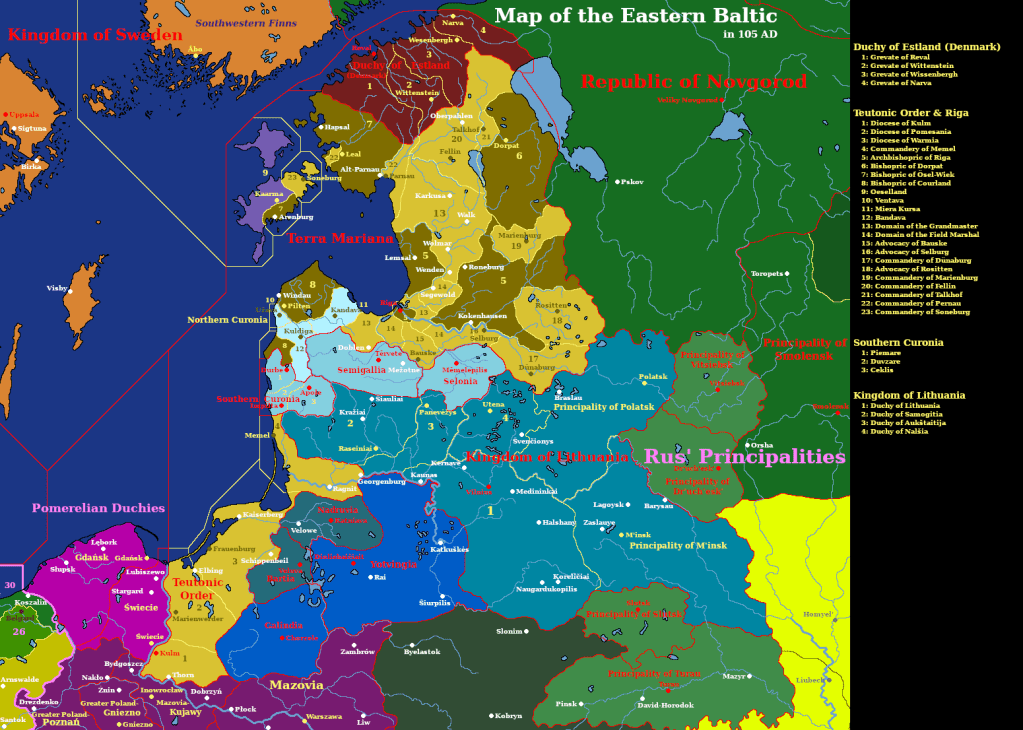
It is August, 108 AD. We turn northward, for just as the Prussian branch of the Teutonic Order must withstand the assaults of the Prussians, so too must the Livonian Order face all-out war. Here in Latvia, the war begins with the rebellion of the Northern Curonians. Prior to the Battle of Durbe, the Big Men of Northern Curonia had reached out in secret to their Southern kin, swearing to defect in exchange for the safe return of their families. Having thus been the catalyst for the defeat of the Teutons at the Battle of Durbe, the Northerners know they can’t simply go back to being the vassals of the Christians.
Instead, the Northerners renounce their Christian faith on the spot. Their elected war leader, Ramis, offers sacrifices to the old gods on behalf of his people and all the Northerners eat the meat of the sacrificial animals. Together with the Southern war leader, Skaisdis, Ramis agrees to launch a joint invasion of Curonian lands occupied by crusaders. Specifically, they intend to invade the Bishopric of Courland. Courland is an alternate name for Curonia and is ruled by Bishop Heinrich von Lützelburg, who is a vassal of Albert Suerbeer, Archbishop of Riga. Lützelburg’s own forces took part in the Battle of Durbe, leaving Courland vulnerable as of their destruction. He implores Suerbeer for aid, but Riga and the Livonians are reeling from the disaster at Durbe and will be unable to gather another army until the spring of 109. In the interval, the Semigallians besiege Doblen once more. Situated much closer to Riga, Doblen is a far higher priority than distant Courland.
Tip me on Ko-Fi: https://ko-fi.com/lordoflore
Follow me on Bluesky for updates (with teasers!): @lord-of-lore.bsky.social
Or subscribe to my newsletter to get updates via email:
Lützelburg is therefore left to fend for himself as the free Curonians invade his territory. Their first action is to sweep over the countryside like a wave destroying settlements and killing German colonists. Special attention is paid to any churches and monasteries they find. All are utterly destroyed, burned, and picked apart stone by stone. Any priests or monks who fall into Curonian hands suffer a terrible fate.
Curonian villages, meanwhile, are mostly spared destruction. As in the south, those who revert to paganism are welcomed with open arms, their warriors joining the marauding army, while those who remain Christian are distrusted and often killed along with the hated Germans. Of particular note are the so-called Courland Livs. Living in far northern Courland, these people are actually a branch of the southern (Livonian) branch of the Estonian people. Bilingual in both the Curonian and Livonian languages, the Courland Livs keep to their Christian faith and remain loyal to Lützelburg.
As the Curonian raiders advance, Lützelburg withdraws his forces to his two mightiest fortresses: the castles of Windau and Pilten, both along the Venta river. Here, he’ll make his stand. Other castles are abandoned without a fight, but Windau and Pilten will be held until the last dying breath of their defenders.
It is now March, 109 AD. Ramis and Skaisdis strategise on how best to capture the bishop’s last two strongholds. Strategy must bend to the dictates of geography, and here the geography is dominated by two features: the Baltic Sea coast and the Venta River. Beginning in Semigallia, the Venta meanders toward the coast but then swings northward, running parallel to the sea before turning west to join the Baltic. Windau is located on the left bank of the river mouth, leaving it vulnerable to attack from the south—which would be perfect for the Curonians except for the fact that Pilten is situated on the right bank of the Venta where it runs parallel to the sea. An army besieging Windau could easily be cut off by men from Pilten trapping them between the river and the sea. Pilten, however, cannot be effectively besieged without command of the river—which might as well be a highway for delivering supplies directly into the castle’s storehouse—but the river can’t be controlled so long as Windau remains under the bishop’s control.
To solve this double bind, then, Ramis and Skaisdis decide to besiege Windau first, leaving a detachment of men behind at the river crossing near Pilten to block any attempt to cut off the main army. Meanwhile, a large Curonian fleet follows the army up the coast. Thus is Windau placed under siege from land and sea. Ramis, leader of the Northerners, has served with the Livonian order for years and is therefore intimately familiar with their tactics, a fact that he uses to insist that he should be in command of the siege. Skaisdis, however, doesn’t trust Ramis for the same reason Ramis is so familiar with crusader tactics. Fearing the Northerner may switch sides again, Skaisdis refuses to take orders from Ramis. As a result, the two of them compromise by splitting the siege into two zones; the Southerners besiege the western side of the castle while the Northerners besiege the eastern side.
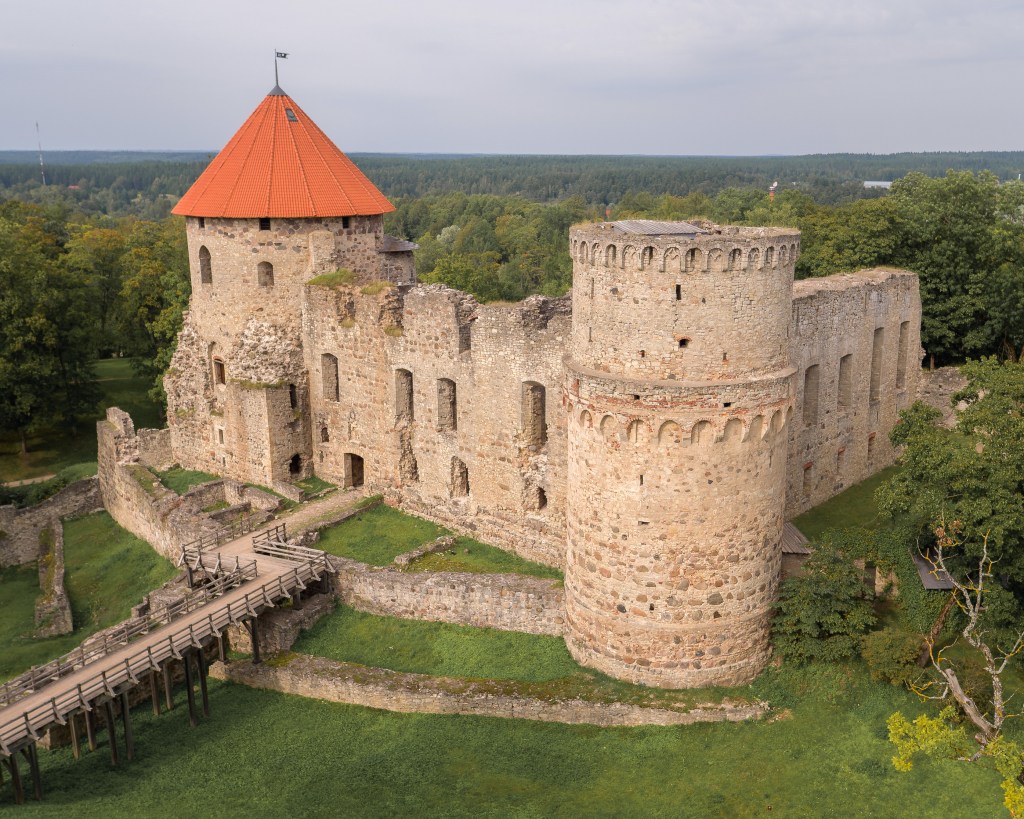
Desperate to relieve Windau, Bishop Lützelburg, holed up in Pilten, sends messengers to Riga, and from there to Sweden asking for help. Sweden has taken interest in the Northern Crusades from time to time, but hasn’t been a major player. Now, however, the spectre of Curonian resurgence rears its head. Sweden and Curonia have a long history of conflict going back at least to the Viking age. Just like the Vikings, the Curonians set forth in ships to sail over seas and up rivers in search of vulnerable targets to strike. Often, those targets were in Sweden. When the Vikings converted to Christianity and left their Viking ways behind, the Curonians carried on the tradition of seaborne raiding, all but indistinguishable from their Scandinavian neighbours. For over a century since the Christianisation of Sweden, the Curonians have raided Swedish coastal communities, kidnapping Christians to sell to merchants who take them across Rus’ lands and all the way to the Muslim world. All that was, if not brought to an end, then at least mitigated by the Baltic crusaders invading Curonian lands. The last thing Sweden wants is for Curonian raids to resume in full force.
Swedish politics at the time are complicated, but the short of it is that the previous king had died without an heir and was succeeded by a boy named Valdemar Birgersson and his father, Birger Magnusson became the regent. Even in 109 AD, when Valdemar had grown into a man, Birger remains the real power behind the throne. Calling the men of Sweden to crusade, Birger spends the spring gathering an army. In June, he sets sail for Courland.
When they arrive, the Curonian fleet scrambles to turn around and face the approaching enemy. There are no chokepoints to funnel the Swedes into, nor any islands the ambush them from behind; there is only the open sea and the adjacent shoreline. Warfare on the Baltic Sea in this era means one thing. The ships exchange arrow-fire as they close on one another, then they lash their ships together, creating a series of floating platforms on which Swedes and Curonians proceed to fight one another.
On shore, the Southern Curonians mostly abandon their siege forts in order to hop into boats and row out to the fleet to fight the Swedes. The Northerners, further away from the coast, hear about Sweden’s arrival last and are slow to react. Ramis decides to stay put, rather than row out to the fleet, because soon after the Southern Curonians leave, the garrison of Windau sallies forth and starts setting fire to the Southerner’s siege forts. Ramis counterstrikes the garrison, driving them back into the castle, but the damage is already done.
Out on the sea, the battle lasts for hours. Gradually, however, the larger number of Swedish soldiers and sailors prevails over the outnumbered Curonians. With their land forts burned behind them, all the Curonians can do is disengage and withdraw with what ships they still have. Abandoned by his allies, Ramis lifts the siege and retreats back home as well. Each man blames the other for the defeat and, as the Swedish threat looms over Northern Curonia, Skaisdis refuses to send aid, preferring to focus instead on liberating a smaller pocket of Lützelburg’s bishopric that borders Southern Curonia.
Birger Magnusson, meanwhile, spends the summer reoccupying crusader castles in Courland and launching raids into Northern Curonia. At the end of September, Birger returns to Sweden with his fleet, but leaves a detachment of the army behind in Courland.
[Next]
Credits:
Cesis Castle via Wikipedia

 Lord of Lore

Leave a comment