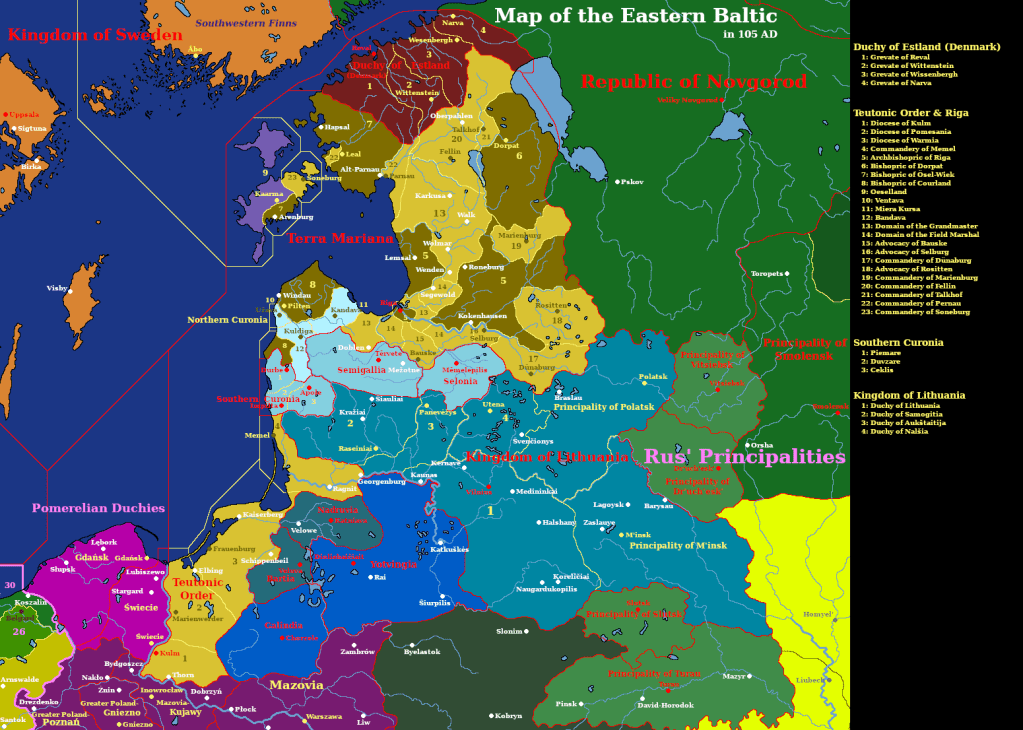
It is the summer of 110 AD. During the campaign season of 110, Birger Magnusson busies himself with an invasion of Northern Curonia. The three tribes of the North split their forces and wage a decentralised war of small battles, skirmishes, and hit-and-run engagements. Bands of Swedish soldiers are drawn deep into the dense forest of Curonia to be ambushed and killed. Birger has to keep his men concentrated in several large groups to avoid being picked off. He succeeds in destroying a number of Curonian forts and villages. Most of them are abandoned by the time he arrives, so he’s unable to strike a decisive military blow, but he does destroy the crops standing in the fields.
This compels Ramis to sue for peace. In the ensuing Treaty of Kuldiga, Ramis agrees to keep the peace with Bishop Lützelburg and Sweden and also agrees to destroy the Northern Curonian fleet. Birger and Ramis oversee the destruction of the fleet in October, after which Birger sets sail with what’s left of his fleet and returns to Sweden. Over the winter and spring, he has to borrow money from merchants in the Hanseatic League to fund the construction of new ships to fill out his fleet once again.
Tip me on Ko-Fi: https://ko-fi.com/lordoflore
Follow me on Bluesky for updates (with teasers!): @lord-of-lore.bsky.social
Or subscribe to my newsletter to get updates via email:
Not all ships are destroyed, however. Curonian ships belong to local Big Men, not to the war leader, and many Big Men don’t like the Treaty of Kuldiga. Some of them hide their ships to prevent them being destroyed. Over the winter of 110-111, controversy arises over Ramis’s handling of the war and the treaty he signed. In March, 111, Ramis is assassinated by a fellow Big Man named Gintis, who is subsequently elected as leader. Gintis repudiates the Treaty of Kuldiga and reaches out to Skaisdis and Alminas, agreeing to join the upcoming Siege of Windau.
That spring, pagan warriors once again swarm over the Bishopric of Courland, pillaging Christian settlements and burning the recently-rebuilt castles they burned before. By June, the combined armies of the Samogitians and both Northern and Southern Curonians once again march on Lützelburg’s strongholds. This time, however, they decide to switch up their strategy. Instead of going straight for Windau, they besiege Pilten. In doing this, they intend to avoid fighting the Swedish fleet on the open sea and force Birger to come fight them on land.
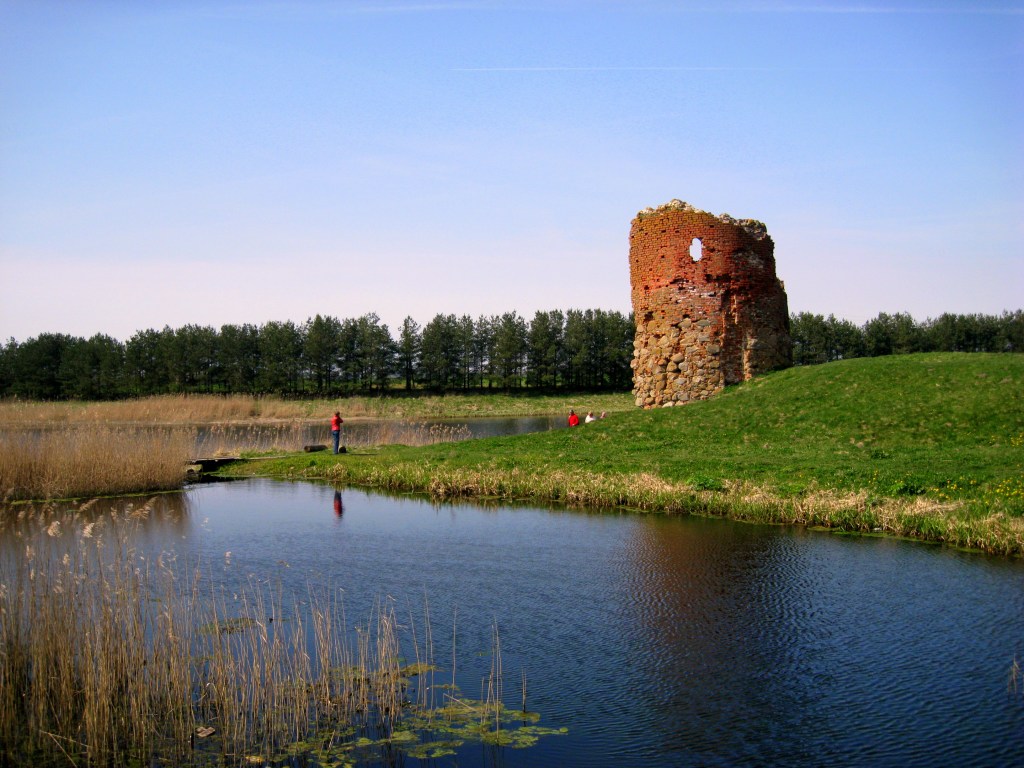
Birger arrives in July, having been delayed by waiting for some of his new ships to be finished. He’s met in Windau by Bishop Lützelburg, who decamped from Pilten to avoid being stuck in a siege. Together, the two of them march on Pilten with an army of 4,500 men, mostly Swedes. The pagan alliance of the Samogitians and Curonians numbers some 3,800. Upon their arrival, Birger and Lützelburg find that the pagans have fortified the road. A ditch cuts from the river to the nearby forest, with the dirt piled up behind the ditch and a palisade built on top of the mound complete with towers and sharpened stakes in the ditch.
Birger sends forth an emissary under a white flag; he offers terms of peace, namely, that the pagans should stay on their side of the border and not bother the Bishopric of Courland. Feigning interest, the pagans draw out the peace talks for days discussing minutiae they have no intention of agreeing to. They’ll accept nothing less that the total liberation of their traditional lands, of course, but stall for time, knowing every day is another day the defenders inside Pilten remain under siege.
After a week, Birger finally breaks off the talks and orders his men to prepare an assault. For two days in the sweltering July heat, the Swedes batter themselves upon the pagans’ wall, but each time they do the pagans drive them off with arrows from the watchtowers and spears wielded from the ramparts.
On the night of the second day, a group of Samogitian light cavalry make use of local guides, who show them a path through the woods around behind the enemy camp. As dawn’s light breaks over the horizon, they attack the camp, setting fire to the tents and causing as much chaos as possible. Meanwhile, the main pagan army descends from their palisade and launches a frontal assault while the Swedes are still getting their armour on. Half-dressed Swedes begin fleeing the field even as the fire engulfs the camp behind them. The only good news for the Christians is that the pagans don’t pursue because they’re too busy trying to put out the fires they started so they can loot what’s left of the camp.
Birger Magnusson survives the battle and decides that this war is simply too costly to continue waging it. Despite the desperate pleas of Bishop von Lützelburg, Birger signs a peace treaty with the Curonians and Samogitians two days after the battle. Both sides agree to a ten-year truce, during which Sweden will not interfere in the wars between the crusaders and Curonians and Samogitians, while the Curonians agree not to raid Sweden’s coast or Swedish shipping for the same period of time. With the treaty in hand, Birger Magnusson returns to Windau and sails back to Sweden.
Isolated and alone, Bishop Lützelburg tries to keep Pilten supplied over the next few months of siege. However, the pagans carry river boats overland and start patrolling the Venta River, making it difficult for supplies to get through. In November, the gates of Pilten are smashed open with a battering ram and pagan warriors overwhelm the starving defenders.
It is now April, 111 AD. With Pilten fallen, Windau now stands as the only crusader foothold in Curonia, and the Curonian-Samogitian army comes for Bishop Lützelburg. With the Curonian fleet already blockading the port and the pagan army now arriving outside the walls, Bishop Lützelburg gives in. He agrees to relinquish Windau and all of Courland to the pagans and in exchange, they allow him to leave with all his remaining soldiers and people. He marches out the gate and heads east in a long, ragged column. Along the way, they’re joined by thousands of Courland Livs, who fear pagan reprisals for their loyalty to their Christian lords.
[Next]
Credits
Pilten Castle Ruins via Wikipedia


Leave a comment