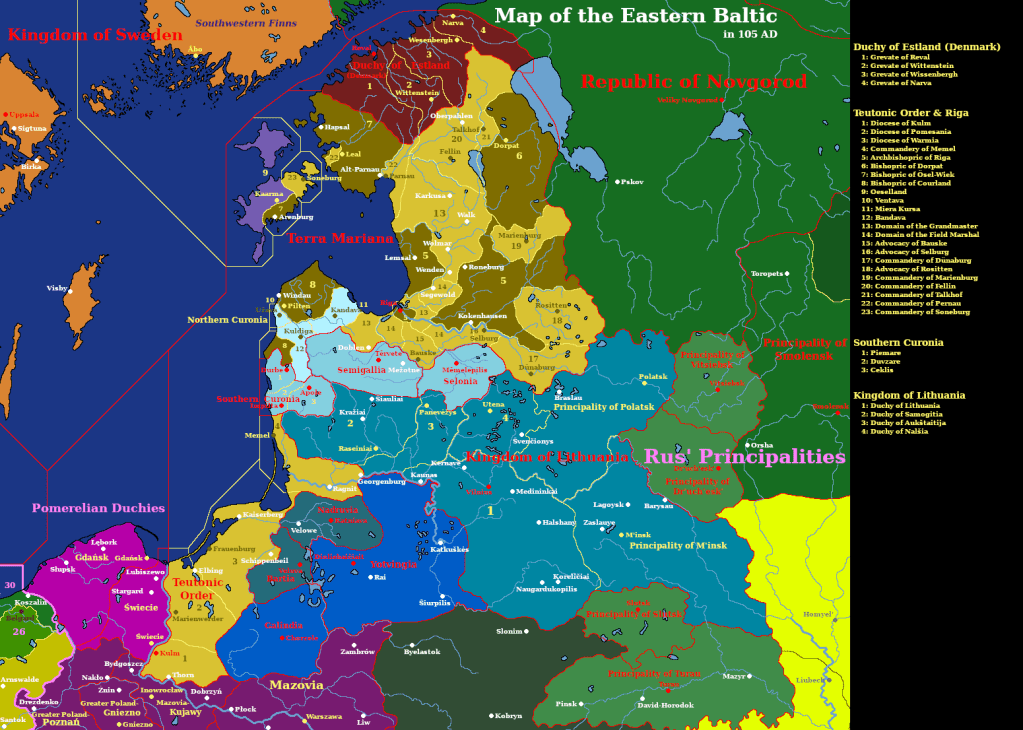
It is May, 112 AD. After nearly a year of siege by a Prussian-Yotvingian-Skalvian alliance, the Teutonic castle of Frauenburg has surrendered and the garrison marches out the gates, leaving the castle to the pagans.
For the past five years, the Teutonic Order in Prussia and Livonia has struggled to merely stay afloat. Losing castles fast, the Prussian branch has called upon the Teutonic bases in Germany, where hundreds of knights operate castles sprinkled across the kingdom for recruitment and economic support purposes. However, the Teutons in Germany have been pursuing their own independent policy of campaigning against the Heathen Romans in the Rhineland. Having taken part in William of Holland’s campaigns, they’ve often been the tip of the lance of raiding parties sent into Heathen lands to pillage or set up new castles. The crusade against a few pagans hiding in the swamp seems a small thing when there’s a huge Heathen empire just across the river from Germany, which has become the heart of Christendom itself. Remember that, in the post-Act of God world, the Kingdom of Germany is by far the single largest realm in the Catholic world with 8.6 million people (the next largest is Poland, with a mere 3 million). So the German chapters send a few dozen men to the Baltic, who do partake in military operations against the Prussians, but their primary purpose is to convince the Prussian branch that they should abandon the Northern Crusades and come to the Rhine.
Tip me on Ko-Fi: https://ko-fi.com/lordoflore
Follow me on Bluesky for updates (with teasers!): @lord-of-lore.bsky.social
Or subscribe to my newsletter to get updates via email:
In the midst of all this, the Polish Duke Kasimir of Kujawy has besieged Thorn, the fortress guarding the Teutons’ southern border with Poland. Pope Clement IV sends a letter to Kasimir reminding him of his Christian duty to help the crusaders against the pagans, imploring him to lift the siege, and not-so-subtly implying that Kasimir could be excommunicated for refusing to comply.
Duke Kasimir keeps his men encamped around Thorn, but eases up the siege a bit to allow messengers and some supplies into the castle. Meanwhile, he enters into negotiations with the Teutons. Ever since arriving in Prussia, the Teutons have been a double-edged sword, both serving as a buffer between Poland and the pagan Balts and also being a thorn in Poland’s own side. Preferring to be rid of that thorn, Kasimir offers to buy Teutonic land in Prussia so that they can migrate to Germany instead. Negotiations drag on; in July, Kasimir withdraws his army while talks continue.
Meanwhile, the pagan alliance has to decide what to do with Frauenburg. Most Teutonic castles that fall to the pagans are simply destroyed, since the pagans don’t have the administrative capacity necessary to garrison them or keep them supplied. But one man has a vision. Kriwe-Kriwaito Dargis of Nadruvia convinces Skomants, war leader of the Yotvingians, that in order to keep the crusaders out of Prussian lands for good, it won’t be enough to just destroy their castles. Even if the Teutons leave, the Poles will simply take their place, or Denmark and Sweden will. Prussia is going to have to undergo radical change in order to meet the challenges of the future—and who better to lead Prussians ever onward than Skomants? With the wise guidance of Dargis, of course.
Skomants, therefore, claims Frauenburg as his own. Renaming it Wārgārbis (the Prussian pronunciation of Frauenburg), he grants it to one of his loyal men, who garrisons it himself and becomes the Big Man over the local area. Warmians object to this on the grounds that Wārgārbis is on traditionally Warmian land, but they can do little against the combined influence of the two most powerful men in the alliance.
Marching along the coast of the Vistula Lagoon, the pagan alliance army moves on Elbing next. It’s a diverse army composed of many tribal elements. Yotvingians and Nadruvians make up the bulk of it, but there are also significant numbers of Bartians as well as smaller contingents of Galindians, Natangians, Warmians, Pomesanians, and Pogesanians, while a joint Sambian-Skalvian fleet sails alongside them.
However, a power struggle soon erupts between Skomants and Erksmants of the Natangians. Skomants assumes that, as the war leader of the largest contingent of the army, he should be in overall command, and Kriwe-Kriwaito Dargis backs him up. Erksmants, however, insists that he’s the most qualified for the job because he’s the most familiar with German ways of thinking. He’s supported by the Sambians and Skalvians, who are wary of Skomants’s outsized influence. Without the Sambian-Skalvian fleet, the land-lubbing Yotvingian army can’t properly besiege Elbing, so the two sides reach an impasse, leading to them camping out on the coast of the lagoon for several days while they resolve it.
After three days of arguing back and forth, the Kriwe-Kriwaito proposes a compromise; Skomants becomes leader, but Erksmants will be his most valued advisor and will direct siege operations. Both men agree to this, and thus is born the Prussian Triumvirate of Skomants, Erksmants, and the Kriwe-Kriwaito. Resuming their march, they soon reach Elbing.
Elbing is a city situated on the northern shore of Lake Drużno, at the point where the Elbing River flows out of the lake and into the Vistula Lagoon. The city operates under Lübeck law, similar to Memel. Also similar to Memel, the place is really the size of a rather small frontier town, contrary to what the word “city” might conjure in the imagination. There is a castle, a warf, several churches, and a marketplace. The main industry is amber artisanry, which is sold to merchants from the Hanseatic League, of which Elbing is a member. Consequently, the city is guarded by its own militia, a Teutonic garrison, and a few mercenaries hired by Hanseatic merchants to protect their interests in Prussia.
Upon arrival, the pagan alliance quickly constructs several forts around the city and closes it off by sea. They even drag some of their ships overland and put them in the lake to prevent resupply by that route as well. Totally closed off, the Elbingers count their supplies, tighten their belts, and hunker down for the long haul.
Meanwhile, Duke Kasimir and Grandmaster Hartmann von Heldrungen are negotiating in a tent outside Thorn. Heldrungen has already decided that the Baltic is a lost cause and fully intends to migrate to the Rhine, but he wants to get something worthwhile out of Kasimir rather than just abandoning the region. Kasimir knows Heldrungen is under time pressure, so he stalls negotiations. When word reaches them that Elbing is under siege, Kasimir stalls some more. He asks for far too low a price; Heldrungen doesn’t wish to be remembered as the grandmaster who sold Prussia for a few pennies and ran away like a whipped dog. On the other hand, he has no forces left with which to relieve Elbing; at this point, he has only a few dozen knights and perhaps a couple thousand men-at-arms. The optics of abandoning the Order’s garrison still within the besieged city (including several brothers of the Order) would be quite bad.
Finally, Kasimir proposes two options. Either he’ll purchase Prussia from the Order at Heldrungen’s higher price, allowing the Order to leave but forcing them to abandon Elbing to its fate, or Kasimir can lift the Siege of Elbing with his own army and then purchase Prussia at his own lower price. Seeing no other options, Heldrungen relents and accepts the latter deal.
And so, Duke Kasimir I of Kujawy regathers his army (most of it had been demobilised to reduce the logistical strain on those camped outside Thorn) and marches on Elbing. Moving around the east side of Lake Drużno, Kasimir’s 3,800-strong army approaches the 4,400 men of the pagan alliance from an unexpected direction. In order to properly siege Elbing, the pagans had to split their forces to cover both sides of the Elbing River, and Erksmants had anticipated a crusader relief army to come from the west side of the lake and attack the smaller, isolated force of 1,000 men on that side of the river. He had, therefore, ordered the pagan fleet to set up camp on the west bank of the river so the crewmen could reinforce the army on that side if necessary. No preparations had been made for the west side to reinforce the east side, however.
Erksmants and Skomants rush their troops into position while sending a message asking the Kriwe-Kriwaito (who’s in command on the west side) for help. Help cannot arrive fast enough, however, as Erksmants and Skomants are unable to get their troops fully formed up before the Polish knights launch their first charge. The Poles break through the ragged line of defence and ride through the throngs of warriros trying to get into their position in the line, wreaking havoc and death. Some of the Prussians flee eastward, but the Natangians form up on the banks of the river while the Yotvingians pull together on the east side of Elbing. Polish knights withdraw for now, but the Polish crossbowmen and archers close in instead, peppering the Yotvingians with arrows while the men-at-arms approach at a measured pace. Soon, the melee begins. As the men-at-arms begin surrounding the smaller Yotvingian force, the Natangians try to get closer but are prevented by a second charge of the Polish knights. After an hour’s fighting, Skomants withdraws his Yotvingians, disengaging and making a fighting retreat until the Poles decide to give up pursuing them. Meanwhile, Erksmants and the Natangians manage to cross the river in boats, ending up stranded on the wrong side with a Polish army between them and their homeland.
Meanwhile, the garrison of Elbing is glad to see the siege partially lifted, but are confused to see a Polish army doing the lifting, and wary of what their intentions are. Howeer, Kasimir approaches the walls and informs them of his deal with their grandmaster, news that has a decidedly mixed reception.
As for the Prussians still on the west side of the river, they begin making preparations to strike camp and escape via the Vistula Lagoon. The day after the battle, the boats on the lake are burned and the crew rejoins the main fleet. However, there isn’t enough space on the ships for everyone, so the tribes begin arguing amongst themselves about who will have to stay behind. Luckily for them, however, Kasimir has no wish to risk his own army any more than he has to. Emissaries arrive from the Polish duke and inform Erksmants and the Kriwe-Kriwaito that Kasimir would like to make peace with them. The two sides get onto boats and meet in the middle of the Elbing River. Kasimir offers to let the remainder of the pagan army leave in peace in exchange for a ten-year truce. Erksmants and the Kriwe-Kriwaito agree. And so, the pagans are allowed to leave with their army still mostly intact. A few hostages are swapped between the two sides to ensure both stand by the truce, and Kasimir sends emmisaries to find Skomants and make a similar deal with him. Soon, all the Prussian tribes, plus the Galindians, Yotvingians, and Skalvians agree to Kasimir’s truce.
True to his word, Grandmaster Hartmann von Heldrungen accepts Kasimir’s relatively paltry lump sum of silver and hands over all the castles and cities the Teutonic Order owns in Prussia. It takes a full year, but by the summer of 113, the Teutonic Order has fully decamped from Prussia and migrated to the Rhineland.
This sparks a crisis in the Livonian Order. Livonia is physcially separated from Prussia by Samogitia, and all attemtps to connect the two failed. The Livonian Order is, technically, a branch of the Teutonic Order, but it has its own leadership and mostly operates autonomously. They’ve also been fighting in the Baltic since before the Teutons arrived, back when the Livonians were in a separate knightly order called the Livonian Sword-Brothers. Some of the Livonians decide to abandon the Northern Crusades and go to the Rhineland, but most of them are too deeply involved in Livonia to simply leave. Instead, the Livonian Order declares independence in 112, renaming itself back to the Livonian Sword-Brothers, and severing ties with the Teutonic Order.
Rebuilding the Sword-Brothers will take over a decade and will require establishing new connections for sources of recruits. Formerly an almost exclusively German order, the Sword-Brothers will soon be accepting mostly Danes and Swedes instead.
In the meantime, the Sword-Brothers are weak, with only a few dozen brothers surviving after the disasters at Durbe, and in Semigallia and Latgallia. They are simply unable to continue feuding with Archbishop Suerbeer of Riga, and as a result they become subordinate to the Archbishop. By about 120, the Sword-Brothers have been subsumed as a mere armed monastic order within the Archbishop’s new theocratic state of Terra Mariana.
Meanwhile, the future of Prussia looks bright. Although they proved unable to capture Elbing, the pagans neverthless have much to celebrate. Schippenbeil, Kaiserburg, Frauenburg, and many other castles besides have fallen to pagan arms, and five tribes once thought subsumed under the Teutonic Order have been freed. But once the external enemy is dealt with, Prussians will forget how well they once worked together and go back to bickering amongst themselves as they did before the crusaders forced them to unite. Prussian will make war on Prussian, and all shall fall to future conquest by Poles, Danes, and Swedes.
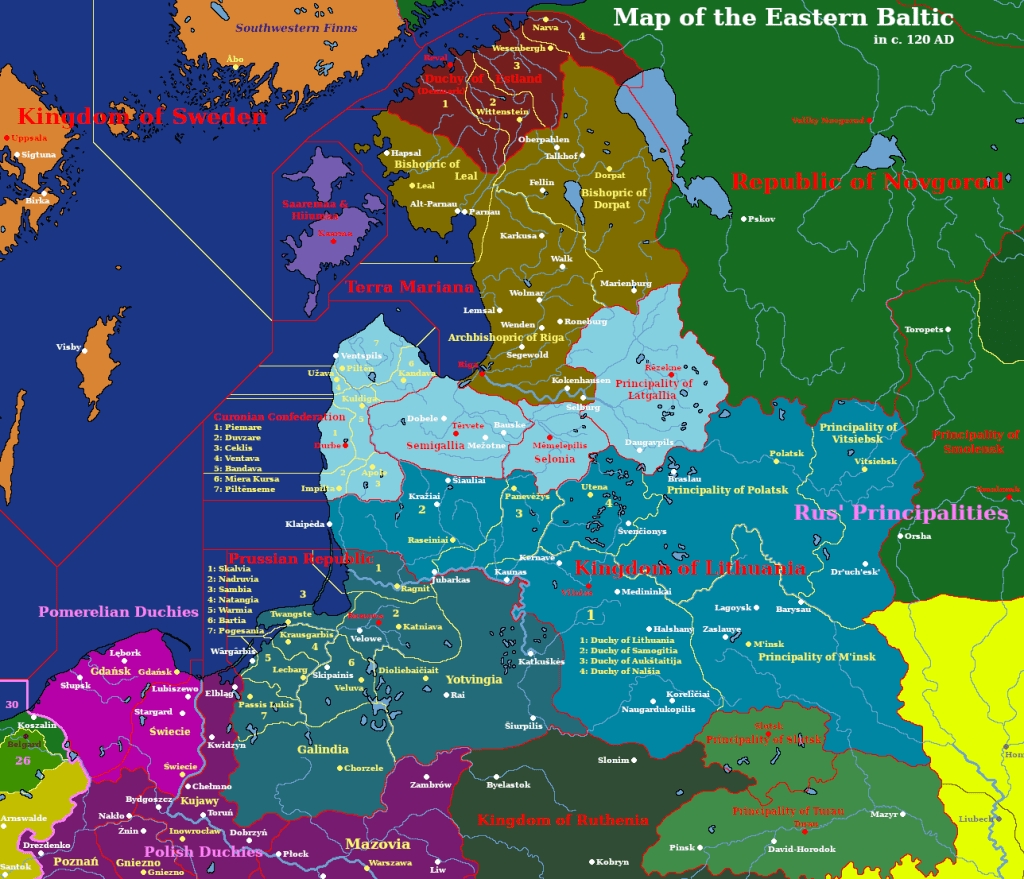
This is what the Kriwe-Kriwaito fears will happen, and so he works tirelessly to prevent such a future. Working together with Erksmants and Skomants, he calls all Prussians, plus the Skalvians, Yotvingians, and Galindians, to a grand meeting at his estate/temple of Romuva. Here, the Triumvirate announce the creation of a confederation for all tribes present. Instead of feuding amongst themselves, they’ll work together for the common good to hold fast to their traditions and keep the crusaders out for good.
Many have doubts. Many think the Triumvirate doesn’t want everyone to work for the good of all, but rather intend to get everyone to work for the good of the Triumvirate. Over the course of the ten-year truce with Kujawy, one tribe after another falls into civil war over how closely their tribe should align itself with the others.
Skalvians divide over the question of whether to align with the Prussian Confederation or to pursue closer ties with Lithuania; a Samogitian army invades Skalvia, links up with local supporters, and then is defeated by a Yotvingian-Nadruvian-Skalvian army. Skomants faces an internal revolt by Yotvingian rivals. Galindia almost erupts into civil war, but then an invasion by the neighbouring Polish Duchy of Mazovia is repelled only with Prussian and Yotvingian assistance, reminding even the most hardline anti-confederationists of the value of having allies.
As time passes, the confederation is centralised and formalised. Erksmants of the Natangians, during his decade of living in Magdeburg, Germany, read a great deal of Latin literature, including the history of the Roman Republic of old. Taking inspiration from this, he renames the Prussian Confederation to the Prussian Republic and organises a senate made up of sixty-five Big Men; five each from Skalvia, Sambia, Natangia, Warmia, Pogesania, and Bartia, nine from Nadruvia, eleven from Galindia, and fifteen from Yotvingia. Senators are elected every three years by the popular assembly of their respective tribes. The senate, in turn, will elect a triumvirate of consuls each year. There are no term limits for consuls or senators, but there are rules banning men from the same family serving simultaneously in order to prevent any one family from gaining too much power in the system.
More offices are added over the following years as the Prussian Republic coalesces into a fledgling state.
[Next]

 Lord of Lore
Leave a comment