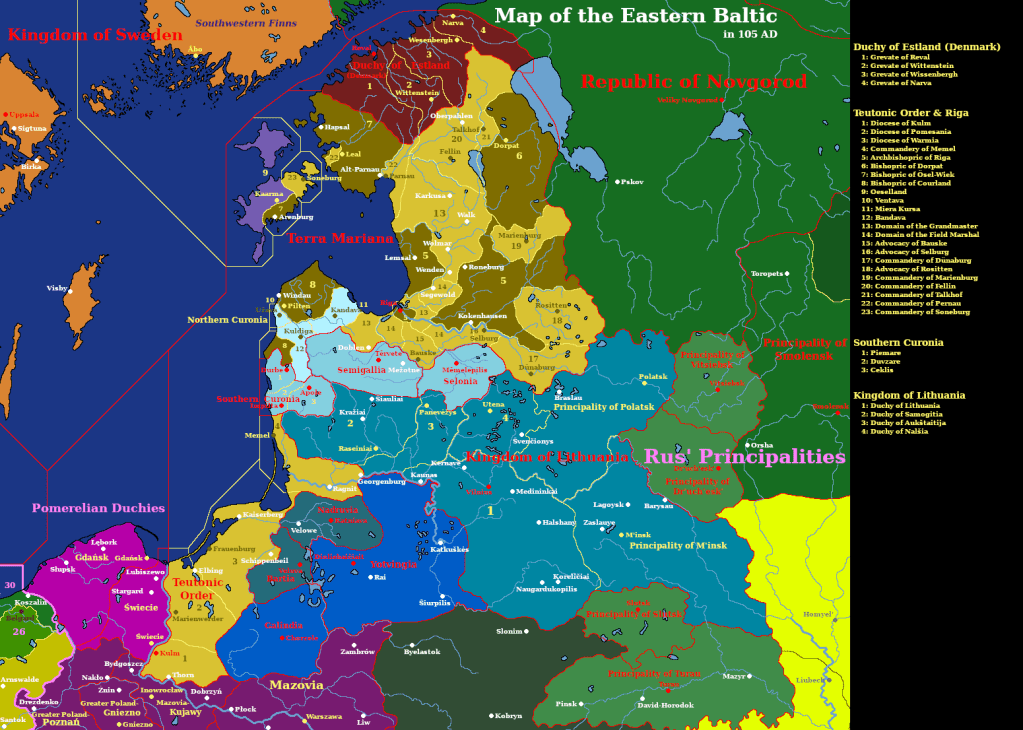
It is May, 109 AD. Northwest of the Gulf of Riga, partly closing the gulf off from the wider Baltic Sea, lies the island of Saaremaa (called Ösel by the Germans) and its neighbour, Hiiumaa (Dagden, according to the Germans). Saaremaa is inhabited by a fiercely independent people called the Saaremians, who maintain close kinship and political ties with their neighbours, the Hiiumians. Since time immemorial, these two peoples have engaged in piracy all over the Baltic and beyond. So prolific were that that, during the Viking Age, they were called the “Eastern Vikings” alongside their Baltic neighbours in Curonia, Skalvia, and Prussia. Saaremians speak an Estonian dialect closely related to those spoken by the Livs and the Estonians proper.
Saaremaa has a story more tumultuous than most in the bloody back-and-forth of the Northern Crusades. Repeatedly invaded and occupied by Danish, Swedish, and Livonian forces, the invaders have been repeatedly driven out again. Even when Saaremian forts are destroyed and the people forced to accept Christianity, they take the first opportunity to revert to paganism and drive the occupiers out again. In 1227, the whole island was conquered and the inhabitants forced to convert, only for them to rebel in 1236, only to be conquered again in 1241. Ever since then, things have been relatively quiet, but with the devastating pagan victory at Durbe, it’s only a matter of time before the Saaremians rise up again.
Tip me on Ko-Fi: https://ko-fi.com/lordoflore
Follow me on Bluesky for updates (with teasers!): @lord-of-lore.bsky.social
Or subscribe to my newsletter to get updates via email:
In spring, the natives seize the opportunity to attack the German forts at Arenburg and Soneburg. Saaremian ships sneak into the harbours of both towns at night and attack the unsuspecting garrison, opening the gates to let the main army in. All the German inhabitants are killed and the stone forts are levelled. Free, once more, to roam the seas, the Saaremians and Hiiumians begin raiding the Estonian mainland and also the coasts of Finland and Sweden. Sweden is an especially ripe target for the next two years, since the Swedish fleet is busy supporting land operations in Curonia, which we already discussed.
Meanwhile, at Rēzekne, self-proclaimed Prince Vaitvaldis is taking steps to ensure the success of his rebellion. He’s just one particularly ambitious rebel leader among many who’ve either captured a castle or are roaming the countryside. Vaitvaldis knows he needs help in order to survive and thrive. To that end, he sends people to Prince Tautvilas, the Lithuanian who has installed himself as ruler of the neighbouring Principality of Polatsk. Tautvilas gladly takes the opportunity to place a buffer state between himself and the Livonian Order, sending his son Constantine with 1,200 men to help arm and organise the Latgallian rebels. Throughout the summer of 109, Vaitvaldis uses Constantine and his army to bully other rebel leaders into acknowledging Vaitvaldis as their sovereign.
In all this, the lands of the Archbishop of Riga are less affected than the lands of the Order, largely because Riga has more soldiers to deal with rebels. August, 109, Livonian Master Breithausen finally acquiesces to Archbishop Suerbeer’s requests to send aid. For the moment, Suerbeer asks for nothing in return, but both parties know this places Breithausen in a subordinate position, unable to defend his own lands against peasant rabble.
But of course, it’s no longer just a peasant rabble out there. By the time the Archbishop sends an army of 3,000 men to Latgallia, the rebels have Constantine and his 1,200 on their side and additional 2,700 men of their own trained by the men from Polatsk. Believing his own men to be superior in equipment and discipline, the Archbishop urges his men forward.
Near a Latgallian village called Višķi, to the northeast of Dünaburg and a quarter of the way to Rēzekne, scouts from the two armies encounter one another. A skirmish ensues, to which reinforcements are added piecemeal. Riga’s men-at-arms, clad in gambesons and mail and wielding spears, guisarmes, and crossbows, fight against Latgallian peasants armed with scythes, boar spears, and hunting bows. Peasants hurl rocks and arrows from the woods, but the men-at-arms shrug them off and keep advancing, cutting a swathe through the ranks of unarmoured peasants. But then, Constantine arrives with his contingent of heavy cavalry and strikes the Archbishop’s men in the flank. Arriving in groups of fifty or a hundred, Constantine’s men hurry into battle. Surrounded on three sides, the Rigans give up hope and flee the field, leaving 1,000 dead behind them.
Over the next decade, Vaitvaldis will continue consolidating and expanding his fledgling realm. He captures Dünaburg (which the Latgallians call Daugavpils) in 114, but fails to capture Kokenhausen after a two-year siege in 116-118. Finally, his advance is checked at a line from Kokenhausen to Roneburg to Marienburg, beyond which Vaitvaldis is unable to expand. By the same token, multiple Rigan-Livonian incursions into Latgallia are unsuccessful, and so the two side settle into an uneasy peace in the 120s. Vaitvaldis turns inward, consolidating his principality along the lines of a German feudal realm by granting fiefs to allied Latgallian rebel leaders—and even a few Germans and Rus’ who serve him as well—while assassinating or imprisoning his internal rivals. By the end of the 120s, it’s clear that the Principality of Latgallia is a new player on the board, not some ephemeral rebellion to be snuffed out in a few years.
[Next]
Credits
Latvian bog via pexels.com


Leave a Reply