[Next]
1.1 – First Contact (c. 1519 – 1540)
In 1492, Christopher Columbus sailed the ocean blue, but he couldn’t have predicted that others had tread his path before him. As the Spaniards colonised the islands off the new continent Columbus had stumbled across on his way to Asia, they kept hearing more and more about the mainland. There reigned a great empire called the Triple Alliance, better known to history as the Aztec Empire. Beyond them was the Purepecha Empire, and far beyond that, rumours swirled of another people whose cold calculus of war was surpassed only by their appetite for the bounties of the New World. Cocoa, spices, feathers, furs, all these things were coveted by the westerners, but most of all they desired silver.
In February 1519, the conquistador Hernando Cortes led an expedition to the mainland to discover what all the fuss was about and to claim it for Spain—and claim a portion for himself too. After passing along the Maya coast, Cortes left his ships on the coast at the site of the future city of Veracruz and marched inland in September.
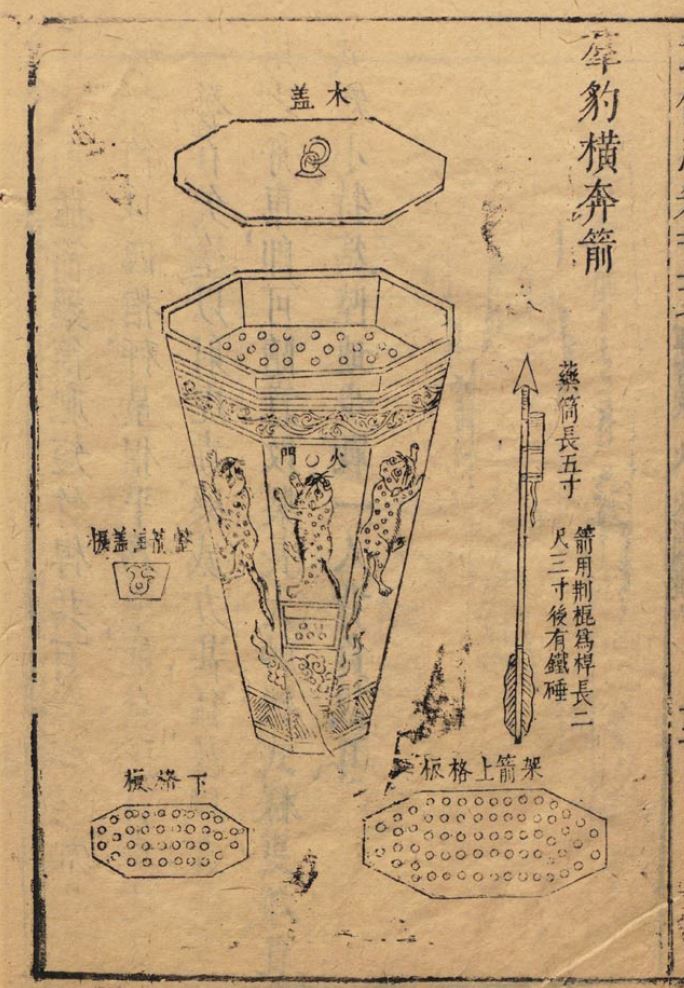
He soon came into conflict with Otomi and Tlaxcallan warriors and was shocked to find himself under fire from rocket arrows. These were no simple fire crackers or burning arrows, they were more like rocket-propelled javelins. Loaded into a handheld frame, a single man could fire thirty or more rocket arrows at once by lighting a single fuse with a match. Cortes couldn’t bring himself to believe the natives had cracked the secrets of gunpowder. On top of that, some their most elite warriors wore lamellar armour and wielded iron weapons, which stood in sharp contrast to the cotton armour and obsidian weapons of the rank and file. After making peace with the Tlaxcallans, they informed him the weapons came from the mysterious western merchants. The Tlaxcallans had a name for the westerners: Sancuca.
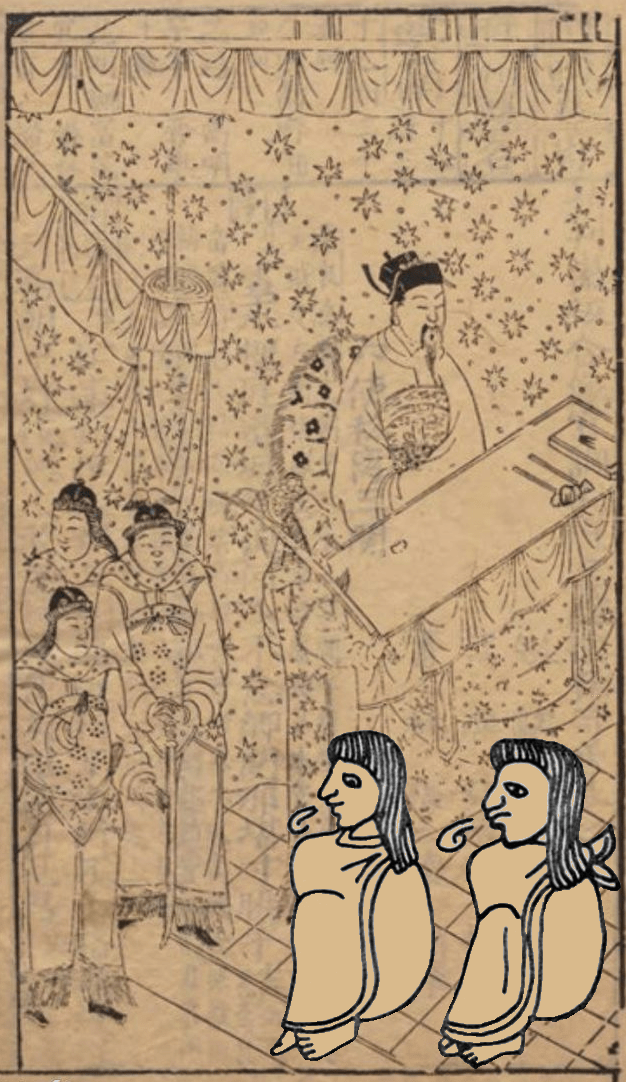
In November of 1519, Cortes arrived at the Aztec capital of Tenochtitlan, where he was peacefully received by Emperor Montezuma II. There, he finally came face to face with some of the elusive Sancuca, who were in the city on a diplomatic mission. Their phenotype made it obvious they weren’t from Mexico and in fact reminded Cortes of descriptions of Mongols that he’d heard about. They wore flowing silk robes and large hats, or at least small hoods, because it was their custom for men to always have their hair covered in public.
It wasn’t immediately clear to Cortes who they were, but he relayed descriptions of them in his letters to Europe. Cortes’s account was compared with accounts of Portuguese explorers in eastern Asia and with Marco Polo’s tales. When a conclusion was finally reached, it reverberated throughout Europe like a bombshell: Cortes had made contact with China. Mexico was, of course, the last place Spain had been expecting to encounter the Chinese. A whirlwind of letter-writing and debates erupted in Europe about how they got there. Many said this meant Asia really could be reached by sailing west while some went so far as to declare this to be proof that Columbus had been right about the size of the Earth, which he’d believed to be much smaller than it really is. Perhaps Mexico and the Caribbean really were just the eastern fringes of Asia itself. Calmer voices cautioned that more information was needed before any conclusions should be made.
Cortes went on to conquer the Aztec Empire for Spain, but to the west lay the Purepecha Empire, greatest rival to the Aztecs. Between 1522 and 1530, the Purepecha were brought under domination through a mixture of diplomacy, guile, and a carrot-and-stick strategy to bring local elites onboard with Spanish rule. Serious resistance began in 1530, when a Spanish conquistador tortured and executed the Purepechan ruler, which plunged the empire into chaos. While fighting Purepechan rebels, the Spaniards and their indigenous allies often found the enemy wielding rocket arrows and other Chinese weapons.
As the 1530s wore on, other conquistadors expanded Spain’s borders to the north and south. In 1533, Francisco Pizarro conquered the Incan Empire.
Through all this, Sancuca merchants continued showing up on Mexico’s Pacific coast and on the Peruvian coast looking to purchase the New World’s bounty. They were all smiles as they conversed with the Spaniards in Nahuatl or in Quechua, even as Chinese fire arrows set Spanish outposts ablaze in western Mexico. When asked how their weapons kept ending up in the hands of Spain’s enemies, the merchants would always deny any knowledge of such a thing. This decidedly bipolar behaviour led the Spaniards to consider the Chinese to be duplicitous actors. That and efforts by Madrid to crack down on smuggling and centralise control of New Spain’s economy led Spain to ban Chinese merchants from all ports except Acapulco in New Spain and Lima in Peru.
1.2 – The Cabrillo Expedition (1542)
Mexico’s early decades were fraught with political turmoil. First, it was governed by the Royal Audiencia of Mexico, a kind of high court. The audiencia itself suffered corruption and infighting and had to be disbanded and reformed in 1530 before being abolished in 1535 with the arrival of the new viceroy. Add to that the numerous indigenous uprisings of the 1530s and ’40s, and Mexico simply had too much on its plate to properly outfit an expedition to find the source of the mysterious Sancuca merchants who were equally happy to sell silk to the Spaniards and fire arrows to their enemies. Several expeditions were sent, but none made it far enough to reach the Sancuca’s country, which the Spaniards called Sancucalan (from Nahuatl: Sancucalán, “place of the Sancuca”).
All that changed in 1542, when Viceroy Antonio de Mendoza commissioned Juan Rodriguez Cabrillo to lead an expedition north and finally establish contact with Sancucalan. Unlike previous expeditions, Cabrillo wouldn’t be sailing blindly into the void. Mendoza enlisted the services of a Chinaman the Spaniards called Chimbàocia. His actual name, according to the signature with which he signed on for the expedition, was Zim Baauciu, which is the Cantonese pronunciation of Zhan Baochao.
As a side note, although Spanish records refer to Zhan Baochao as Chinese his surname reveals that he was almost certainly a Cham, or descended from Chams. The Sultanate of Champa was located in what is now south-central Vietnam and was conquered by the Vietnamese in the late 15th century, which prompted mass emigration in the following decades. Upon arrival in the New World, these people were labelled Zhan (Chinese for Cham), which some of them took as a surname.
Speaking in a mixture of Nahuatl and broken Spanish, Zhan Baochao claimed to represent a larger organisation called the Dongguang Silver Society. He continually assured Cabrillo that he’d receive a king’s welcome when they reached Dongguang, the capital city of the southern half of what he called Xinguo. Xinguo, he elaborated, meant ‘New Country.’ In Cantonese, it’s pronounced Sangwok, and it was from this that the Nahua name Sancuca was derived.
Setting sail with three ships on June 27th, 1542, Cabrillo duly noted and described every landmark he passed on his way north. Zhan Baochao had made the round trip from Dongguang to Acapulco and back many times and was a veritable encyclopedia of knowledge on the terrain, landmarks, and peoples they passed.
Along the way, he pointed out Xinguan outposts set up to trade with natives or to accommodate merchants travelling to and from Acapulco and Lima. At some of these outposts, the expedition stopped to spend the night, resupply, and let the crew stretch their legs. Other outposts, however, Zhan told Cabrillo in no uncertain terms that he should avoid. When asked why, Zhan replied cryptically that they were unfriendly to Spaniards and to Zhan’s people but refused to elaborate further, saying that it was complicated. All would be made clear when they reached Dongguang, he said.
On the morning of July 2nd, after rounding a headland, Zhan pointed to the bay ahead of them and announced that they’d reached the southernmost part of Xinguo. From then on, the settlements the expedition passed were markedly different. Previously, they’d been passing indigenous villages of various stripes and colours. Tribes on the Cactus Peninsula lived in tents made of animal skins and went naked as a matter of routine. Beyond them, tribes became better dressed, their architecture more sophisticated, and articles of Chinese manufacture became more prevalent. Here on the coast of Xinguo, the people and buildings were clearly of Asian origin.
On July 3rd, the expedition was stopped by two Xinguan patrol ships flying red flags. Zhan Baochao pointed out the flags and explained,
“Red good. Red means southerner. Black means northerner. Northerner bad.”
He conversed with the man in charge of the patrol boats before informing Cabrillo that the patrol ships would be escorting them to Dongguang.
“Is that normal?” Cabrillo asked,
“No,” Zhan scratched his chin, “but neither is Meixigou expedition in this water.”
On July 6th, they reach the Jaw, a narrow strait between two peninsulas. It was obscured by fog and would’ve been easy to miss were it not for Zhan pointing it out. After navigating the Jaw’s waters, they found themselves in the Bay with a handful of islands ahead. Zhan was in high spirits.
“We be there in a day, you see, then my master treat you and crew like kings,” Zhan declared in broken Spanish. Just as he finished speaking, eight ships swept out from behind one of the islands, speeding toward the Spaniards. Elation turned to confusion on Zhan’s face as he saw that the ships were flying red flags.
Cabrillo turned to Zhan and bellowed, “You led us all this way to lead us into a trap?!”
The two Xinguan ships escorting the expedition opened fire at the same time as the newcomers before Zhan could answer. Cannonballs slammed into the Spanish hulls while fire arrows got caught in the rigging or rained down onto the deck. These fire arrows had bags of burning (not exploding) gunpowder tied to them which Spaniards rushed to put out before the ships could be engulfed in flames. They returned fire. Although they were outnumbered, the Spanish ships were bigger and better armed than their counterparts. They gave as good as they got, forcing the Xinguans to veer off and begin circling the Spaniards, peppering them with cannonballs and fire arrows.
“A trick! A trick, it has to be!” Zhan insisted on his innocence as two of Cabrillo’s men put him in irons and started leading him away while Cabrillo directed the battle. On the way to the hatch that led below decks, Zhan was hit in the back by two arrows which mortally wounded him.
After exchanging several volleys things were looking grim, but manageable. The fires had been kept under control on the Spanish ships and one of the Xinguan ships was dead in the water with a broken mast. Then four more ships appeared from behind another island. Surrounded on three sides, the only way of escape was back out the Jaw. Amid a hail of cannonballs and fire arrows, the Spaniards managed to turn their ships around and sail back out the Jaw, but not before the smallest of the three was set ablaze by a final volley of fire arrows. The other two ships were forced to turn their backs and flee as their comrades jumped in the water to escape a fiery death.
The expedition took heavy casualties, including Zhan Baochao, who succumbed to his wounds while still murmuring that it was a trick of some kind. Juan Rodriguez Cabrillo was also among the dead, having been decapitated by a cannonball while the ships turned around. Nevertheless, the rest of the expedition was able to make it back to Mexico in early September with Cabrillo’s logs intact.
1.3 – Xinguo (1437 – 1542)
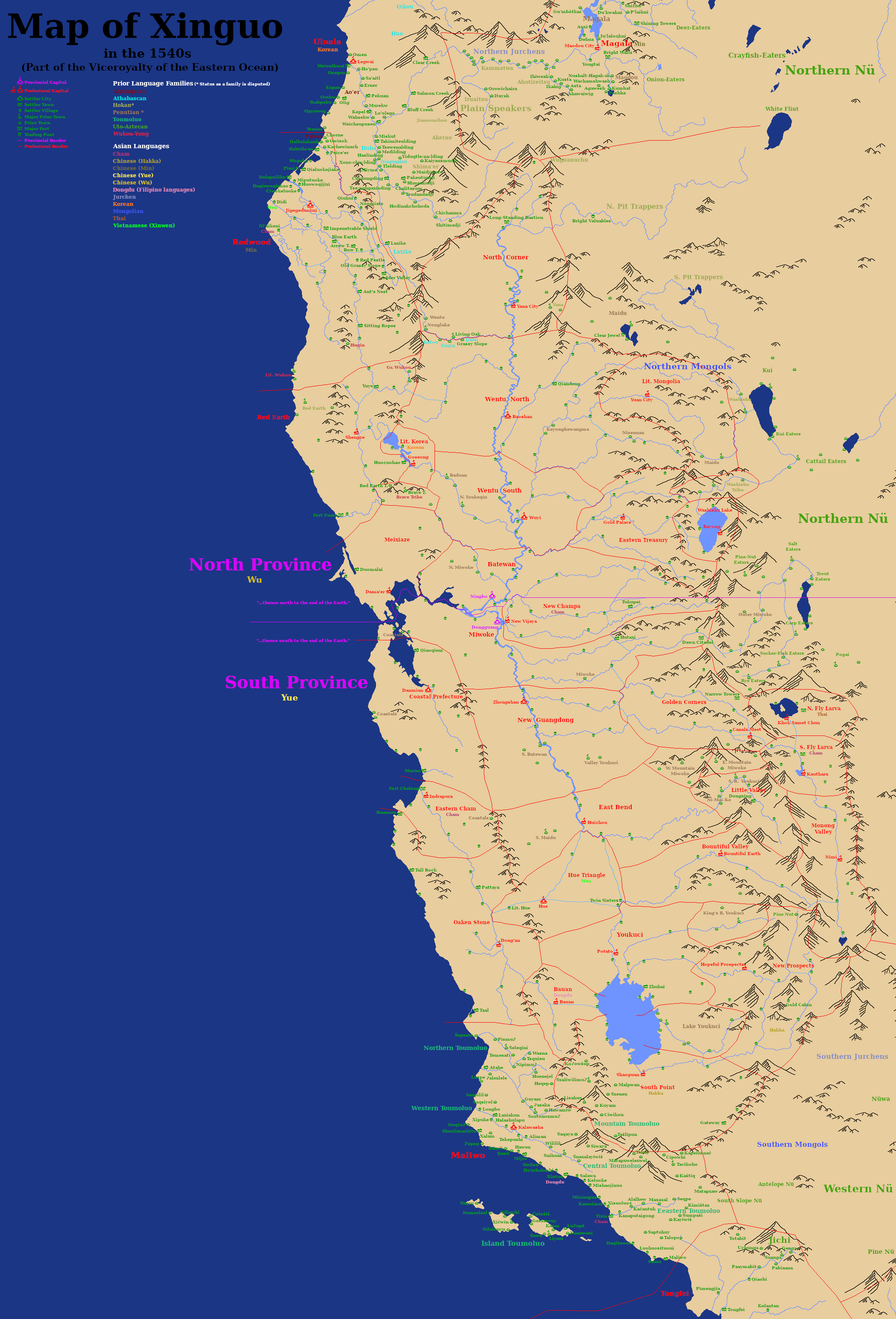
Detailed map of Xinguo in the 1540s with prefectures and settlements:
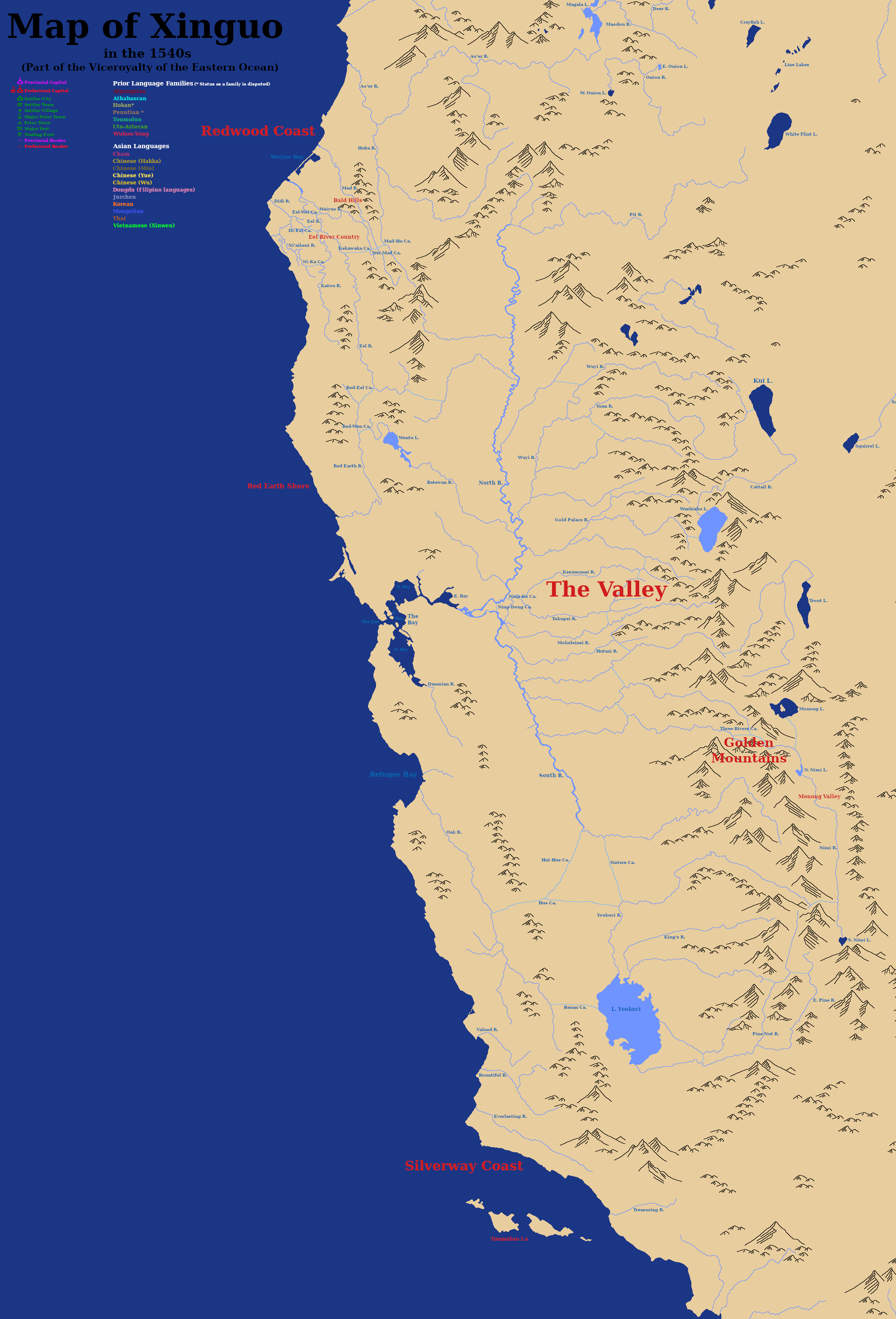
Detailed map of Xinguo in the 1540s with geographical labels:
To explain what Cabrillo had stumbled into, we must take several steps back and observe events from the Xinguan point of view. In the 1420s, Ming Dynasty China embarked upon a series of maritime expeditions to extend its influence and tributary network. An explorer named Wei Shuifu discovered the New World in 1437, following rumours in Xiaweiyi about a distant eastern land. After several early settlements on the coast were levelled by an earthquake, two colonies were built in 1449, located further inland where earthquakes were less common. These would become the cities of Ningbo and Dongguang.
From the very beginning, the colonies were rivals. Ningbo was founded by Wei Shuifu himself while Dongguang was founded by a rival explorer named Bai Hongjin. This rivalry was deliberately fuelled by the emperors back in China to prevent either one from rising to dominate all of Xinguo. Xinguo was all the way across the biggest ocean in the world and the emperors reasoned that if any one man were ever to gain sole predominance there, he would be able to break away from Chinese control entirely. Ningbo and Dongguang were therefore each made the capital of a new province. These two new provinces were creatively named North Province (with its capital at Ningbo), and South Province (with Dongguang as its capital) Red and black are associated with the directions north and south, and the Azure Dragon is associated with the east; therefore, the North was given a black banner with the Azure Dragon on it facing upward while the South had a red banner with the Azure Dragon facing downward.
Wei Shuifu was a native of the city of Ningbo in Zhejiang province. Ningbo in Xinguo was named for Ningbo in Zhejiang, but it’s spelled differently in Chinese. Pronunciation is the same in Mandarin (tones included), but different in Wei’s native Wu. The North was mainly settled by the Wu-speakers of Zhejiang, but there were also Min-speakers from Fujian as well as Vietnamese, Cham, and Malay settlers.
Bai Hongjin named the capital of South Province Dongguang, which means Eastern Expanse. This bears an obvious resemblance to the name of Bai’s home province of Guangdong, which means Expansive East. According to Bai, however, the name was a reference to the wide open expanse of the virgin eastern land where Dongguang was built. South Province was mainly settled by Yue-speaking people from Guangdong, but also by Chams, Vietnamese, Hakka, Zhuang, Thais, and Filipinos (whom the Chinese called Dongdu).
Chinese emperors and bureaucrats were never all that enthusiastic about colonising the New World. Furthermore, it was hard to maintain meaningful control over a land on the other side of Earth’s biggest ocean. As a result of the Beijing government’s neglect, Wei and Bai entrenched themselves in local politics so deeply that they successfully established feudal dynasties in Xinguo.
In fact, they were able to do this in part because of the Beijing government. Inter-factional intrigues led to the Yingzong Emperor bestowing hereditary noble titles on Wei and Bai over the objections of some of his ministers. Wei Shuifu was given the title Duke of Jia (Gōngjiǎ – 公甲), while Bai Hongjin was given the title Duke of Yi (Gōngyǐ – 公乙). Jia and Yi are the first two of the heavenly stems, which are a concept involved in the Chinese Sexagenary Cycle, which is a way of recording years. Specifically, Jia and Yi are associated with the east, hence their selection as part of Wei’s and Bai’s titles.
Using the prestige and authority granted to them along with these titles, Wei and Bai gave out huge tracts of land to men from China, Vietnam, and Champa. These men, in turn, brought colonists over to settle their lands and became effectively feudal barons under the auspices of their liege lord.
This gave rise to the phenomenon of the magnate. Magnate (Latin: Magnas, “great person”) is the English equivalent of two Chinese phrases, namely Dafu (Dàfū – 大夫, big man) and the less common Daren (Dàrén – 大人, big person), both of which convey the idea of an extremely wealthy and influential individual.
In Xinguo, magnates were those who got in early on land purchase, and were thus able to buy up vast tracts of land. Some of these magnates were from wealthy landowning families back in Asia, while others were successful merchants who decided to invest their money in a more predictable stream of income. Below the magnates were the gentry, who were affluent landowners, but not as fabulously wealthy as the magnates. Below them were the artisans, who lived in market towns and cities and produced all of Xinguo’s material goods: porcelain, clothing, weapons and tools, furniture, buildings, ships, and much more. Alongside the artisans in what might be termed Xinguo’s middle-class were the less successful merchants and middling landowners. At the bottom of society were the majority of the population: freeholding peasants and tenant farmers. Freeholders owned their own land, about 3-5 acres on average (although since villages in the Valley tended to own rice paddies in common, the land legally owned by freeholders might be only 1-2 acres). Tenant farmers rented from the landowning classes.
This hierarchy has led to Xinguan society in this period being described as a “feudal bureaucracy” by European observers. Magnates held immense wealth and, therefore, social and political influence over the countryside. However, they had to compete with each other for positions in the bureaucracy which conferred concrete political authority in the government. Merchants were often in competition with the magnates for influence over the government, but they typically did so by forming powerful lobby groups rather than joining the bureaucracy. Bureaucrats were tied to a geographic region over which they had responsibility, but merchants needed to be free to travel from place to place making deals and ferrying goods around. Because they lived in the cities, employed many workers there, and often invested in urban businesses, merchants held immense social influence there, unlike the magnates with their rural power base.
Militarily, 15th century Xinguo had no rival. No one anywhere close by could withstand the might of the one of the Xinguan provinces except the other Xinguan province. Consequently, they didn’t need a very large professional military. It was enough to have a large militia reserve that could be called upon in times of need while a small cadre of professionals garrisoned the cities and key forts in peacetime. North Province had the Black Banner Guard, and the South had the Red Banner Guard. Both armies also included a naval section in the form of the Black Banner Fleet and the Red Banner Fleet, which hwere organisationally subordinate to the army.
Legally, these organisations were considered to be part of the guard-post military system of Ming Dynasty China. Ming’s early army was based on regional “guard” units (Wèi – 衛, guard, protect), consisting of 5,600 men organised into groups of 1,120 men called a post (Suǒ – 所, post, instiution). In the beginning, North and South Provinces were each assigned one guard (the Red Banner and Black Banner Guards). Membership of the guard was to be determined by the governors, who were to provide the guardsmen (Wèirén – 衛人, guard person) with land. This system was never really updated (much less regulated) by the Beijing government. Wei Shuifu and Bai Hongjin began filling out the ranks of the guards by giving land grants to volunteers. Successive governors dispensed with the land grants. Instead, they sold the land to magnates and used the proceeds to pay guardsmen in cash. Untethered from specific plots of land, guardsmen could be posted anywhere they were needed for as long as necessary, rather than having to be kept close to the land they’d been given. They could also be recruited and discharged as needed.
Maintaining a large army of paid soldiers was expensive, however, so to supplement the guardsmen, the provincial militia was devised. Provincial militia (Shěngbīng – 省兵, province troop) were under the governor’s authority, but the prefects were also authorised to mobilise and command them unless the governor overrode them. Service in the provincial militia counted as a tax write-off in this period.
However, these were not the only armed groups in Xinguo in those days. Xinguan expansionism was resisted by native tribes and there were plenty of Xinguan bandits roaming the land, not to mention friction between magnates and peasants leading to fairly frequent rebellions. Owing to the high frequency of violence on the frontiers and low likelihood of a frontier village or isolated homestead receiving outside help before bandits roasted a family over a fire to ascertain the location of the family’s savings, people armed themselves and organised into local village militias. Magnates and gentry also had armed men called gentry guards (Shēnwèi – 紳衛, gentry guard) to protect their family homes, estates, and tenants—and to kill tenants who rebelled against them. Merchants had guards of their own (Shāngwèi – 商衛, merchant guard) to protect trading posts beyond the frontiers from hostile natives and to defend merchant shipping and coastal facilities from pirates.
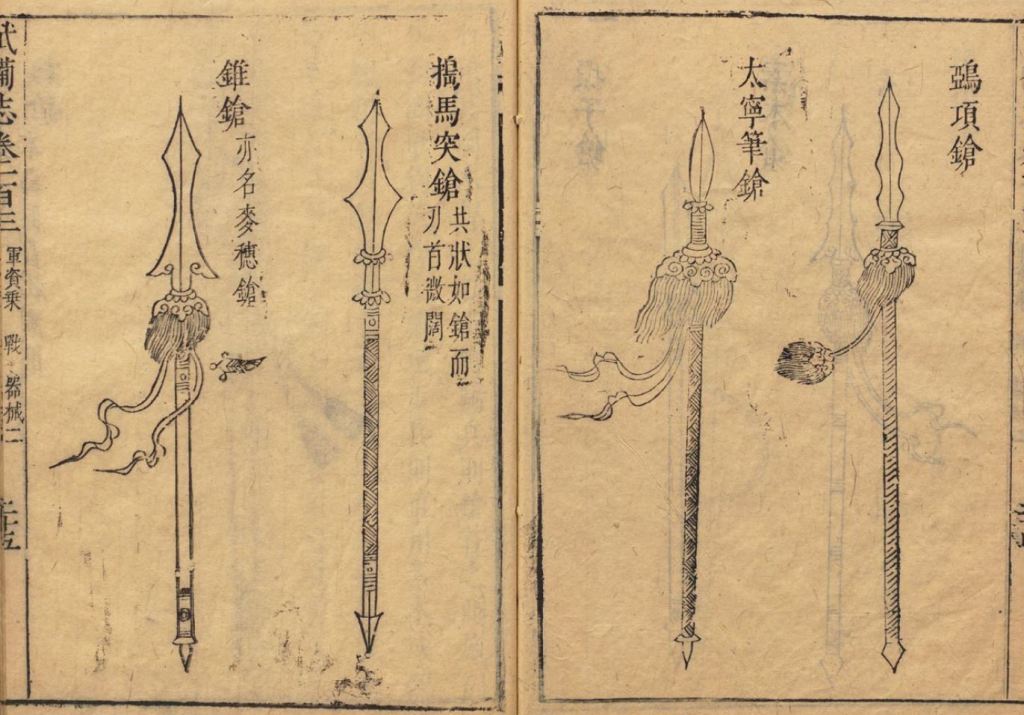
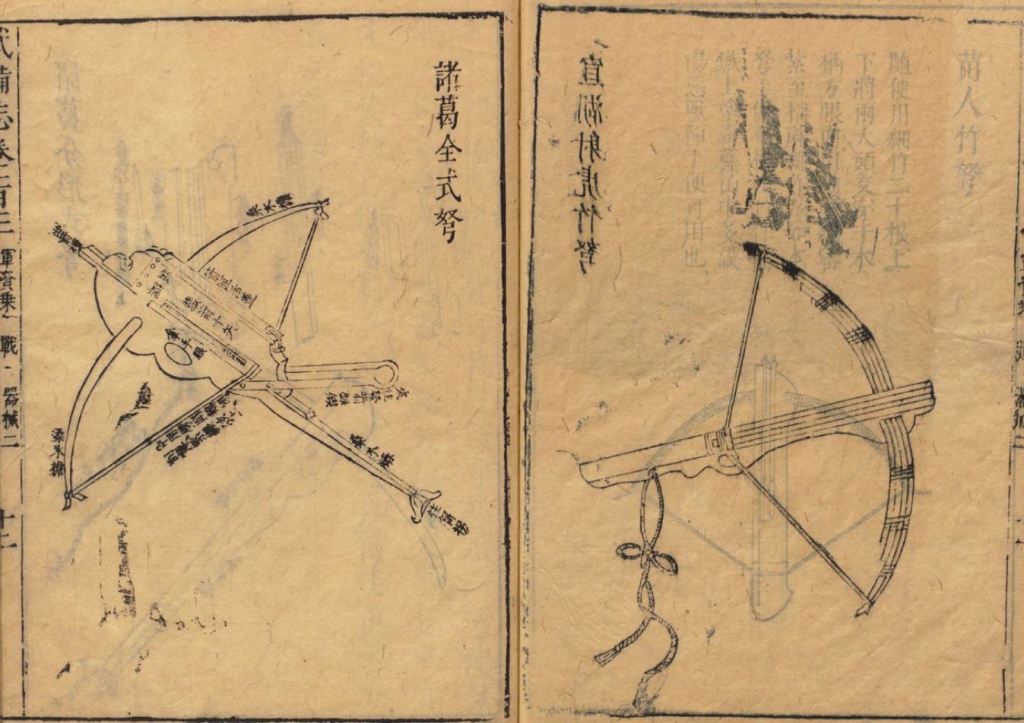
Xinguo, therefore, developed a strong weapons culture. Every household had two or three weapons. The two staples of this culture were the spear and the crossbow, since both weapons were relatively affordable and easy to learn how to use. Other polearms, of which China has a dizzying array of types, were also common. Swords were common too, at least among the affluent. Axes were uncommon, but not unknown. Maces of Chinese design were mostly for use against armoured targets so were not used much, but clubs of American design were fairly easy to make, and were thus common in the hands of those who couldn’t afford more expensive weapons. Bows were used as well, but only in households where hunting was a common pasttime, since it takes a lot of practice to be good with a bow. Guns and rocket arrows were expensive at first, but slowly become more and more common, especially the dragon lance (the equivalent of a European hand cannon). A dragon lance was not particularly accurate, but it was relatively simple to use and the loud noise it made when fired was both intimidating to the enemy and reassuring to allies. Meanwhile, even the poorest of families would be armed with a knife, a quarterstaff, and perhaps a club.
Elite guards in the employ of a magnate or merchant might be equipped with high-end armour, but armour was otherwise fairly rare. When it was used by village militias, only the cheapest textile, leather, or wooden armour was affordable.
Collectively, any and all types of soldiers, militia, and warriors could be called braves (Yǒng – 勇, brave, courageous, valiant).
In China, an office like that of governor was just that: an office. The particular office holder could be replaced at will. In Xinguo, however, the Wei and Bai families became too important to replace. When a governor died, his son travelled to China to perform the kow-tow to the emperor and humbly request he be granted the governorship. This was a ritual intended to remind each new of governor of his place in the hierarchy. In practice, emperors almost never interfered in the line of succession. Ducal titles passed from father to son seamlessly because they were legally hereditary, and the governorship passed on with them. On the few occasions when an emperor did try to replace a governor, it never went well. Gentry, merchants, and the militia all supported the Wei and Bai families to the point where removal became nigh-impossible without a full-scale invasion—and an invasion of a land across the ocean was no mean feat to consider, much less pull off successfully.
Instead of trying to actually control their Xinguan colonies, the emperors treated them more like vassal states than as actual provinces. To keep the governors in line, the emperors played the two of them off each other. Throughout the 15th century, Ningbo and Dongguang fought a long series of proxy wars. Each one had a mandate to expand. In fact, a line starting in the Golden Mountains demarcated the boundary between North and South, and that line extended all the way across America until it reached the ocean again, theoretically placing the entire northern half of North America inside North Province and the southern half in South Province, along with the whole of South America. Which, naturally, put them in conflict with the peoples already inhabiting the lands around them. Whenever one came into conflict with a hostile tribe, they found their enemies wielding weapons provided to them by the other. And so it went, both sides jockeying to put the other in a weaker position while currying favour with the imperial court back in China.
In the late 15th century, China began winding down its overseas tributary network in order to focus on threats closer to home. Xinguo, however, could provide things China couldn’t get anywhere else, at least not in such quantities. There were, of course, cocoa and New World spices that couldn’t be obtained anywhere in Asia or Europe, but the Ming government was most interested in silver.
Mexico and Peru are home to the two biggest silver deposits in the entire world, rendering all Asian silver sources trivial by comparison. The indigenous peoples living atop the silver deposits had only a rudimentary understanding of how to smelt and smith it, with their metallurgical craft being in its infancy. Nevertheless, it didn’t take a master smith to understand how valuable it was to the Xinguans. They were happy to dig it up and exchange it for Chinese goods they couldn’t make for themselves.
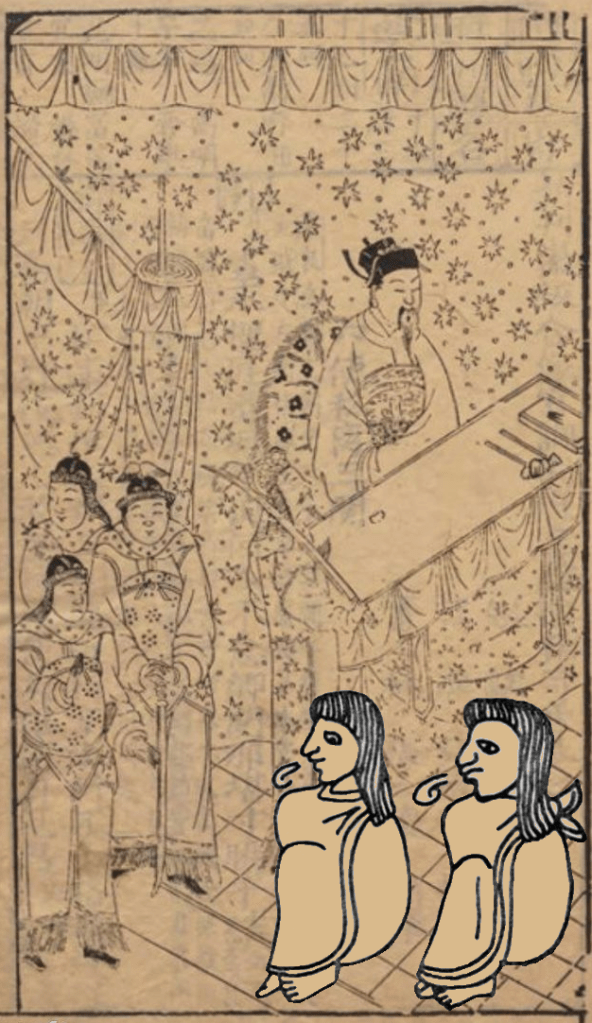
Beginning with its official establishment as an institution of China in 1450, Treasure Fleets set sail every year from Suzhou, China, loaded with all the goods of the Old World. Two or three months later, they arrived at Dongguang in Xinguo, and exchanged Asia’s bounty for that of America before returning to Suzhou. The round trip took about four or five months and upon its return, a portion of the silver went straight into the emperor’s coffers as a gift. By the beginning of the 16th century, this trade had become a vital component of China’s economy. Most importantly, the annual influx of silver was essential to maintaining the health of China’s silver-based currency (which replaced the earlier, highly volatile fiat currency). Coins were minted in silver, which made silver the lifeblood of the economy. Government officials and soldiers were paid in silver, government projects were paid for in silver, and taxes were typically paid in silver.
Mexican silver was mined by the Chichimecs, an unsophisticated group of tribes called barbarians by their neighbours. They sold it to the Aztecs and Purepecha, who sold it to Xinguo. In Peru, it was the Incan Empire who controlled the precious metal. All three were happy to trade for silk, iron, and gunpowder. Both the North and South Provinces owed tribute every year, but with several options to choose from, they could play their trading partners off each other to get the best price. Simultaneously the Aztecs, Purepecha, and Incans were able to play the Xinguan factions off against each other to get the best deals for themselves. It was a highly lucrative trade beneficial to all involved.
Then Spain happened.
To the Xinguans, Spain was a most unwelcome intruder. A bull in the proverbial china shop, Spain conquered all of Xinguo’s trading partners between 1519 and 1533. Suddenly, the Xinguans could only get silver from a single source. No more playing different nations off each other, they had to take what they could get.
The northerners and southerners reacted differently to the change. South Province decided to take it with a smile. Their merchants continued visiting the same old ports they always had, grinning while they exchanged silk for silver. Meanwhile, North Province decided it wouldn’t take this lying down. At every opportunity, they provided weapons to Spain’s enemies. Purepechans, Mixtecs, and others received fire arrows, swords, and spears from Ningbo.
In 1540, North Province was governed by a man named Wei Chengjia, who’d been governor since 1526. He was known to be polite and mild-mannered, but also wily and devious. In his youth, he’d been captured by a raiding party from the Brave Tribe during the Brave Hills War (1512 – 1515). While in captivity he was treated well and met many prominent members of the tribe, including the daughter of the chief who captured him. The two of them fell in love and thereafter, Chengjia became the most vociferous proponent of peace with the Braves. Writing letters from captivity, he convinced his father not to invade Brave territory, but to make peace instead, which resulted in the Treaty of the Braves, and marriage between Wei Chengjia and his beloved, whom he gave the Chinese name Yinglan. The marriage secured lasting peace between Ningbo and the Braves. Wei was rare among upper-class Chinese men in that he married no other wives and took no concubines, preferring Yinglan as his one and only wife.
When Wei caught wind of Mexico’s plans to send an expedition to make contact with Dongguang, he decided this wasn’t ideal for his purposes. The meeting would have to be sabotaged. North Province spies were embedded in Acapulco, pretending to be simple merchants. When they found out about Cabrillo’s expedition, they sent word ahead of him to Ningbo, where Wei set a trap. Ships loyal to Wei but flying South Province’s colours were to meet Cabrillo and prevent him from making it to Dongguang. The rest has already been discussed.
1.4 – The 1st Silver War (1542 – 1543)
The fight between Cabrillo’s expedition and Wei’s ships flying Southern flags has become known to history as the Battle of the False Flags, and it was the first confrontation in the Silver Wars. These were the first in a series of conflicts between Xinguo and Spain which would break out again in the late 17th century and once more in the early 18th. The Spaniards call them the Xinguo Wars while in Xinguo, they’re known as the Xin-Mei Wars, taken from the first characters of Xinguo and Meixigou.
Meixigou is derived from Mexica (pronounced ‘meh-she-cah’), which is what the Aztecs called themselves. Even after the Spanish Empire planted itself on the corpse of Xinguo’s former trading partner, Mexico was still Mexico, as far as the Xinguans were concerned, and its inhabitants were Mexican regardless of whether they spoke Nahuatl or Spanish. Thus, Spain was always called Mexico in Xinguo. Spaniards were called Meixigou Min, which translates as Mexico People, with ‘people’ here referring more to a nationality rather than individual persons. This was habitually shortened to Meimin. In later times, when Mexico was able to assert a measure of independence from the mother country, Xinguans began referring to Mexico specifically as Meiheguo. This was an alternate spelling of Mexico derived from the Spanish pronunciation of ‘meh-he-co.’
For the reader’s benefit, this document will follow the English convention of using ‘Spain,’ ‘Spanish,’ and ‘Spaniard’ to refer to both Spain specifically and the wider Spanish Empire while ‘Mexico’ and ‘Mexican’ will refer to Mexico and its overseas territories in the Caribbean and the Philippines. Where a Xinguan or Chinese refers to Spain and Spaniards as Mexicans, this document will use to word ‘Meixigou.’
Believing themselves to have been betrayed by the duplicitous Chinamen, Spain banned trade with Xinguo entirely. In response, South Province sent pirates to seize Spanish shipping and raid the coast of Mexico. While some of these pirates were from South Province, the bulk were from Ryōseikoku far to the north of Xinguo in a region that was colonised by a mixture of pirate warlords, dispossessed nobles, and Buddhist missionaries, mostly from Japan. The Japanese had ensconced themselves among the multitude of islands and coves in the late 15th century and had resisted all attempts at dislodging them. From hidden bases in the treacherous waters of their home, they struck out at Xinguan shipping and returned with holds full of treasures to distribute among their followers. These pirates were known by the Chinese as wokou (Wōkòu – 倭寇, literally, dwarf bandit: “dwarf” is an ethnic slur for a Japanese person).
Spain launched retaliatory strikes at Xinguo using Cabrillo’s description of the route to get there, but these were less effective since Spain had precious little idea of what targets were actually valuable. They were also busy with other things, making a major expedition unfeasible.
Meanwhile, North Province pivoted its policy. Ships set out from Ningbo in 1543 and sailed into Acapulco under a white flag. There, they told the local mayor about the north-south split in Xinguo and swore that they, the northerners, were no enemies of Spain. They travelled to Mexico City and concluded a deal with Viceroy Antonio de Mendoza allowing North Province merchants to trade in Acapulco.
However, the Spaniards still couldn’t tell the Northerners and Southerners apart. Their manner of dress was largely the same and the Spanish ear couldn’t tell the difference in speech between the Wu-speakers of the North and the Yue-speakers of the South. This meant Southern merchants could trade in Acapulco as long as they were flying black flags.
South Province was governed by a man named Bai Guguan. Although he was culturally Chinese, Bai was a product of the mingling of two worlds. His grandfather, Bai Zhongqiang, had made the Pact of Perpetual Peace with the Youkuci League in order to put an end to the long and bloody Youkuci Wars. As part of the deal, he’d married Lady Meiyou, daughter of the Youkuci League’s paramount warchief. Apocryphal legends circulating afterward claimed she was also either the daughter or sister of the man who’d killed Bai Zhongqiang’s eldest brother in the 2nd Youkuci War. Their son, Bai Shunyong, had married a Cham woman from a village near New Vijaya. Bai Guguan was thus only around one-quarter Chinese ethnically.
Once he realised he could obtain silver through clandestine means, there was no reason to keep sponsoring piratical expeditions against Mexico’s coastline. The war, therefore, entered a dormant state. Historians call the 1542-43 conflict the First Silver War.
In 1546, however, two things happened.
First, Spain officially reopened Lima to Xinguan trade. The reason for this was because a group of hostile tribes called the Chichimecs were waging a bloody war against Spain in the part of Mexico where the silver was mined. Silver flowing from Mexico slowed to a crawl, making Lima a much more viable outlet for the precious cargo.
Second, regulations were tightened on the silver trade. For Xinguan merchants to buy or sell goods in Acapulco or Lima, they now had to prove they were a member of the Ningbo Silver Society. The NSS was a guild of merchants based in North Province and its members were the only ones authorised by China to deal in the silver trade. North Province eagerly leapt onboard with this change, since it would shut the Southern merchants out of the market.
Spain began demanding Chinese merchants provide proof of membership in the Ningbo Silver Society before the merchant could purchase silver. NSS membership badges were a lot harder to forge than a black flag, so South Province’s trade volume dropped sharply. This prompted Bai Guguan to start sponsoring pirates again, thereby starting the so-called Second Silver War.
[Next]


 Lord of Lore
Leave a reply to Chapter 2 – The Battle of Acapulco | Xin-Mei Wars Vol. 1 – Lord of Lore Cancel reply